Disclosure: BlueBear sells an agent control layer, which is one of the four categories compared below, so we have a commercial interest in how this comparison lands. The concessions — what your existing tools genuinely already do, and when you need nothing new — are the part worth reading first.
The short answer: work out which gap you have before you look at vendors
There is no settled product category called "AI audit trail software", which is why evaluations in this space tend to compare things that are not alternatives. Four different kinds of tool get proposed, and they do different jobs:
| Category | What it genuinely does | What it cannot do |
|---|---|---|
| Observability platform (tracing, metrics, logs) | The shape of a run: which calls, in what order, how long, where the time went. Increasingly with AI-specific conventions for model call spans. | Record a policy decision, because it observes execution and a permission decision is not an execution event. |
| Security event platform | Collection, long retention, tamper-evidence, search and alerting over security-relevant records. | Produce the record. It retains faithfully whatever it is given, including nothing. |
| AI evaluation tooling | Grade output quality, track regressions, compare prompts and models. | Say who was allowed to do what. It is about quality, not authority. |
| Agent control layer | Make the permission decision at the boundary and record it, with identity, plan, execution and outcome. | Replace any of the above. It is an addition, not a substitution. |
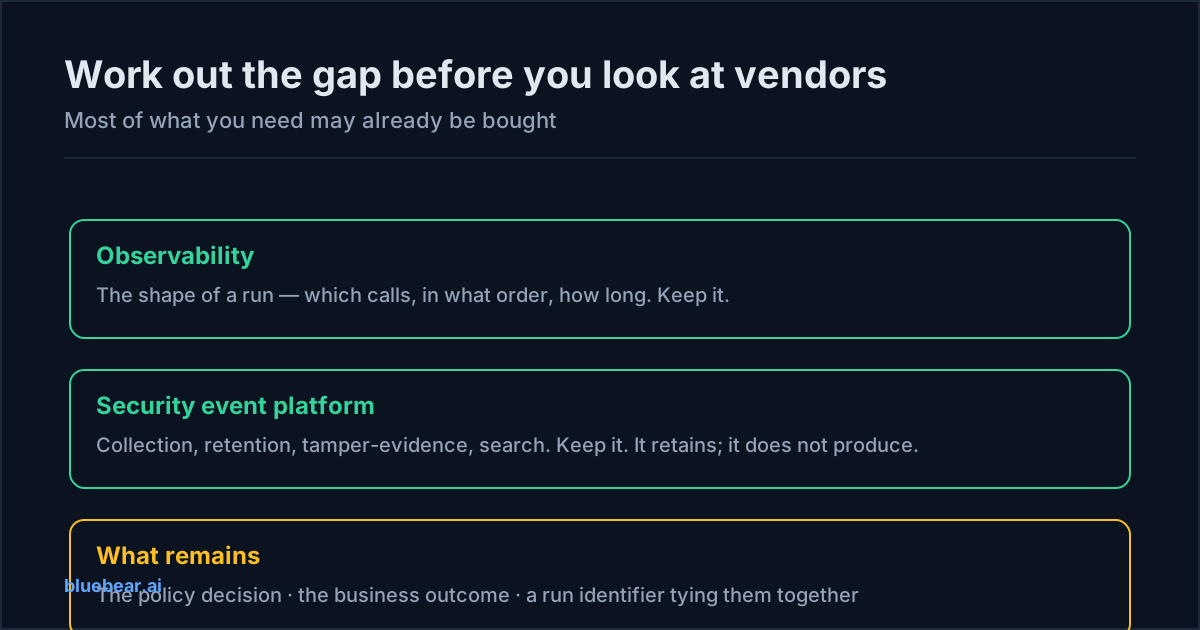
Most organisations already own the first two and often the third. That means the honest evaluation question is not "which vendor" but "which specific gap remains" — and for many teams the answer is one component, not a platform migration.
The three gaps that remain after your existing tooling
Gap 1: the policy decision. Which rule was evaluated, against what, with what result and reason. Nothing you already run produces this, because nothing you already run is making the decision. This is structural, not a configuration oversight.
Gap 2: the business outcome. Accepted, corrected, rejected, abandoned. This never exists in infrastructure. It requires a producer in the product surface where a person judges the work.
Gap 3: the run identifier. One user action becomes many calls; without a shared identifier attached at admission, the records exist but cannot be assembled. This is the cheapest of the three to close and is often already half-done.
If gaps 1 and 2 are open, no amount of additional telemetry will close them, and this is the moment where buying something is a reasonable answer. If only gap 3 is open, you have a day of engineering, not a purchase. The seven-link requirements specification is the artefact for working out which you have, and designing an AI agent audit trail for governance and compliance is the existing guide to the design the gaps sit inside.
The four questions that separate an evidence layer from a dashboard
Feature lists in this category are unusually unhelpful, because every product will claim audit logging. These four cannot be answered with a slide.
- "Show me a stored record from a real failed run." Not a schema, not a screenshot of a successful run. Failure records are where systems are thinnest, and where reviews concentrate. If the demo environment cannot produce one, that is the answer.
- "Show me the schema, and tell me its version. What happens to old records when it changes?" A typed, versioned record can be validated at write time and migrated later. Free text can only be read by someone who already knows the format, which after two years is nobody.
- "Are records sampled, and at what rate?" Sampling is correct for telemetry and fatal for evidence. It is frequently a default that nobody volunteers.
- "Show me the read path, and what enforces the tenant filter." A shared store is fine. A shared store where a filter is applied by convention in application code is a contractual problem waiting for its first customer question.
A fifth, if you are buying for a regulated environment: "Give me a sample export of one complete run." A reviewer wants a file, not a login.
A capability matrix you can fill in
| Capability | Observability | Security event platform | Evaluation tooling | Agent control layer |
|---|---|---|---|---|
| Run shape and timing | Strong | Partial | No | Partial |
| Policy decision and reason | No | Retains only | No | Strong |
| Actor and tenant at admission | Partial | Retains only | No | Strong |
| Plan recorded separately from execution | No | Retains only | Partial | Varies — ask |
| Human approval with what was shown | No | Retains only | No | Varies — ask |
| Business outcome | No | Retains only | Partial | Varies — ask, and ask for a row |
| Long retention and tamper-evidence | Weak by default | Strong | No | Varies |
| Output quality measurement | No | No | Strong | No |
Three rows say "varies — ask". Those are the rows where products in the same category differ most, and where the four questions above earn their keep.
Where a build is the right answer
It often is, and a vendor saying so should count for something. Build rather than buy when: you have one enforcement boundary already, your obligations are internal rather than regulatory, and you can afford to own the schema, the retention and the export path for as long as the records must live. That last clause is the one that catches people — the store outlives the team that built it, which is why a typed schema with a version matters more than the initial write path.
Buy when the boundary does not exist yet, when the decision has to be made somewhere the agent cannot bypass, or when multi-tenancy means a mistake in a read filter is a contractual event rather than a bug.
If you operate in a regulated industry
Add two evaluation criteria that are easy to forget until late: who can reach the evidence store directly, and what the process is for changing its schema. Both are questions about control rather than capability, and both are usually answered badly by products designed for engineering teams. Audit trails for financial services covers the sector-specific requirements.
If you are a platform or engineering lead
Resist evaluating on dashboards. The dashboard is the cheapest part of any of these products to build and the least valuable to own — the expensive, durable parts are the write path, the schema discipline and the retention. Judge on those and the shortlist changes. Security posture evidence for buyers covers the wider artefact list.
If you resell this to customers
Per-customer export becomes a product requirement rather than a compliance one, because your customers will ask for it as a feature. Score every candidate on whether an export can be scoped to a single tenant without an engineer writing a query. White-label brand workspaces explained covers the boundary this implies.
Do this next
Fill in the "which gap do I have" section for your own stack before you take a single vendor call — it takes an hour with someone who knows the systems, and it is the difference between a two-week evaluation and a two-month one. Then read the seven-link requirements list to write the RFP lines, or observability vs. audit trail if the argument inside your team is about whether the tracing already covers it.
Questions people actually search for
- ai audit trail software
There is no single established category, which is why evaluations go sideways. What is on offer splits into four kinds of tool: observability platforms that trace execution, security event platforms that collect and retain security-relevant records, AI-specific evaluation tools that grade output quality, and agent control layers that record authority at the point an action is permitted. Only the fourth produces the authority record, and most organisations already own the first two, so the useful question is which specific gap remains rather than which vendor has the longest feature list.
- ai audit trail tools comparison
Compare on four axes rather than on features. Does it record the policy decision and its reason, or only the action? Is the record typed and versioned, or free text? Is it complete, or sampled? And is it tenant-scoped on the read path as well as the write path? A tool can be excellent at tracing, dashboards and alerting and still score zero on all four, because those capabilities answer an engineering question rather than an accountability question.
- do I need a separate tool for ai audit logs
Often you need one additional component rather than a replacement. Keep the tracing and the security event platform you already run; they do real work you should not rebuild. What is usually missing is the layer that makes the permission decision at the boundary and writes the authority record - and that has to sit where the decision is made, which is why it tends to be a different product rather than a feature you can switch on in an existing one.
- what questions should I ask an ai audit vendor
Four that cannot be answered with a slide. Show me a stored record from a real failed run. Show me the schema and tell me its version, and what happens to old records when it changes. Tell me whether records are sampled, and if so at what rate. And show me the read path and what enforces the tenant filter. A vendor who answers all four precisely is worth continuing with; one who answers with a dashboard tour is selling something else.
- is a siem enough for ai agent auditing
A security event platform gives you collection, retention, tamper-evidence and search, which is a genuinely large part of the problem and is expensive to build. What it does not give you is the content: it can only retain what something else produced, and the authority record for an agent action is produced at the point a permission decision is made. If nothing is making and recording that decision, the platform will faithfully retain a complete set of records that do not answer the question.