Organizations are struggling to govern AI agents reliably, securely, and cost-effectively at scale.
As businesses adopt AI agents, they often accumulate various runtimes and frameworks. However, a shared, centralized place to manage deployment, identity, integrations, evidence, and cost remains elusive. This fragmentation leads to operational challenges, making it difficult for platform engineering leaders and AI infrastructure architects to maintain control and ensure consistent performance across diverse workloads.
Understanding the AI Agent Control Plane
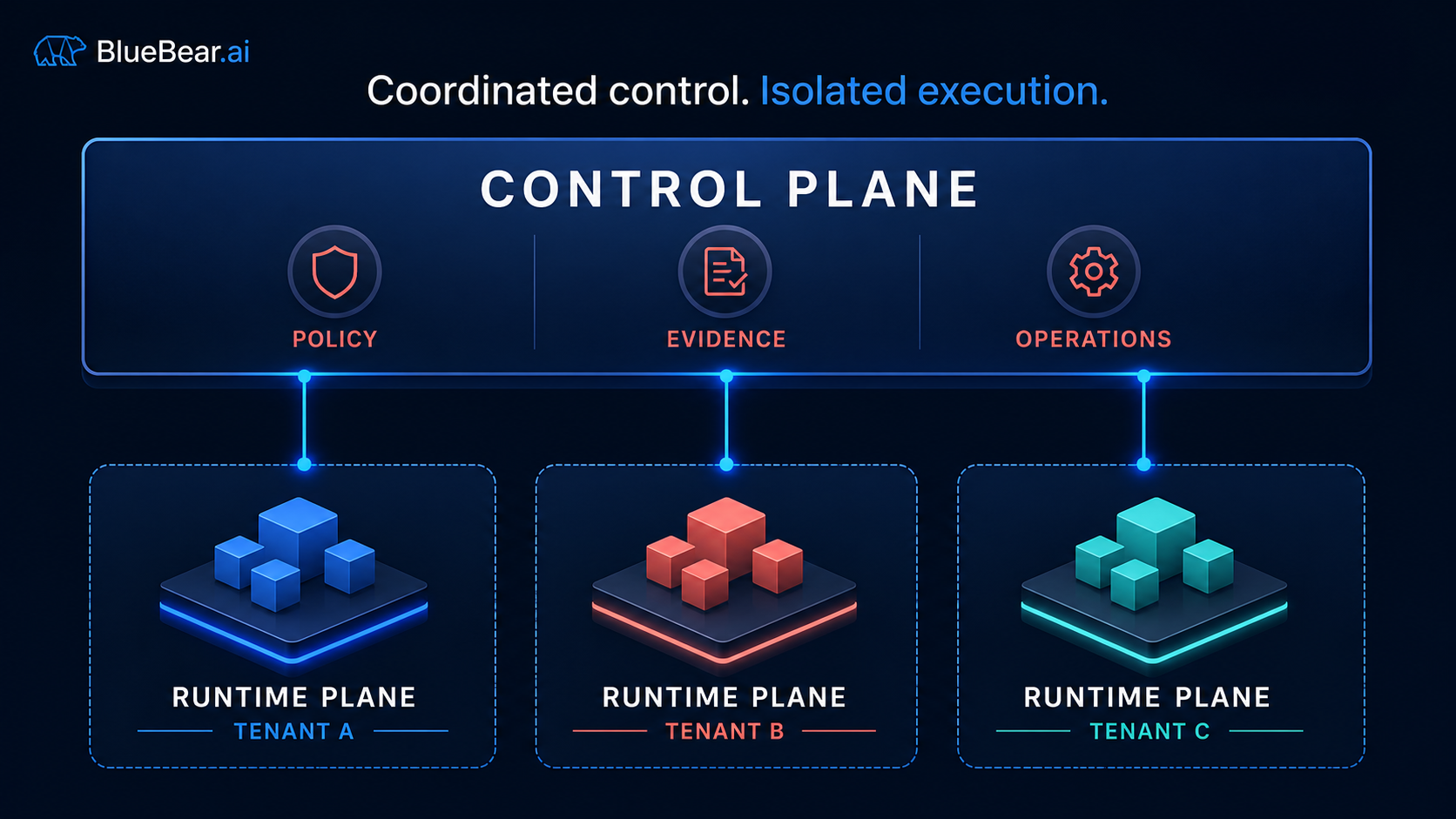
An AI agent control plane is a centralized system for orchestrating and managing AI agents across an organization. It focuses on centralizing decisions while deliberately leaving execution to specialized runtime planes. Think of it as the brain that directs the actions of many hands, each operating in its own environment.
This separation means policy decisions—like security, compliance, and resource allocation—are handled uniformly at the control plane. Actual agent tasks, such as data processing or interacting with external APIs, occur in the distributed runtime planes. This architecture allows teams to standardize governance without forcing every workload into a single model or cloud environment.
Centralized Decisions, Decentralized Execution
The control plane addresses key governance areas:
- Deployment Management: Standardizing how agents are deployed and updated.
- Identity and Access: Ensuring agents have appropriate permissions and adhere to security policies.
- Integration Governance: Managing connections to external systems and data sources.
- Evidence Collection: Gathering logs, metrics, and audit trails for observability and compliance.
- Cost Controls: Monitoring and optimizing resource consumption across agent workloads.
By centralizing these concerns, businesses can achieve consistency and oversight, even as their AI agent footprint expands.
Why Fragmented AI Agent Infrastructure Creates Pain
Without a control plane, organizations face significant operational hurdles. Agent infrastructure becomes fragmented across teams, leading to inconsistencies and inefficiencies.
The Challenge of Fragmented Infrastructure
When different teams deploy agents using disparate tools and processes, it creates silos. Each team might solve similar problems independently, leading to duplicated effort and varying standards. This fragmentation makes it nearly impossible for VP Engineering or Platform Engineering Leads to get a unified view of their AI agent landscape.
This lack of centralized oversight contributes to issues like "shadow agent proliferation" and budget overruns. As Microsoft's Cloud Adoption Framework states, centralized oversight and lifecycle management are crucial to address shadow agent proliferation, budget overruns, security gaps, retirement, and resource allocation. [1]
Reconstructing Failures is a Nightmare
In a fragmented environment, failures are difficult to reconstruct end to end. An agent's operation might span multiple systems, frameworks, and data sources. When something goes wrong, tracing the root cause across these disconnected components is time-consuming and complex. This hinders rapid problem-solving and reduces operational reliability.
The AWS Agentic AI Lens highlights this, treating prototypes-to-production operations, modularity, observability, graceful degradation, human oversight, and cost awareness as durable design concerns. [2] Effective observability is a foundational element for reliable agent operations.
Tenant Isolation and Capacity Controls Arrive Late
As AI agent adoption scales, ensuring tenant isolation and managing capacity becomes critical. Without a control plane, these essential controls often arrive late, if at all. This can lead to security vulnerabilities, performance bottlenecks, and inefficient resource utilization. Teams may struggle to provide dedicated resources or isolate agent workloads, increasing risks and operational costs.
The BlueBear Approach: Governed Control, Flexible Execution
BlueBear addresses these challenges by separating governed control from tenant execution. This approach allows teams to standardize policy without forcing every workload into one model or cloud. Our platform provides the necessary governance while preserving the flexibility that development teams need to innovate.
BlueBear’s AI agent platform offers a unified control plane. It coordinates policy, evidence, and operations. Meanwhile, individual agent workloads execute within their distinct runtime planes. This architecture ensures consistent governance across your entire AI agent ecosystem.
How BlueBear Differs
BlueBear is not just another runtime; it is a governance layer designed for agent operations. Our MCP gateway acts as a central policy enforcement point, while our governed agent runtime provides a secure and compliant environment for execution. This means:
- Standardized Policies: Define and enforce consistent policies for all agents, regardless of their underlying frameworks.
- Enhanced Observability: Centralized evidence collection makes failures easier to reconstruct and troubleshoot.
- Built-in Isolation: Tenant isolation and capacity controls are foundational, not afterthoughts.
- Reduced Operational Burden: Automate many governance tasks, freeing up engineering teams.
This distinct approach helps organizations move AI agents from pilots to reliable, shared infrastructure.
Representative Operating Scenario
Imagine an enterprise software company with multiple product teams developing AI agents. Each team uses different frameworks and deploys to various cloud environments. Before BlueBear, standardizing security policies or tracking costs across these agents was a manual, error-prone process. Failures often took days to diagnose due to fragmented logging.
With BlueBear, the VP Engineering defines security and cost policies in a central control plane. These policies are automatically enforced across all agent deployments via the MCP gateway. Platform Engineering Leads can now quickly view agent performance, resource consumption, and audit trails from a single dashboard. An AI Infrastructure Architect can ensure new agent deployments adhere to corporate standards without slowing down development cycles. This allows teams to troubleshoot sessions effectively and ensure compliance across models and tools.
BlueBear Control-Plane Request Lifecycle
A control plane is useful when it makes the effective decision inspectable. This lifecycle separates configured intent from runtime execution.
| Stage | Control-plane decision | Evidence |
|---|---|---|
| Resolve context | Identify tenant, workspace, actor, agent, workflow version, deployment, and budget owner. | Authenticated subject and effective resource boundary. |
| Compute policy | Evaluate roles, model eligibility, MCP assignments, action scope, approvals, quotas, and fallback. | Policy version, eligible set, exclusions, and allow/deny reason. |
| Issue execution | Pass the bounded request and credential reference to runtime without exposing reusable secrets to model context. | Execution request, credential reference, runtime, and correlation ID. |
| Reconcile | Join route, tool attempts, approvals, cost, terminal state, and downstream accepted outcome. | Session timeline and outcome identifier. |
| Change or contain | Version policy changes, disable capabilities, identify affected workflows, and retain the operator decision. | Change actor, reason, time, impact set, and recovery approval. |
Deployment compute may remain managed, customer-cloud, or private. The BlueBear value is the shared policy and evidence boundary around those execution environments, not a claim that one control plane owns every underlying system.
Is an AI Agent Control Plane Right for Your Business?
Determining the need for an AI agent control plane involves assessing your current operational landscape. Consider these questions as a practical diagnostic checklist:
- Are different teams deploying AI agents with inconsistent security and compliance standards?
- Do you struggle to get a unified view of all AI agent activity and resource consumption across your organization?
- Is troubleshooting agent failures a complex, multi-day effort due to fragmented logs and metrics?
- Are you concerned about "shadow AI" or unmanaged agent deployments within your enterprise?
- Do you find it difficult to implement consistent tenant isolation or capacity controls for your agent workloads?
- Are you looking to move AI agents from experimental pilots to production-grade, governed infrastructure?
If you answered yes to several of these questions, an AI agent control plane could significantly improve your operational efficiency, security, and governance.
Direct Answer: What an AI Agent Control Plane Controls
An AI agent control plane is the governance layer that decides which agent may run, on whose behalf, with which models, tools, data, budgets, approvals, and evidence requirements. The runtime plane executes that decision; the data plane carries prompts, retrieved context, tool payloads, and results.
| Requirement | Control-plane decision | Proof to inspect |
|---|---|---|
| Identity | Human, workload, tenant, workspace, and delegation. | Effective subject and delegated authority. |
| Capability | Allowed model, connection, tool, action, and resource. | Policy version, decision, reason, and denial test. |
| Human control | Which action needs which approver and assurance. | Bound approval, expiry, and execution receipt. |
| Economics | Budget, route, attempt, and concurrency ceilings. | Cost per accepted outcome and budget-stop event. |
| Lifecycle | Version, release, exception, revocation, and retirement. | Owner, change record, active scope, and final state. |
A catalog or dashboard is not a control plane unless it can prevent an unauthorized action at an enforcement boundary the model cannot rewrite.
Next Steps for Better AI Agent Governance
The proliferation of AI agents presents both opportunities and challenges. Establishing a robust control plane is crucial for maintaining order, ensuring security, and optimizing costs. It enables organizations to scale their AI initiatives confidently and consistently.
Before adding another tool to your stack, evaluate your current workflow. List the agent decisions repeated across teams and determine which belong in a shared control plane.