Disclosure: BlueBear builds an AI agent control plane, so we have a commercial interest in this definition. It is written to be usable by someone who will not buy anything, and where we describe implementation detail it is our own and named as such rather than presented as an industry norm.
The definition, in one paragraph you can quote
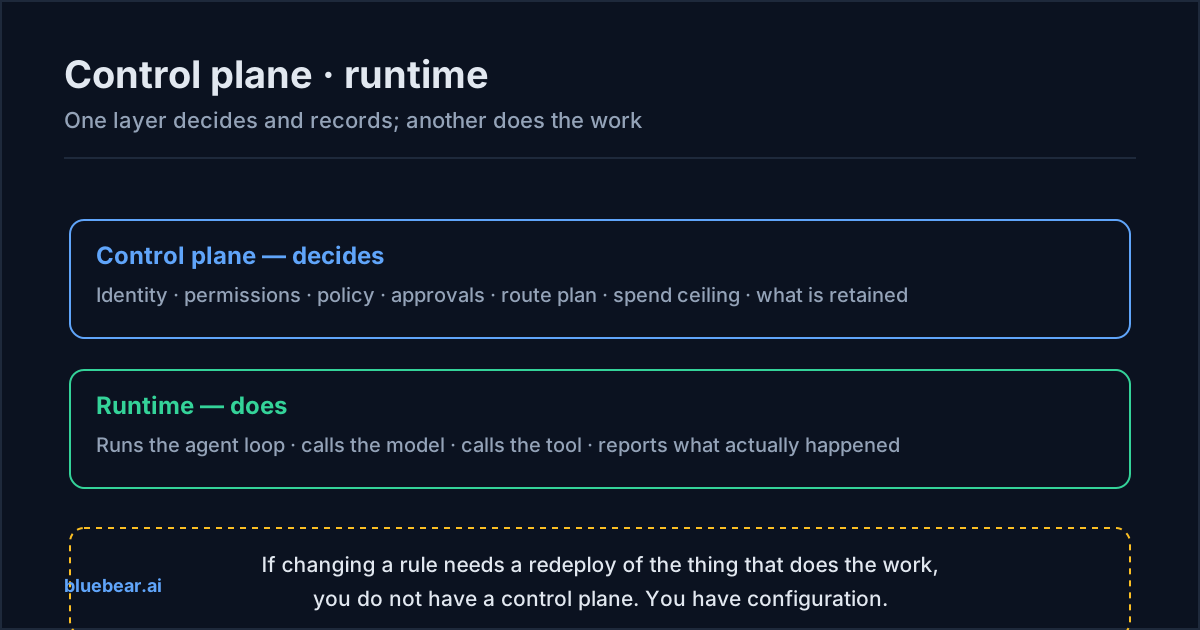
An AI control plane is the layer that decides what an AI agent is permitted to do and records what it did, kept separate from the runtime that performs the work. It holds identity, permissions, policy, approval requirements, spending limits and the evidence record. It does not itself do the task. That separation is the whole of the definition — and the practical test is simple: if changing a rule means redeploying the thing that does the work, you do not have a control plane, you have configuration.
Where the term comes from, and why it transferred
"Control plane" is borrowed. In networking, the control plane works out the routes and the data plane forwards the packets. In container orchestration, the control plane holds the desired state and the worker nodes run the containers. In both cases the point of the split is the same: decisions live in one place, can be inspected, and can change without touching the machinery that executes.
It transferred to AI agents because agents broke the assumption that reviewing code reviews behaviour. Conventional software does what it was written to do, so a code review tells you what will happen. An agent decides at run time which tool to call, in what order, and how many times. The only durable place to constrain and record that is outside the agent, at the boundary where a tool call or a model call actually happens.
What sits in each layer
| Control plane — decides and records | Runtime — does the work |
|---|---|
| Who this agent is, and which tenant or workspace it belongs to | Runs the agent loop, calls the model, calls the tool |
| Which systems and operations it may reach | Holds the conversation, the memory, the intermediate state |
| Which actions require a human approval before proceeding | Handles retries, timeouts and streaming |
| Which models are eligible, and how a route is chosen | Executes the chosen model call |
| The spending ceiling and what happens when it is reached | Produces the output |
| What is written down, in what shape, and for how long | Reports back what actually happened |
Note the last row on each side. The control plane decides what must be recorded; the runtime reports what occurred. Those two can disagree, and the disagreement is one of the most informative signals in the whole system — see did your router actually honour the plan, which is about exactly that gap.
Three terms it is constantly confused with
An orchestrator sequences work: what runs next, what gets passed along. It answers "in what order". A control plane answers "is this permitted, with whose credentials, and what gets recorded". You can run an orchestrator with no control plane, and most teams do at first.
A gateway is a single entry point that centralises something — keys, rate limits, model choice, tool access. A gateway is often how a control plane is enforced, because a single choke point is the easiest place to evaluate a policy. But a gateway with no policy behind it is a proxy. Control plane vs. orchestrator vs. gateway works the distinctions through with a decision table.
An agent framework is a code library for building the agent itself. It is inside the runtime, not above it. Platform vs. framework covers which problem each solves.
A concrete example of the separation, from our own implementation
Model routing is the clearest place to see the split, because there the decision and the execution are visibly different events.
In our gateway, routing runs in one of three modes — off, shadow or active. In shadow the control plane produces a route plan and records it, and execution is unchanged; in active the planned model becomes the model the runtime is told to run. The planner is given a bounded window to answer — the default plan timeout is 750 ms — because a control plane that becomes the latency problem has stopped being useful. And because the plan and the execution are separate events, the system records whether the plan was honoured: a plan can time out, a preferred model can be unavailable, a fallback can fire.
That is the separation as machinery rather than as a metaphor. The gateway plans; a runtime executes; and the record says which of those two happened and whether they agreed. Shadow-mode routing is the practitioner treatment of the same mechanism.
When you need one, and when you honestly do not
You do not need a control plane to run one agent, in one team, that only reads. Adding one at that stage buys you overhead and a vocabulary problem. The threshold is crossed when a decision needs to be reviewable by someone who was not present — a second team, a risk owner, an auditor, or you in six months.
The existing guide what is an AI agent control plane, and when does a business need one takes that decision apart properly, including the case for waiting. This page is deliberately just the definition.
If you operate in a regulated industry
The control plane is where your evidence obligation is met, because it is the only layer that sees the authority question and the action in the same place. A record produced by the runtime alone can say what ran; only the control plane can say what was permitted and by which rule. What an AI agent audit trail is covers the record itself.
If you resell this to customers
Your control plane has an extra job: keeping each customer's agents, credentials, connections and data inside a boundary you can describe contractually. That is the tenant boundary, and it belongs in the control plane rather than in each agent, because a boundary enforced by convention inside application code is a boundary that one mistake removes. What a secure workspace boundary is covers it in plain terms.
Do this next
Take one AI workflow you already run and write down, in two columns, which decisions are made by the control plane and which by the runtime. If a column is empty, you have found the answer to whether you have one. Then read what an AI agent control plane actually contains if you need the technical shape, or the vocabulary disambiguation if the terms are colliding in an evaluation.
Questions people actually search for
- ai control plane definition
An AI control plane is the layer that decides what an AI agent is permitted to do and records what it did, kept deliberately separate from the runtime that performs the work. It holds identity, permissions, policy, approval requirements, spending limits and the evidence record. It does not itself carry out the task. The separation is the definition: if changing a rule requires redeploying the thing that does the work, you do not have a control plane, you have configuration.
- what is a control plane in ai
The term is borrowed from networking and from container orchestration, where the control plane decides and the data plane forwards. Applied to AI agents, the control plane is where an operator states which agents exist, what each may reach, which actions need a human approval, what the ceiling on spend is, and what must be retained afterwards. The runtime reads those decisions and does the work. The value of the split is that policy becomes something you can inspect, version and audit on its own.
- control plane for ai agents
For AI agents specifically, a control plane exists because an agent chooses its own steps. Traditional software does what it was coded to do, so reviewing the code reviews the behaviour. An agent decides at run time which tool to call and in what order, so the only durable place to constrain and record it is outside the agent, at the boundary where a tool call or a model call actually happens. That boundary is the control plane.
- agentic control plane meaning
"Agentic" here just means the workloads being governed are agents rather than fixed pipelines - software that plans its own steps. An agentic control plane is therefore a control plane whose policy decisions are evaluated per step rather than per deployment, because the set of steps is not known in advance. The practical difference from a conventional control plane is that it must decide and record continuously during a run, not once at start-up.
- is a control plane the same as an orchestrator
No. An orchestrator sequences work - it decides what runs next and passes results along. A control plane decides whether a step is permitted at all, supplies the credentials for it, and records what happened. You can have an orchestrator with no control plane, which is the common starting point, and it works until more than one team is running agents or something needs to be explained after the fact.