AI agent projects frequently stall in pilot, failing to reach production readiness.
Organizations building with AI agents face a critical decision: invest in an agent framework or an AI agent platform? This choice is not about feature lists. It is about solving distinct problems across the agent lifecycle. Understanding this difference is crucial for VPs of Engineering, Platform Engineering Leads, and AI Infrastructure Architects. It determines if your agent initiatives remain isolated experiments or scale into governed, cost-effective operations.
Frameworks Accelerate Development, Platforms Govern Operations
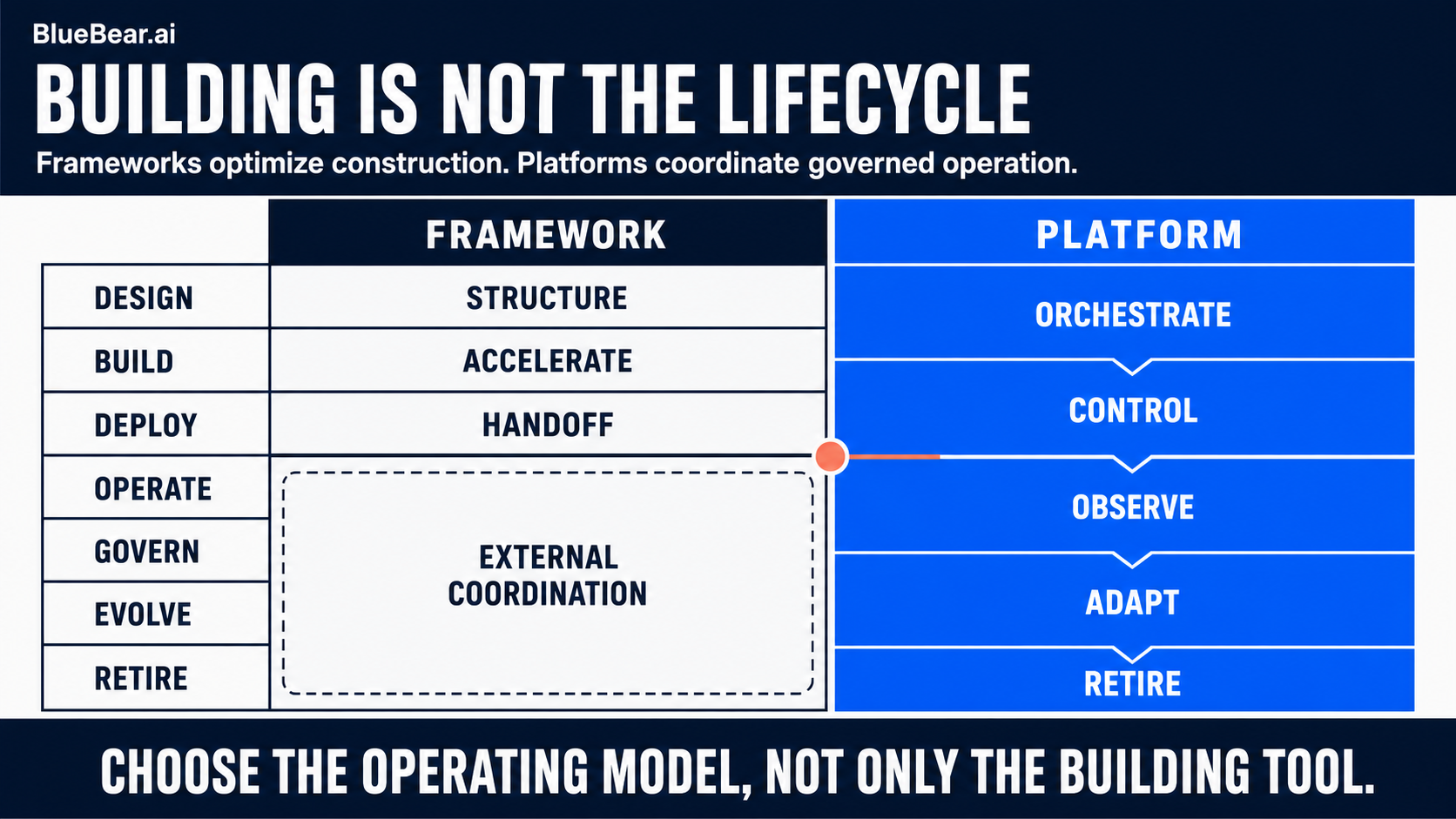
Agent frameworks provide tools for building individual agents. They offer libraries, abstractions, and best practices to accelerate code creation. This is invaluable for prototyping and initial development. Frameworks help developers quickly assemble agent capabilities, define their behaviors, and integrate with various large language models (LLMs) and tools.
However, the journey from a working prototype to a production-grade AI agent system involves more than just development. It requires robust operational capabilities. A single agent framework cannot inherently address the complexities of shared operation, governance, deployment, evidence collection, and cost management at scale.
This distinction is recognized by industry leaders. Microsoft's agent architecture framework, for instance, guides buyers to evaluate more than just build-time capabilities. It emphasizes fit, operability, governance, lifecycle management, observability, traceability, and long-term return (Architecting agent solutions: Principles and patterns | Microsoft Learn). Similarly, the AWS Agentic AI Lens focuses on reviewing reliability, security, cost, and operational readiness as agent systems transition from prototypes to production (Agentic AI Lens - AWS Well-Architected - Agentic AI Lens).
These perspectives highlight a core challenge: agent infrastructure often becomes fragmented across teams. Without a unified approach, failures are difficult to reconstruct end to end. Furthermore, critical operational concerns like tenant isolation and capacity controls often arrive too late in the development cycle, leading to costly re-engineering.
The Lifecycle of an AI Agent: Build vs. Run
To clarify the roles of frameworks and platforms, consider the full lifecycle of an AI agent system:
Design and Build (Frameworks Excel Here)
- Concept & Prototyping: Developers experiment with agent behaviors, LLM integrations, and tool usage. Frameworks provide the scaffolding for rapid iteration.
- Code Development: Building the agent's core logic, defining its prompts, and integrating with external APIs. Frameworks streamline this process.
- Testing & Debugging (Unit Level): Ensuring individual agent components function as expected. Frameworks offer local testing utilities.
Deploy and Operate (Platforms Become Essential Here)
- Deployment: Moving agents from development environments to shared infrastructure. This involves containerization, orchestration, and scaling.
- Runtime Governance: Managing agent access, enforcing policies, and ensuring compliance. This includes data privacy, security, and ethical considerations.
- Observability & Monitoring: Tracking agent performance, detecting anomalies, and gathering evidence of agent actions. This is crucial for troubleshooting and auditing.
- Resource Management: Allocating compute, memory, and LLM access efficiently. This includes cost tracking and optimization.
- Scalability & Reliability: Ensuring agents can handle varying workloads and recover from failures. This involves load balancing and fault tolerance.
- Lifecycle Management: Versioning agents, managing updates, and deprecating older versions.
- Security: Implementing robust authentication, authorization, and threat protection for agent interactions and data.
The BlueBear Approach: Governing Agents in Production
BlueBear complements build frameworks by governing how agents connect, run, produce evidence, and consume resources. It addresses the operational challenges that frameworks are not designed to solve. As agent deployments scale, organizations face fragmented infrastructure and difficulty reconstructing failures. BlueBear provides a governed agent runtime.
Consider a representative operating scenario: an enterprise is deploying multiple AI agents across different business units. Each unit might use a preferred agent framework for development. However, these agents need to operate within shared infrastructure, adhere to corporate governance policies, and provide auditable evidence of their actions. Without a platform, managing this becomes a significant burden, leading to inconsistent operations and unpredictable costs.
How BlueBear Differs
BlueBear is an AI agent platform, not an agent framework. It does not replace your chosen framework for building agents. Instead, it provides the operational layer necessary to bring those agents into production with control and visibility. Key differentiators include:
- Governed Agent Runtime: BlueBear ensures agents run within defined operational boundaries. This includes resource allocation, security policies, and access controls.
- MCP Gateway: The BlueBear MCP Gateway governs Model Context Protocol connections, credentials, policy checks, and audit evidence across agent environments. It does not redefine MCP as a cloud-management acronym.
- Session Management: BlueBear offers comprehensive session management, allowing platform engineering teams to troubleshoot failures end-to-end and reconstruct agent interactions with full traceability. This directly addresses the pain point of difficult failure reconstruction.
- Inference Routing: Optimizing LLM usage by intelligently routing inference requests to the most cost-effective and performant models.
- Usage Controls: Implementing granular controls over agent resource consumption, preventing unexpected cost overruns and ensuring tenant isolation and capacity controls from the outset. This directly tackles late arrival of tenant isolation.
- Evidence Generation: Automatically capturing and structuring evidence of agent actions, decisions, and interactions, vital for compliance and auditing.
BlueBear Framework-versus-Platform Decision Record
The useful decision is not whether a framework or platform is “better.” Record which production responsibilities the application team will own directly and which require a shared operating boundary.
| Responsibility | Framework-led path | BlueBear platform path | Decision evidence |
|---|---|---|---|
| Agent logic | Application team selects libraries and implements orchestration. | Agent definitions run inside governed workspaces and workflows. | Version, test result, and accountable application owner. |
| Tool authority | Team builds credential, scope, approval, and audit controls. | MCP assignments, action policy, credential resolution, and approvals share an execution boundary. | Allowed and denied tool-action traces. |
| Model policy | Team implements eligibility, routing, fallback, and cost attribution. | Routing policy and session evidence connect choice, usage, fallback, and outcome. | Effective policy and route explanation. |
| Multi-tenant operations | Team owns isolation, roles, quotas, evidence, and lifecycle. | Tenant and workspace boundaries organize users, agents, integrations, budgets, and sessions. | Boundary tests and responsibility matrix. |
| Incident reconstruction | Team correlates application, model, connector, approval, and infrastructure logs. | BlueBear preserves correlated workflow evidence where the capabilities are enabled. | Reconstructed failure timeline and containment action. |
A framework remains appropriate when the team intentionally owns these controls. A platform becomes valuable when multiple workflows or teams need the same policy, evidence, and lifecycle conventions.
A Practical Diagnostic Checklist
Before committing to another tool, evaluate your current AI agent workflow. Use these questions to identify gaps in your operational readiness:
- Can you centrally manage and enforce security policies across all deployed agents, regardless of their build framework?
- Is it easy to reconstruct an agent's full interaction history and decisions when a failure occurs or an audit is required?
- Do you have granular control over resource consumption and budget limits for individual agents or teams?
- Can you ensure tenant isolation and prevent resource contention when multiple agent applications share infrastructure?
- Is your agent deployment strategy consistent across different cloud environments or internal infrastructure?
- Do you have clear visibility into the cost of running each agent and its interactions with various LLMs and tools?
- Are you able to manage agent versions and rollbacks effectively in a production environment?
If your answers reveal significant challenges in these areas, your organization likely needs the operational capabilities of an AI agent platform.
Conclusion
The choice between an AI agent framework and an AI agent platform is not an either/or proposition. Frameworks are crucial for the rapid development of intelligent agents. However, platforms are indispensable for operating these agents reliably, securely, and cost-effectively in a production environment. For VPs of Engineering, Platform Engineering Leads, and AI Infrastructure Architects, understanding this distinction is paramount.
Do not confuse build-time acceleration with run-time operational control. Recognize that fragmented agent infrastructure, difficult failure reconstruction, and late tenant isolation controls are symptoms of a missing operational layer.
Separate build-time from run-time operating requirements before evaluating vendors.