Disclosure: BlueBear builds an AI agent platform that produces audit evidence, so we have a commercial interest in this topic. The definition below is written to be useful to someone who buys nothing; where we describe our own implementation it is named as ours, and where our own telemetry has a gap we say so.
The short answer: it is a record of authority, not a bigger log
An AI agent audit trail is a durable record of what an agent was permitted to do, what it actually did, and under whose authority. The word doing the work in that sentence is authority. A log records that something ran. An audit trail records that something was allowed to run, by whom, under which rule — and that distinction is the entire reason the two are different artefacts.
The practical test is a single question: can someone who was not present reconstruct one specific action, months later, without asking an engineer? If the answer requires somebody to interpret a log line, you have logs.
Why AI agents need this more than ordinary software does
Conventional software does what it was written to do. Reviewing the code reviews the behaviour, so the audit question is largely answered before the software runs.
An agent decides its own steps at run time. It reads a request, chooses which tools to call, in what order, how many times, and when to stop. Nobody wrote that sequence down in advance, which means there is no artefact you can review beforehand that tells you what happened. The record has to be made as it happens, at the point where each step is authorised, or it does not exist at all.
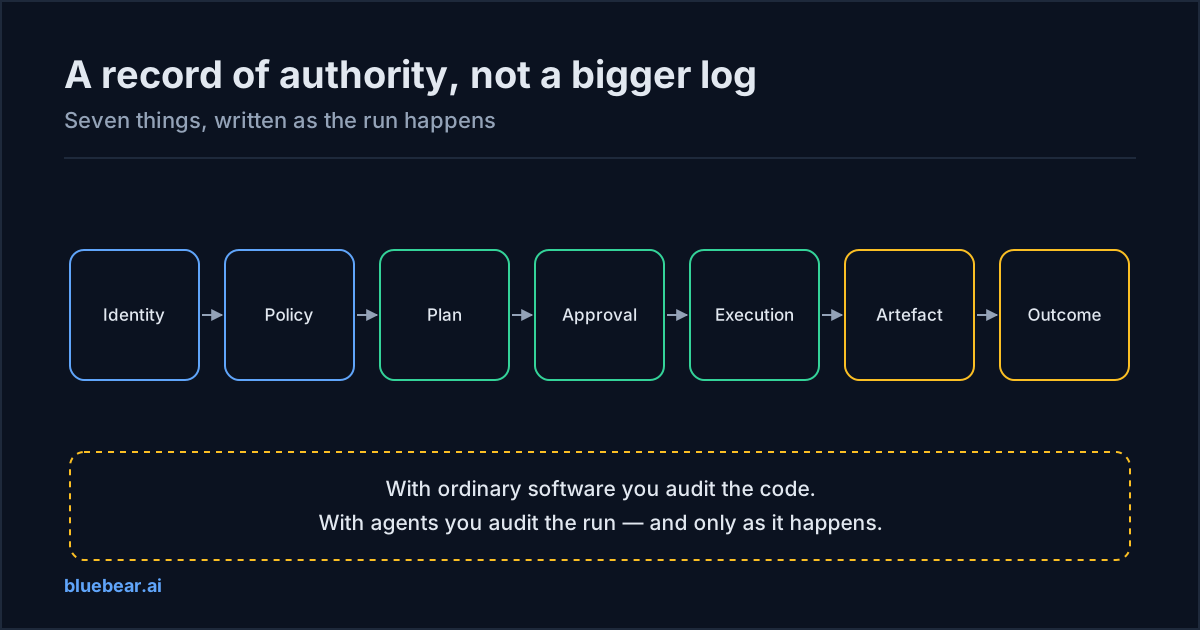
That is the whole argument for the category, and it is worth stating in one line for a colleague: with ordinary software you audit the code; with agents you audit the run.
What has to be in it: seven fields
| # | What is recorded | The question it answers | What breaks without it |
|---|---|---|---|
| 1 | Identity — the requester, the agent, and the boundary they belong to | Who did this? | Everything traces to one shared key, so nothing is attributable to a person or a customer. |
| 2 | Policy — which rule was evaluated, with what inputs, and the result | Was it allowed? | You can show what happened but never that it was permitted, which is the question a reviewer actually asks. |
| 3 | Plan — the steps the agent intended, and the constraints applied | What was it trying to do? | You can see the actions but not the intent, so a wrong outcome cannot be distinguished from a wrong instruction. |
| 4 | Approval — who authorised the step, when, and on what information | Did a human agree? | "A person approved it" becomes an assertion instead of a record. |
| 5 | Execution — what actually ran, against which system, with which credential reference | What really happened? | The plan is mistaken for the outcome. These diverge more often than people expect. |
| 6 | Artefact — what was produced or changed, and where it went | What came out? | You cannot connect a downstream problem back to the run that caused it. |
| 7 | Outcome — accepted, corrected, rejected, or abandoned, in business terms | Did it work? | You measure completions and call them successes, and every cost and quality figure derived from that is wrong. |
These seven form what is usually called an evidence chain: a linked record where each entry points at the next, so a single reference at either end pulls the whole run back. The evidence chain explained walks the sequence properly, and what an audit trail must capture to survive review turns the seven into a specification you can hand to a vendor.
Why the logs you already have will not do
This deserves its own answer, because "we already log everything" is the most common and most expensive misconception in the whole subject.
| Application logs | Audit trail | |
|---|---|---|
| Written for | An engineer debugging code | A reviewer establishing accountability |
| Records | That something ran | That something was allowed to run |
| Shape | Free text, whatever the developer chose that day | Typed fields with a declared contract |
| Retention | Days to weeks, by cost | Years, by obligation |
| Mutability | Whoever owns the service can change the format or drop a field | Append-only, with change to the schema itself controlled |
| Missing fields | Authority and business outcome — neither recoverable afterwards | These are the point |
Why your existing logs are not an audit trail is the longer version of this argument, with the specific reconstruction exercise that settles it in an afternoon.
A candid example from our own system
It is easy to describe an evidence model and much harder to populate one, so here is a real gap in ours rather than a capability claim.
Our gateway's session records carry a field for the error that ended a failed session. At the time of writing it is populated in none of the error rows in our production database — the sessions are marked failed, and the field that would say why is empty. That is not a design flaw in the schema; it is a producer gap, and it is the single most instructive kind of failure in this whole subject: having the field is not the same as having the record.
We mention it because it is exactly what you should test for when evaluating anything in this category. Ask to see a stored record from a real failed run, not a schema and not a screenshot of a happy path. A field that is never written is indistinguishable, to a reviewer, from a field that does not exist.
If you operate in a regulated industry
Your obligation is usually phrased as reconstruction rather than logging: for a named action on a named date, produce who authorised it, under what control, what the system did, and what evidence you retained. That maps onto fields 1, 2, 5 and 6 above, and it is why retention has to be decided by obligation rather than by storage cost. Audit trails for AI agent activity in banking and financial services covers the sector framing, and designing an AI agent audit trail for governance and compliance is the existing deep dive on the compliance design.
If you are a platform or engineering lead
Build the recording before the dashboards. Fields 1, 2 and 7 are the ones that cannot be back-filled — identity and policy because they only exist at decision time, and outcome because it only exists in the business, not in the infrastructure. Charts, alerts and allocation are all derived and can wait. The control plane architecture walkthrough covers where each record is written.
If you resell this to customers
Every record needs a customer identifier attached at write time, and every read path needs to filter on it. A shared evidence store is fine; a shared evidence store that any query can read across is a contractual problem the first time a customer asks. Multi-tenant isolation for buyers covers what to ask for.
Do this next
Pick one action an AI already takes in your business and try to answer the seven questions in the table for a specific instance of it from last week. The ones you cannot answer are your specification. Then read how to make AI actions auditable for the implementation order, or the audit trail glossary if the vocabulary is the immediate obstacle.
How long each of these records is kept, and what gets redacted, is its own policy: AI agent audit trail retention.
Questions people actually search for
- ai audit trail
An AI audit trail is a durable, tamper-evident record of what an AI system was permitted to do, what it actually did, and under whose authority. For AI agents specifically it has to cover more ground than a conventional application audit log, because the agent chooses its own steps at run time - so the record must capture the decision as well as the action. The practical test is whether someone who was not present can reconstruct a single action months later without asking an engineer.
- ai agent audit trail
The record of an autonomous agent working. Seven things belong in it: the identity of the requester and the agent, the policy that was evaluated and its result, the plan the agent formed, any human approval, what actually executed, the artefact produced, and the business outcome. Miss any one and a specific question becomes unanswerable - miss the policy and you cannot say it was allowed; miss the outcome and you cannot say it worked.
- what makes agents auditable
Recording authority, not just activity. An agent is auditable when every consequential step passes through a boundary that knows who is acting, decides whether it is permitted, and writes that decision down at the moment it is made. Auditability is a property of where the enforcement sits, not of how much you log: a system that logs everything but decides nothing at a boundary produces volume without evidence.
- is an application log an audit trail
No. Logs are written for engineers debugging code and record that something ran; an audit trail is written for a reviewer establishing accountability and records that something was allowed. Logs are usually free text, rotated after weeks, mutable by whoever owns the service, and missing exactly the two fields that matter most - the authority under which an action was taken and the business outcome it produced. Neither can be reconstructed later, because neither was ever anywhere else.
- how long should ai audit records be kept
Long enough to satisfy whichever obligation reaches furthest - the retention period in your sector regulation, your contractual commitments to customers, and the window in which a dispute could reasonably arise. That is usually years rather than the weeks a log platform defaults to, which is why audit records generally need a separate store with its own retention policy rather than living in the same place as debug logs.