Disclosure: BlueBear sells a platform that produces audit evidence, so we have a commercial interest in convincing you of the distinction below. The reconstruction drill is designed to settle it without us — if your logs pass, you do not need us for this.
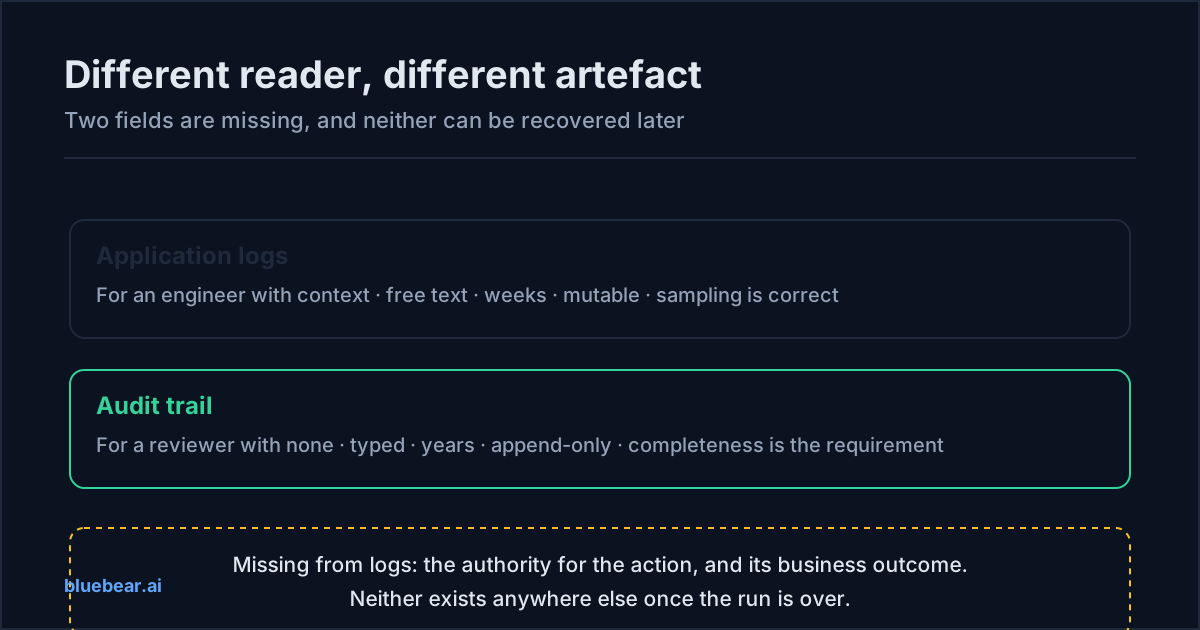
The short answer: different readers, different artefact, two fields that are missing
"We already log everything" is the most common objection in this subject, and it is not silly — teams that say it usually do have excellent telemetry. The problem is that logs and audit trails are built for different readers, and being good at one says nothing about the other.
| Application logs | Audit trail | |
|---|---|---|
| Reader | An engineer, debugging, who has context | A reviewer, months later, who has none |
| Question | What did the software do? | Who was responsible, and were they allowed? |
| Shape | Free text, whatever suited that day | Typed fields with a declared contract |
| Retention | Days to weeks, decided by cost | Years, decided by obligation |
| Mutability | The owning team can change or drop a field at will | Append-only; the schema itself is change-controlled |
| Completeness | Best effort. Sampling and dropped spans are normal and correct | Completeness is the requirement. A sampled audit trail is not one |
| Missing | Authority; business outcome | Nothing — those two are the point |
The last row is the one that matters, so it is worth dwelling on. Every other difference is a matter of degree that you could close with enough engineering. Those two fields cannot be closed later at all.
The two fields, and why they are unrecoverable
Authority. Which rule permitted this action, evaluated against what inputs, with what result. This exists for a few microseconds at the moment of evaluation and then is gone. Nothing downstream retains it — the system of record knows an update arrived, not that a policy allowed it. If you did not write it down at the boundary, there is nowhere to get it from.
Business outcome. Whether the result was accepted, corrected, rejected or abandoned. This never exists in your infrastructure at all. It exists in the business: in a person's judgement, in a downstream approval, in whether the customer complained. Unless a product surface reports it back, no volume of telemetry contains it.
Everything else in an audit record — what ran, when, against which system, with which result — is in principle reconstructable from logs, given enough effort and a stable enough log format. These two are not reconstructable at any price.
Why AI agents make this worse than it was
Three specific ways, all of them consequences of the agent choosing its own steps rather than following a written sequence.
One user action is many system actions. A single request can become a dozen model calls and several tool invocations. Logs record each call; nothing in them says which ones belonged to the same business decision unless a run identifier was attached deliberately.
The sequence is not in the code. With conventional software, reading the code tells you what the log lines mean. With an agent, the sequence was chosen at run time, so the log is the only account of it — and a log written for debugging omits the reasoning that produced the sequence.
The interesting failures are silent. An agent that did the wrong thing successfully produces no error. Log-based monitoring is tuned for exceptions, and the failure mode that matters most here — a permitted action that should not have been taken — looks exactly like success.
The reconstruction drill
This is the part worth actually doing, and it costs an afternoon.
- Pick one consequential action an AI system took in your business last month — something it changed, sent, or decided.
- Hand it to someone who was not involved. That constraint is the whole experiment; a person with context will unconsciously supply the missing fields from memory.
- Ask them to produce four things from what exists today: who was responsible, what rule permitted it, what the system actually did, and what the business result was.
- Give them a working day and no engineering support beyond read access.
The output is a list of what they could not produce. That list is your specification, and it is a much better artefact to take to a vendor or a build decision than a policy document, because it is specific to your systems and impossible to argue with.
In our experience of running this against systems generally, the fourth item — the business result — is the one that is almost never available, followed by the second. The first and third usually turn out to be present but expensive to assemble, which is a different and much smaller problem.
What your observability platform genuinely does do
It would be dishonest to argue that existing tooling contributes nothing. Distributed tracing gives you the shape of a run — which calls happened, in what order, how long each took, where the time went. That is real, it is hard to build, and you should not rebuild it. Emerging conventions for AI telemetry are standardising what a model call span should carry, which makes the shape of an agent run more legible than it was two years ago.
What tracing does not give you is the authority record and the outcome, for the structural reason that a tracing system observes execution and neither of those two is an execution event. The right conclusion is and, not or: keep the tracing, add the authority record beside it, and expect them to have different retention, different completeness requirements and different readers. Observability vs. audit trail works this boundary through in detail, and AI agent observability with OpenTelemetry is the existing technical guide to the tracing half.
If you operate in a regulated industry
The mutability row in the table above is the one that will be tested. An audit record that the owning team can edit does not establish much, so append-only storage and change control over the schema are usually the first two questions a reviewer asks after they have seen the fields. Designing an AI agent audit trail for governance and compliance is the existing guide to that design.
If you are a platform or engineering lead
The cheapest correct move is to add a run identifier that ties every model call, tool call and record to one business action, and to attach the actor and tenant to it at admission. That single change makes the third item in the drill go from expensive to trivial, and it is a day of work rather than a project. What to trace in an AI agent covers the wider recording decision.
Do this next
Run the drill. One action, one uninvolved person, one day. Whatever they cannot produce is the gap, and you will have a concrete specification instead of an argument. Then read what a trail must capture to survive review to turn the gap into a field list, or what an AI agent audit trail is if a colleague still needs convincing that the two artefacts differ.
Questions people actually search for
- audit trail vs log
A log answers "what did the software do" for an engineer who is debugging; an audit trail answers "who was responsible and were they allowed" for a reviewer who was not there. They differ in reader, shape, retention and mutability. The consequential difference is content: an audit trail records the authority for an action and its business outcome, and application logs record neither, because no one writing a log line had any reason to.
- why are application logs not enough for compliance
Four reasons, and each is sufficient on its own. They are free text, so a field can quietly change shape or disappear when someone refactors. They are retained for weeks and obligations run for years. They are mutable by whoever owns the service, so they do not establish anything against a determined counter-argument. And they omit the authority under which an action was taken, which is the actual question being asked.
- can I use my observability platform as an audit trail
Partly, and it is worth being precise about which part. Distributed tracing genuinely gives you the shape of a run - which calls happened, in what order, how long each took - and that is real value you should not rebuild. What it does not give you is the authority record: which policy was evaluated, who approved the step, which customer boundary it belonged to, and what the business outcome was. Use the tracing, add the authority record beside it, and do not expect either to do the other job.
- what should an audit record contain that a log does not
Two things above all: the policy that was evaluated with its inputs and result, and the business outcome of the run. Neither is recoverable afterwards. The policy only exists at the moment of evaluation and nothing downstream retains it; the outcome only exists in the business, so unless a product surface reports it back, no amount of infrastructure telemetry contains it. Everything else in an audit record can, with effort, be reconstructed.
- how do I know if my logs would survive an audit
Run the reconstruction drill. Pick one consequential action an AI took last month, hand it to someone who was not involved, and ask them to produce four things from what you have: who was responsible, what rule permitted it, what the system actually did, and what the business result was. Give them a day. What they cannot produce is your specification, and it is a far more useful artefact than a policy document.