Disclosure: BlueBear sells software that does some of what this article describes, so we have a commercial interest. The four steps are deliberately vendor-neutral — three of them are architecture decisions you make regardless of what you buy, and the article says plainly where a tool is unnecessary.
The short answer: change where the decision is made, then record it
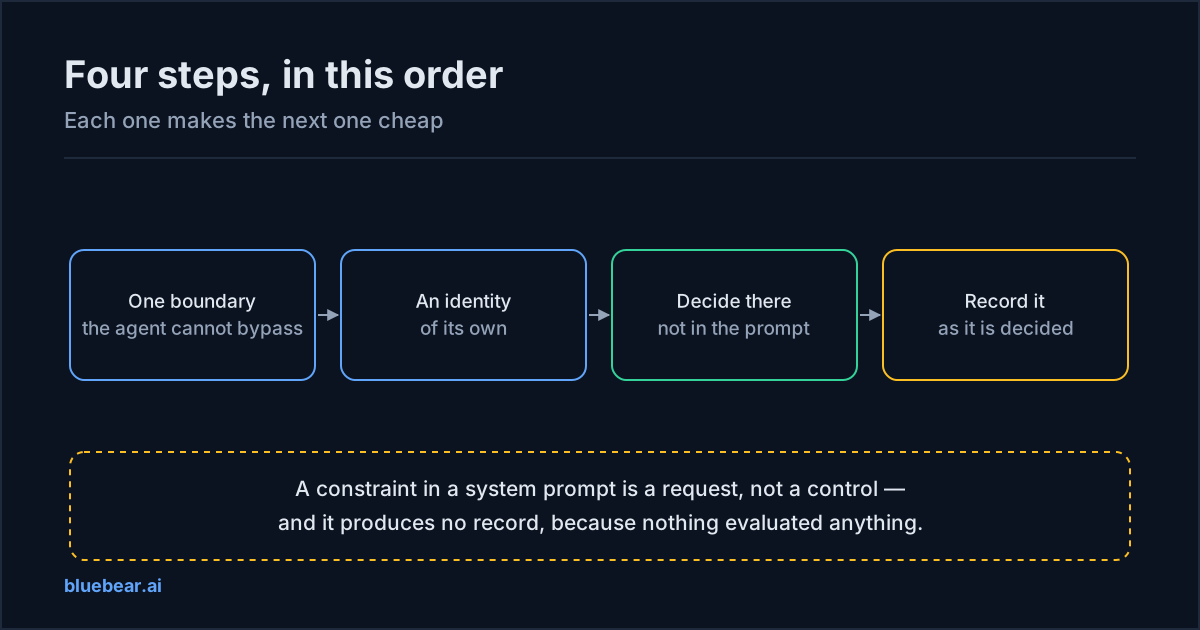
Making AI actions auditable is not a logging exercise. It is a decision about where enforcement sits. The four steps below work in this order because each one makes the next one cheap, and doing them out of order is why most attempts produce volume without evidence.
- Route consequential actions through one boundary the agent cannot go around.
- Give the agent an identity that is distinct from the application it happens to run inside.
- Make the permission decision at that boundary, not in the prompt.
- Write the decision down as it is made, in a typed record, alongside what actually happened.
Everything else — dashboards, alerts, exports, reports — is derived from step 4 and can wait.
Step 1: one boundary, and only consequential actions through it
A boundary is any point every relevant call must pass through: a tool layer, a gateway, a service that holds the credentials. The requirement is not that it is a particular product, it is that the agent cannot bypass it. An agent that can also call the API directly makes the boundary decorative.
"Consequential" is doing useful work in that sentence. Not everything needs this. An agent reading public documentation, drafting text a person will review, or querying a read-only reporting copy does not need an authority record, and building one for it is cost with no buyer. The line is crossed when the agent changes something — a record, a message, a payment, a ticket, a schedule — or reads something whose access is itself regulated.
Practically this means enumerating your agent's tools and sorting them into two lists. In most systems the consequential list is much shorter than people expect, which makes this step far less work than it sounds.
Step 2: the agent needs an identity of its own
Most agents inherit an identity by accident: they run inside an application, so they use the application's credentials. Everything the agent does then looks, in every downstream system, exactly like everything the application does.
That single fact defeats auditing before you start. You cannot attribute an action to an agent, you cannot revoke an agent's access without breaking the application, and you cannot scope permissions to what the agent's job actually requires.
The fix is a credential issued to the agent as an actor in its own right, carried on the request rather than assumed from the environment, and never something the agent can name for itself. In our own gateway, keys are issued per tenant and the boundary a request belongs to is established from the credential presented at admission rather than from any value in the payload — a request that could nominate its own tenant would be a request that could nominate someone else's. What AI agent identity is covers this in plain terms; workload identity for AI agents goes deeper on replacing shared secrets.
Step 3: decide at the boundary, not in the prompt
This is the step that most often goes wrong, and it goes wrong in a way that looks fine in testing.
Writing "you may only read from the CRM, never write" into a system prompt is not a control. It is a request. The agent constructs its own steps from text, and text can be argued with — by a hostile input, by an unusual document, or simply by a model update. A constraint evaluated at the boundary holds regardless of what the agent was persuaded to attempt.
The Model Context Protocol, an open standard for describing a tool connection and the named operations inside it, makes this practical: it turns "the agent has CRM access" into an enumerated list of operations a policy can be written against. Least privilege for AI agents covers the scoping design, and MCP token security covers why the credential must never reach the agent.
The audit consequence is direct: a decision made at the boundary produces a record, because something had to evaluate it. A decision made in a prompt produces nothing, because nothing evaluated anything.
Step 4: record the decision, not just the action
The record needs five things at minimum, and the first two are the ones that distinguish it from a log:
| Field | Why it cannot be added later |
|---|---|
| Actor and boundary — the agent, the human behind it, the tenant or workspace | Only known at request admission. A provider invoice knows an API key, not a person or a customer. |
| Policy and decision — which rule was evaluated, with what inputs, and the result | Only exists at the moment of evaluation. Nothing downstream retains it. |
| Action — the connection, the operation, the target | Recoverable in principle, painfully, from several systems. |
| Result — what actually happened, including the failure | Recoverable, but usually only for successes; failures are where logs are thinnest. |
| Outcome — accepted, corrected, rejected, abandoned | Exists only in the business. No infrastructure knows it unless a product surface reports it. |
Two design points are worth more than the field list. First, type the record. A record with a declared contract can be validated when it is written and migrated when the shape changes; free text can only be read by someone who already knows what to look for. Second, write it at the boundary, not from the agent. An agent reporting on itself is both the actor and the witness, and any step it decides not to mention produces no record.
What to retain, and what not to
There is a real tension here and pretending otherwise produces bad advice. Prompts and tool arguments often contain personal or confidential data, so retaining everything converts an audit control into a data-protection liability.
A workable default: retain the authority record in full and for a long time, retain identifiers and content hashes rather than content, and retain full content only where a stated obligation requires it, with a retention period attached. That keeps the reviewer's questions answerable without turning the evidence store into a second copy of your customer data. GenAI telemetry without leaking prompts, tool arguments, or customer data is the existing deep dive on this trade-off.
If you operate in a regulated industry
Run the reconstruction drill before you buy anything: pick one action from last month and try to produce actor, authority, action and outcome from what you have today. The drill takes an afternoon and it converts a vague compliance worry into a specific field list, which is a far better thing to take to a vendor. What a trail must capture to survive review is that field list written out.
If you are a platform or engineering lead
Steps 1 to 3 are architecture and cost engineering time, not licence fees. Step 4 is where buying can genuinely save you work, because a typed evidence store with retention, tenant scoping and a query path is more work than it looks. If you build it, build the write path first and resist the dashboard until the records exist.
If you resell this to customers
Your customers will eventually ask for their own audit export, which means the tenant identifier has to be on the record and on every read path from day one. Retrofitting it means either reprocessing history you may not be able to attribute, or telling a customer their first year is unavailable. Workspace boundary access control covers where that identifier comes from.
Do this next
List your agent's tools and split them into consequential and not. That list is step 1, it takes half an hour, and it usually shrinks the problem by an order of magnitude. Then read what an AI agent audit trail is for the seven fields, or how to evaluate audit trail software if you already know you are buying.
Questions people actually search for
- how to make ai actions auditable
Route every consequential action through one boundary the agent cannot bypass, give the agent an identity distinct from the application it runs in, make the permission decision at that boundary rather than in the prompt, and write the decision down at the moment it is made. In that order. Logging more of what you already have does not produce auditability, because the two fields a reviewer needs - the authority for the action and its business outcome - are not in your logs and cannot be recovered from them later.
- can you audit what an ai agent did
Only if the system was built to be audited, and only from the moment it was. An agent chooses its own steps at run time, so there is no artefact you can review after the fact the way you would review code. Anything not recorded as the run happened is gone. That is why auditability is a design decision taken before deployment rather than an analysis performed afterwards.
- do I need to log every ai prompt and response
Usually not, and often you must not. Prompts and responses frequently contain personal or confidential data, so retaining them wholesale converts an audit control into a data-protection problem. What a reviewer needs is the authority record - actor, policy, decision, action, outcome - plus enough of a reference to locate the content if a specific investigation requires it. Retain identifiers and hashes by default, and full content only where a stated obligation requires it and a retention period bounds it.
- where should ai audit logging happen
At the boundary where the action leaves your system - the tool call, the write to a system of record, the model call - and not inside the agent. An agent that reports on itself is both the actor and the witness, and any step it decides to skip is a step that produces no record. A boundary records what passed through it regardless of what the agent intended.
- what is the difference between logging and auditing ai
Logging is a volume activity aimed at debugging; auditing is a completeness activity aimed at accountability. A log is judged by whether it helps an engineer find a bug, an audit record by whether it lets a stranger establish who was responsible. You can have terabytes of the first and none of the second, and that is the normal state of a system that was never designed for the question.