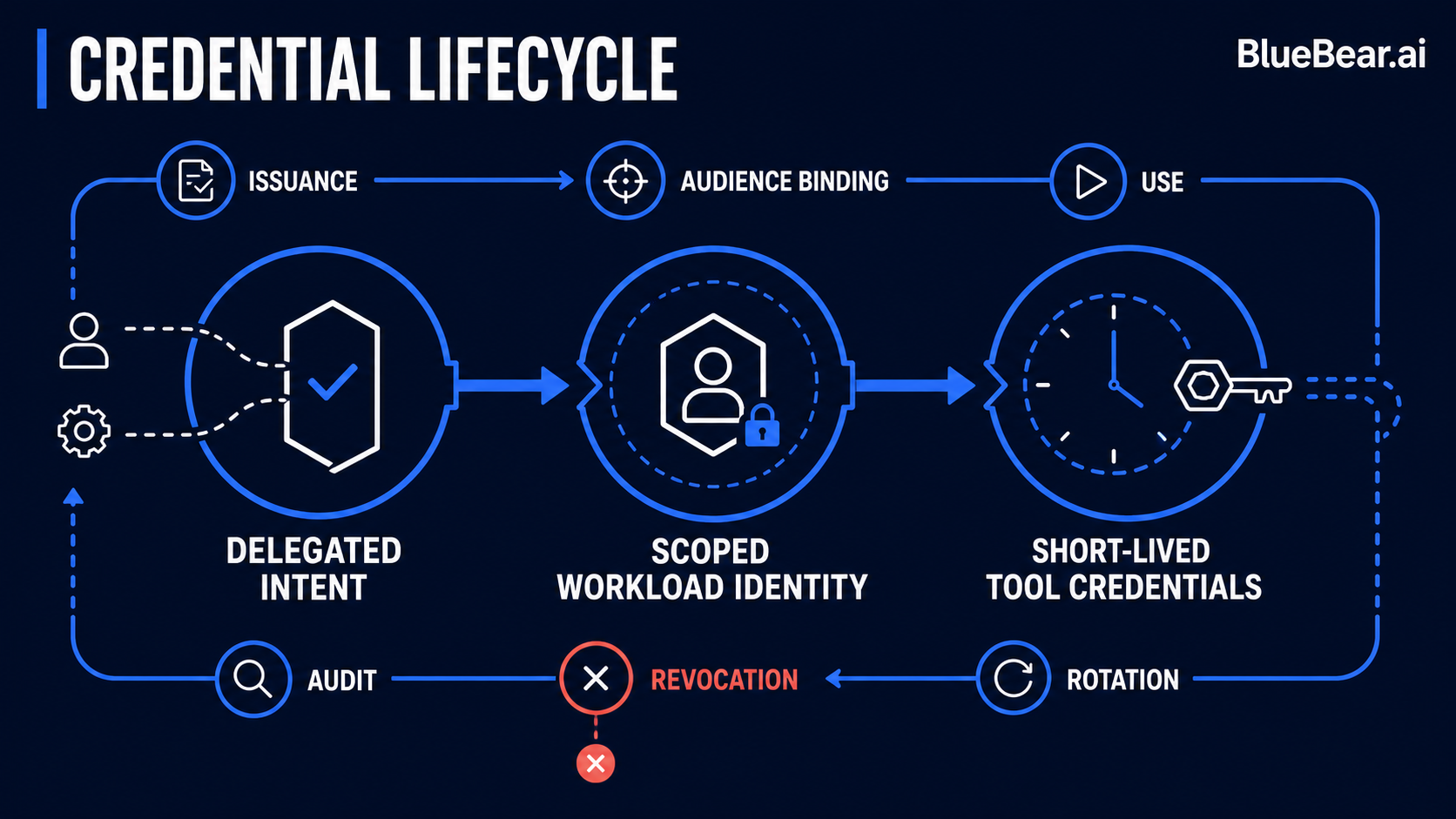
Managing shared secrets for AI agents creates security vulnerabilities that are hard to control. This challenge complicates governance and compliance.
Artificial intelligence (AI) agents increasingly automate complex tasks. These agents require access to various systems and data. Historically, this access relied on shared secrets or long-lived credentials. This approach introduces significant security and operational risks. For security leaders like CISOs and AI Governance Leads, scattered credentials and opaque authorization logs are critical concerns. Tool autonomy often expands faster than policy coverage. This creates a difficult security posture for regulated operations and enterprise software environments.
The Challenge of AI Agent Credentials
Long-lived shared keys are difficult to constrain, rotate, attribute, and revoke across tools and tenants. This core problem undermines your security posture. Traditional credential management was not designed for the dynamic and distributed nature of AI agents. Agents operate across diverse environments, from cloud services to on-premises systems. Each interaction requires specific permissions. When credentials are hard-coded or long-lived, the attack surface grows. This makes it challenging to maintain control.
Scattered Credentials and Opaque Authorization
Credentials and permissions are scattered across multiple platforms. This leads to a fragmented security landscape. An AI agent might use a database password here, an API key there, and a cloud token elsewhere. Tracking these access points becomes a manual and error-prone process. Furthermore, logs do not preserve authorization context. This means security teams often see that an action occurred but lack crucial details about *why* it was authorized. This gap complicates incident response and compliance audits, particularly in regulated industries.
Uncontrolled Tool Autonomy
The speed of AI agent development and deployment often outpaces security policy implementation. Tool autonomy expands faster than policy coverage. As new AI agents are introduced, they often inherit broad permissions or are granted access based on expediency. This creates shadow IT risks and potential over-privileging. Security architects and risk and compliance leads face the burden of retrofitting controls onto already deployed systems. This leads to insecure defaults and ongoing vulnerabilities.
Understanding Identity Boundaries for AI Agents
To address these challenges, a structured approach to identity is essential. This involves clearly defining identity boundaries. We move from user delegation through workload identity to audience-bound downstream credentials. This framework helps secure AI agent access.
User Delegation: Initial Intent and Oversight
User delegation is the initial step where a human user grants an AI agent the authority to act on their behalf. This sets the scope of the agent's actions. However, direct user delegation often results in the agent inheriting the user's full privileges. This is rarely appropriate for automated tasks. The goal is to narrow this scope as quickly as possible.
Workload Identity: Distinct Agent Identities
Workload identity provides a distinct, non-human identity for software workloads, including AI agents. Instead of using shared human credentials, each AI agent or service instance gets its own identity. This identity is tied to its specific context and purpose. This means an AI agent has its own set of permissions. These permissions are scoped to the tasks it needs to perform. This granular control is crucial for managing AI agent security. It supports the principle of least privilege, reducing the impact of a compromised credential.
Audience-Bound Downstream Credentials: Short-Lived Access
Audience-bound downstream credentials are short-lived, narrowly scoped tokens or keys. An AI agent obtains these credentials for specific tools or services it needs to interact with. The "audience" refers to the intended recipient of the credential, ensuring it cannot be misused by other services. This mechanism prevents token passthrough and enhances overall security. For example, an agent needing to access a specific database would request a credential valid only for that database, for a limited time. This reduces the lifespan of sensitive information, making compromise less likely.
BlueBear's Approach: Centralized Credential Governance
BlueBear centralizes credential isolation and authorization context instead of embedding secrets in agents. This approach directly tackles the problems of scattered credentials and opaque logs. The BlueBear AI agent platform provides a governed agent runtime that manages access at a fundamental level. It ensures agents operate within defined security boundaries.
This differs significantly from traditional methods. Instead of agents directly managing or storing long-lived credentials, BlueBear introduces an MCP gateway. This gateway acts as a central control point. It handles all requests for resources, prompts, and tools. This means agents themselves do not possess sensitive long-lived keys. This reduces the risk of credential compromise.
The Model Context Protocol (MCP) architecture assigns hosts responsibility for connection permissions, authorization decisions, policy enforcement, and isolation. Servers expose focused resources, prompts, and tools to the AI agents. This clear separation of duties enhances security and auditability (Source 1). BlueBear leverages this architecture to enforce granular policies.
Furthermore, MCP security guidance forbids token passthrough. It recommends validating that tokens are issued specifically for the receiving MCP server (Source 2). This means every credential exchange is verified and scoped. It prevents an agent from inadvertently or maliciously using a credential beyond its intended purpose or audience. BlueBear implements this guidance, providing robust control over AI agent workload identity.
This governed agent runtime ensures that authorization context is always preserved. Every action an AI agent takes is linked to its specific workload identity and the policies governing that identity. This provides clear, defensible audit trails. It helps address the pain point of logs not preserving authorization context, a crucial requirement for compliance and risk management in regulated operations.
Representative Operating Scenario: Secure Agent Tool Access
Consider an AI agent designed to process customer support tickets. Traditionally, this agent might have direct access credentials to a CRM system, a knowledge base, and an email service. These credentials might be long-lived API keys. If this agent is compromised, an attacker gains immediate access to all these systems with the agent's privileges.
With BlueBear, the AI agent, operating within the governed agent runtime, does not hold these long-lived credentials. Instead, when the agent needs to access the CRM, it requests access through the BlueBear MCP gateway. The gateway, based on the agent's workload identity and predefined policies, issues a short-lived, audience-bound credential specifically for the CRM. This credential is valid only for the required interaction and expires quickly. The gateway logs the request and the authorization decision, providing full context. If the agent is compromised, the attacker only gains access to a short-lived, narrowly scoped credential that will soon expire, limiting potential damage.
A Practical Diagnostic Checklist for AI Agent Security
For CISOs, AI Governance Leads, Security Architects, and Risk and Compliance Leads, evaluating your current AI agent workflow is paramount. Use this checklist to identify potential vulnerabilities and improve your AI agent workload identity posture:
- Credential Inventory: Can you list every shared credential used by AI agents? Identify its owner, purpose, and expiration policy.
- Authorization Context: Do your security logs clearly show *who* (which agent workload identity) initiated an action and *why* it was authorized? Or do they just show that an action occurred?
- Principle of Least Privilege: Are AI agents operating with the minimum permissions required for their tasks, or do they have broad, inherited access?
- Credential Lifespan: Are agents using long-lived credentials, or are they acquiring short-lived, audience-bound credentials for specific interactions?
- Token Passthrough: Is there any instance where an AI agent passes a token it received to another service without validation, potentially leading to a confused deputy problem?
- Policy Coverage: Does your security policy keep pace with the deployment of new AI agents and their evolving capabilities?
- Isolation: Are agent credentials and authorization contexts isolated from the agent's runtime environment?
Improve Your AI Agent Security Posture
The rise of AI agents demands a new approach to identity and access management. Relying on shared secrets introduces unacceptable risks. Governed access, built on clear identity boundaries and centralized control, provides the necessary security and accountability. This protects your enterprise from fragmented credentials and uncontrolled agent autonomy.
Take the critical first step towards a more secure AI agent ecosystem:
Identify every shared credential and define audience, owner, and revocation path. Then, evaluate the current workflow before adding another tool to your environment. Consider how a dedicated AI agent platform can centralize credential isolation and authorization context to move beyond embedding secrets in agents.
BlueBear Agent Workload Identity Manifest
Replace the idea of “the agent credential” with a versioned manifest that states who delegated the work, where it runs, what it may request, and how its authority expires.
{
  "tenant": "tenant-id",
  "workspace": "workspace-id",
  "agent": "agent-definition-id",
  "workflowVersion": "approved-version",
  "subjectType": "service-principal",
  "allowedConnections": ["approved-mcp-connection"],
  "allowedActions": ["read:case", "propose:update"],
  "approvalRequired": ["execute:update"],
  "credentialMode": "resolve-at-execution",
  "expiresAt": "bounded-timestamp"
}| Lifecycle event | Control | Evidence |
|---|---|---|
| Issue | Bind the workload to tenant, workspace, approved agent/workflow version, and runtime. | Issuer, subject, audience, version, owner, and expiry. |
| Use | Authorize the requested MCP capability and resource at execution time. | Effective policy, connection, tool/action, credential reference, and result. |
| Change | Require review when tools, actions, runtime, workflow version, or delegation scope changes. | Previous and new manifest, approver, reason, and activation time. |
| Revoke | Disable the workload identity and dependent capabilities without editing prompts. | Revocation actor, time, affected sessions, and containment confirmation. |