Integrating AI agents quickly risks operational gaps if ownership, actions, and health are not transparent. For VP Engineering, Platform Engineering Leads, and AI Infrastructure Architects, managing a growing fleet of AI agents presents a new layer of complexity. Agent infrastructure is fragmented across teams. Failures are difficult to reconstruct end to end. Tenant isolation and capacity controls often arrive too late in the development cycle.
An AI agent is an autonomous software program that perceives its environment, makes decisions, and performs actions to achieve specific goals. These agents often rely on various external services and data sources, which are connected via integrations. An integration catalog lists these connections, but without proper controls, it can become a source of risk.
Effective governance of this catalog transforms a simple list into an operational control. This article outlines how to design a governed integration catalog, defining clear lifecycle states for AI agent integrations to ensure transparency, security, and operational resilience.
The Risk of Ungoverned AI Agent Integrations
An integration list becomes risky when teams cannot see ownership, allowed actions, tenant scope, credential health, and evidence requirements. This lack of visibility leads directly to fragmented agent infrastructure. Without a clear understanding of who owns an integration, what it does, and how it's secured, troubleshooting failures becomes an arduous task. Reconstructing end-to-end failures across disparate systems is nearly impossible when integration details are opaque.
Moreover, the absence of robust governance means tenant isolation and capacity controls are often retrofitted, leading to security vulnerabilities and performance bottlenecks. Each new AI agent integration, if not properly managed, amplifies these risks, turning potential innovation into operational debt.
BlueBear's Approach to Governed Integration Catalogs
BlueBear treats its integration catalog as an operational control tied to workspaces and MCP access. This means every integration within the BlueBear AI agent platform is managed with explicit policies and lifecycle states, ensuring that governance is embedded from the outset.
The Model Context Protocol (MCP) architecture underpins this approach. It assigns hosts responsibility for connection permissions, authorization decisions, policy enforcement, and isolation. Servers, in turn, expose focused resources, prompts, and tools. This clear division of responsibility ensures that integrations are not only listed but actively controlled and monitored. For more details, consult the Model Context Protocol architecture specification.
Defining Lifecycle States for AI Agent Integrations
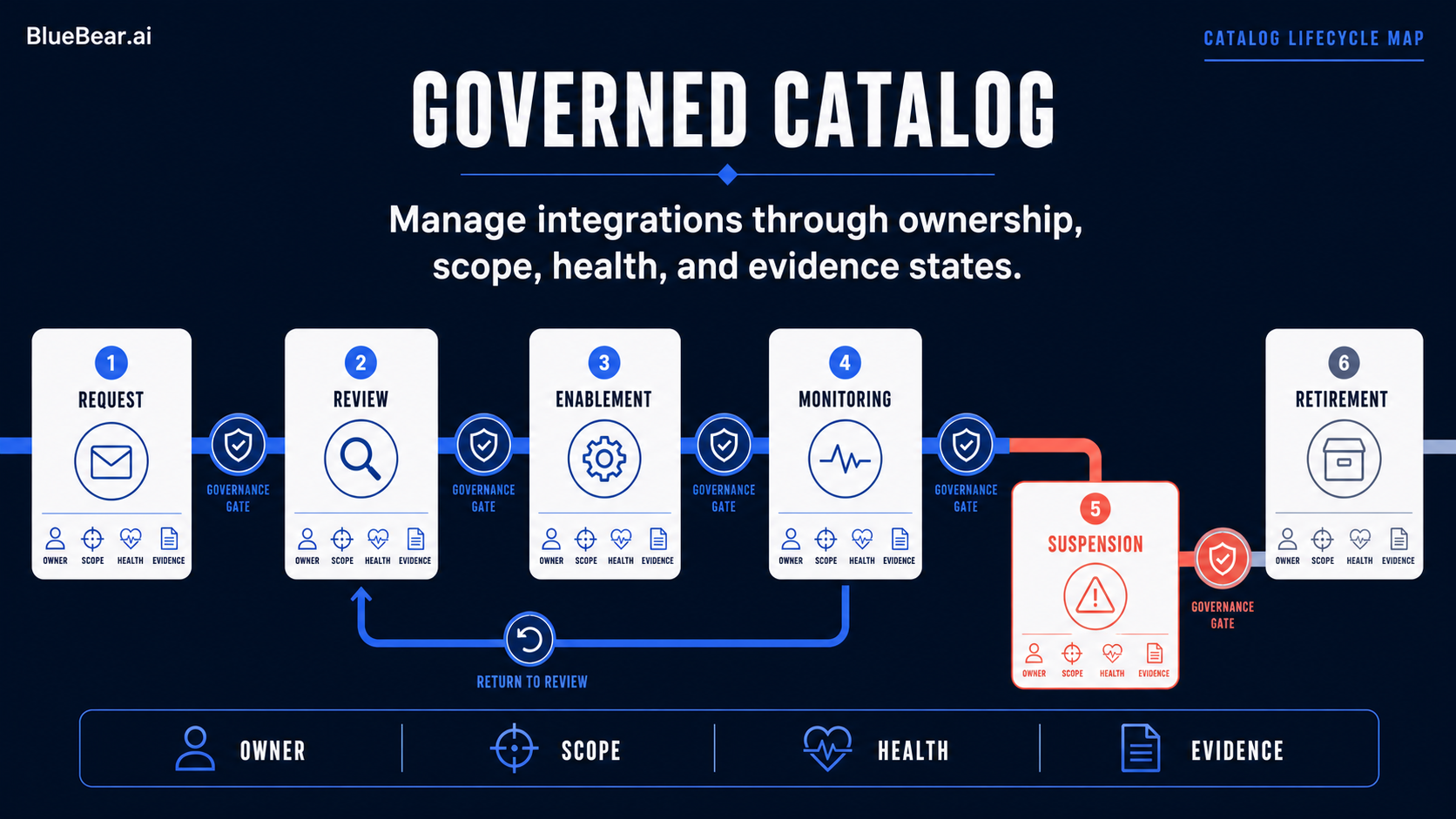
To establish a truly governed integration catalog, defining clear lifecycle states is essential. This framework ensures that every integration progresses through a controlled journey, from initial request to eventual retirement, with continuous oversight.
- Requested: An integration is proposed by a team, outlining its purpose, intended scope, and required resources. This initial state focuses on documenting the need.
- Approved: The integration request undergoes a formal review. This includes assessing its security implications, compliance with internal policies, potential impact on tenant isolation, and resource consumption. Approval signifies that the integration aligns with organizational standards and business needs.
- Enabled: Once approved, the integration is actively deployed and made available to AI agents within defined workspaces. This state requires verification of credential health and operational readiness.
- Degraded: The integration is operational but experiencing performance issues, errors, or security concerns. Monitoring systems detect these issues, triggering alerts and potential remediation workflows.
- Suspended: Due to critical issues, security vulnerabilities, or policy violations, the integration is temporarily disabled. During suspension, access is revoked, and a thorough investigation or corrective action is required before re-enabling.
- Retired: The integration is no longer needed or supported. It is formally decommissioned, and all associated resources are removed. This ensures that outdated or unused integrations do not pose dormant risks.
How BlueBear Differs
Many platforms offer integration lists, but BlueBear elevates this to an operational control. Our MCP gateway and governed agent runtime ensure that the catalog isn't just a passive inventory. Instead, it’s an active system where each lifecycle state dictates real-world access and enforcement.
For example, MCP security guidance explicitly forbids token passthrough. It also recommends validating that tokens are issued specifically for the receiving MCP server. This level of granular control helps prevent common security pitfalls, ensuring that tenant isolation and capacity controls are integrated from the design phase, not as afterthoughts. For a deeper dive into these practices, refer to the MCP security best practices documentation.
This proactive governance directly addresses the pain point of failures being difficult to reconstruct end to end. By tracking an integration through its defined lifecycle states and enforcing policies via the BlueBear MCP gateway, teams gain a clear audit trail and immediate insights into the operational status and security posture of every connection.
BlueBear Governed Integration Catalog Contract
A catalog entry should describe an authorization boundary, not just display a connector logo. BlueBear separates what may be discovered from what may be assigned and executed.
{
  "connection": "approved-connection-id",
  "tenant": "owning-tenant",
  "workspaceAssignments": ["approved-workspace"],
  "server": "mcp-server-id",
  "allowedTools": ["read_record", "propose_update"],
  "approvalRequired": ["execute_update"],
  "credentialMode": "resolve-at-execution",
  "dataClass": "customer-defined",
  "owner": "integration-owner",
  "reviewBy": "bounded-date"
}| Lifecycle step | Required decision | Evidence |
|---|---|---|
| Admit | Approve the server, owner, trust boundary, tools, data class, and deployment path. | Review record, version, source, and test result. |
| Assign | Choose the tenant/workspace, permitted actions, approvers, and budget boundary. | Effective assignment and policy. |
| Execute | Resolve identity and credential only after the requested capability is authorized. | Policy result, credential reference, tool receipt, and outcome. |
| Change | Re-review new tools, scopes, side effects, versions, or data flows. | Diff, approver, activation time, and rollback plan. |
| Revoke | Disable the connection or assignment and identify dependent workflows. | Revocation event, affected sessions, owner, and completion state. |
Practical Diagnostic Checklist for Your Integration Catalog
To evaluate your current workflow and identify potential gaps in your AI agent integration catalog, consider the following questions:
- Is there a documented owner for every integration?
- Are the allowed actions for each integration clearly defined and enforced?
- Is the tenant scope for each integration explicit and appropriately limited?
- Do you have real-time visibility into the credential health of each integration?
- Are there clear evidence requirements for an integration to move from requested to approved to enabled?
- Are the suspension criteria for integrations well-defined and automatically triggered where possible?
- Can you easily reconstruct the end-to-end flow of an AI agent operation, including all integrated services?
Representative Operating Scenario
Consider a platform engineering team developing a new AI agent for customer support. This agent needs to integrate with a CRM system for customer data, a knowledge base for information retrieval, and an internal messaging tool for escalating complex queries. Without a governed catalog, each integration might be set up ad-hoc by different developers, leading to inconsistent security practices, unclear ownership, and potential data exposure across tenants.
With a governed integration catalog, each of these integrations would follow a defined lifecycle. The CRM integration, for instance, would be 'Requested' with clear documentation of its purpose and required permissions. Upon 'Approval', security reviews would verify that the integration adheres to the principle of least privilege and uses tokens issued specifically for the receiving MCP server, as recommended by MCP security guidance. Once 'Enabled', its credential health would be continuously monitored. If a security vulnerability were detected in the CRM connection, the integration could be 'Suspended' automatically by the BlueBear MCP gateway, preventing further unauthorized access until the issue is resolved. This prevents fragmented agent infrastructure and ensures tenant isolation.
Conclusion
Designing a governed integration catalog for AI agents is no longer optional; it is a critical requirement for operational control and security. By implementing clear lifecycle states and leveraging robust architectural frameworks like the Model Context Protocol, organizations can move AI agents from fragmented pilots to reliable, shared infrastructure.
Before adding another tool or integrating another agent, evaluate your current workflow. Document owner, actions, scopes, health, and suspension criteria for one high-impact integration.