MCP for Business Leaders: The Operating Model Behind Connected AI Agents
Rushing AI agents into production without clear controls creates hidden costs and security risks.
Many business leaders, particularly those in enterprise software, AI platforms, and managed services, encounter the Model Context Protocol (MCP) as a technical standard. This often frames MCP as purely a developer concern, obscuring its critical role in executive-level decisions around tool access, governance, integration reuse, and managing switching costs. For Heads of AI, AI Product Directors, FinOps Leads, and Operations Directors, understanding MCP through an operating model lens is essential.
What is Model Context Protocol (MCP)?
The Model Context Protocol (MCP) is a communication standard designed to enable AI agents to interact securely and effectively with tools and services. Think of it as a common language that allows different AI systems and external applications to understand each other's requests and responses. This protocol goes beyond simple API calls by focusing on context exchange and managing sessions, ensuring that agents can maintain state and carry out complex workflows. When an AI agent needs to use an external tool, MCP defines how that connection happens, how data is exchanged, and how permissions are managed.
Historically, connecting AI agents to various business systems often meant custom, one-off integrations. This approach quickly leads to sprawl, security vulnerabilities, and a lack of oversight. For FinOps Leads and Operations Directors, this translates directly into significant pain points: provider invoices often lack clear workflow attribution, making it impossible to connect AI spend to specific business outcomes. Furthermore, the excitement of a successful demo can be confused with actual production readiness, masking underlying operational complexities.
Beyond Developer Protocol: MCP for Business Operations
MCP is more than a technical specification; it’s a framework for operational control. It translates into concrete decisions about who can connect which tools, how those connections are governed, and how integrations can be reused across multiple AI agents and workflows. This is crucial for managing the sprawl and complexity of AI in the enterprise.
Without a clear operating model, organizations face escalating costs and risks. Retries and manual review labor can hide the true unit cost of AI agent operations. A lack of standardized integration paths means every new agent or tool connection is a bespoke project, increasing development time and technical debt. This directly impacts the ability of AI Product Directors to scale successful agents and for Heads of AI to maintain control over their AI ecosystem.
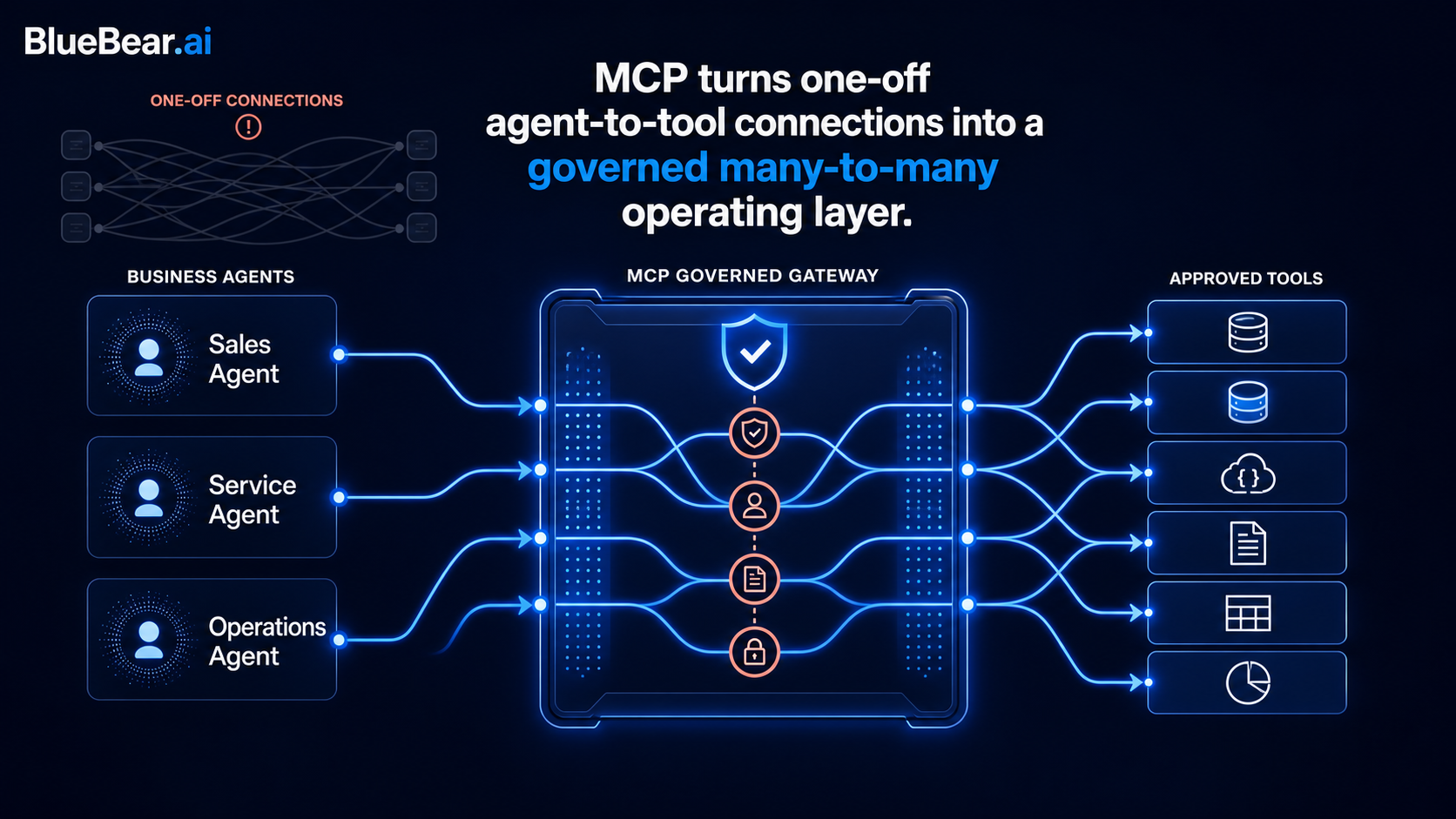
MCP addresses these challenges by shifting the focus from individual agent-to-tool connections to a governed, many-to-many operating layer. The architecture assigns "hosts" responsibility for connection permissions, authorization decisions, policy enforcement, and isolation. Meanwhile, "servers" expose focused resources, prompts, and tools (Source 1). This means the infrastructure itself manages the rules of engagement, not just individual developers.
The BlueBear Approach: Governed Agent Runtimes
BlueBear understands that bringing AI agents into enterprise workflows requires more than just connectivity; it demands governance, control, and clear operational visibility. Our platform uses an MCP gateway and an integration catalog as operating controls. These components sit between business agents and your critical systems of record.
The BlueBear MCP gateway acts as a central control point. All agent-to-tool communications flow through it. This allows for consistent policy enforcement. It ensures that every connection adheres to predefined access rules and security standards. This centralized management helps to mitigate the risks associated with unauthorized data access and unmanaged integrations.
Complementing the gateway, the BlueBear integration catalog provides a clear inventory of approved tools and services that AI agents can access. This catalog isn't just a list; it's a set of pre-configured, governed integration patterns. It simplifies the process of connecting agents to enterprise systems like CRMs, ERPs, and data warehouses. This approach prevents the proliferation of one-off integrations, a common source of technical debt and security vulnerabilities.
This governed agent runtime ensures that AI initiatives scale responsibly. It moves beyond isolated demos to production-ready deployments. For operations leaders, this means a clearer understanding of how AI agents interact with existing systems. It also provides the ability to audit and control those interactions.
How BlueBear Differs: An Operating Story
Many AI agent platforms focus primarily on agent development and deployment, often leaving the complexities of integration governance to the user. This can lead to a fragmented operational landscape where security and cost controls are an afterthought. BlueBear, however, positions MCP as a foundational element of its operating model.
Consider a representative operating scenario: an AI Product Director wants to deploy an agent to automate customer support tasks. This agent needs to access the CRM for customer history, a knowledge base for troubleshooting, and a ticketing system to log new issues. Without MCP and a governed runtime, each of these connections might be managed independently, with varying security configurations and access permissions.
With BlueBear, the Head of AI can define a policy that states which departments can deploy agents that access the CRM. The FinOps Lead can set cost limits for interactions with certain external tools. When the support agent is developed, it leverages existing, approved integrations from the BlueBear catalog through the MCP gateway. This ensures that CRM access is authorized, sensitive data is handled according to policy, and usage costs are tracked against the specific customer support workflow.
This structured approach contrasts sharply with environments where agent integrations are ad hoc. BlueBear’s MCP gateway and integration catalog offer transparent, auditable controls. These controls ensure that the enterprise can benefit from AI automation without sacrificing security or operational efficiency. Importantly, MCP security guidance explicitly forbids token passthrough. It also recommends validating that tokens are issued specifically for the receiving MCP server (Source 2). BlueBear implements these security best practices as core features, offering a more robust and compliant operating environment.
A Practical Diagnostic Checklist for AI Agent Operations
Before expanding your AI agent deployments, consider these questions to assess your current operating model:
- Do provider invoices clearly attribute AI agent usage to specific business workflows or projects? (Addressing: Provider invoices lack workflow attribution)
- Are your AI agent demonstrations truly representative of production readiness, including security, governance, and cost implications? (Addressing: Demo success is confused with production readiness)
- Can you accurately calculate the true unit cost of an AI agent action, accounting for retries, human review, and integration overhead? (Addressing: Retries and review labor hide true unit cost)
- Is there a centralized, auditable process for approving new tool connections for AI agents?
- Are integration patterns for common business systems standardized and reusable across different AI agents?
- Who owns the decision-making process for granting AI agents access to sensitive systems of record?
- How do you ensure that data exchanged between AI agents and tools adheres to your organization's data governance policies?
Answering these questions will reveal potential gaps in your AI agent operating model. Addressing these gaps proactively can prevent significant issues as your AI initiatives mature.
Conclusion
The Model Context Protocol offers a powerful framework for managing AI agent integrations, but its true value for business leaders lies in its operational implications. By translating MCP into clear decisions about access, governance, and reuse, organizations can build a secure, efficient, and scalable AI agent ecosystem. BlueBear provides a relevant implementation path, helping enterprises establish the operating controls needed to move beyond fragmented agent deployments to a truly governed agent runtime.
Inventory which business systems agents should access and define the approval owner for each connection.