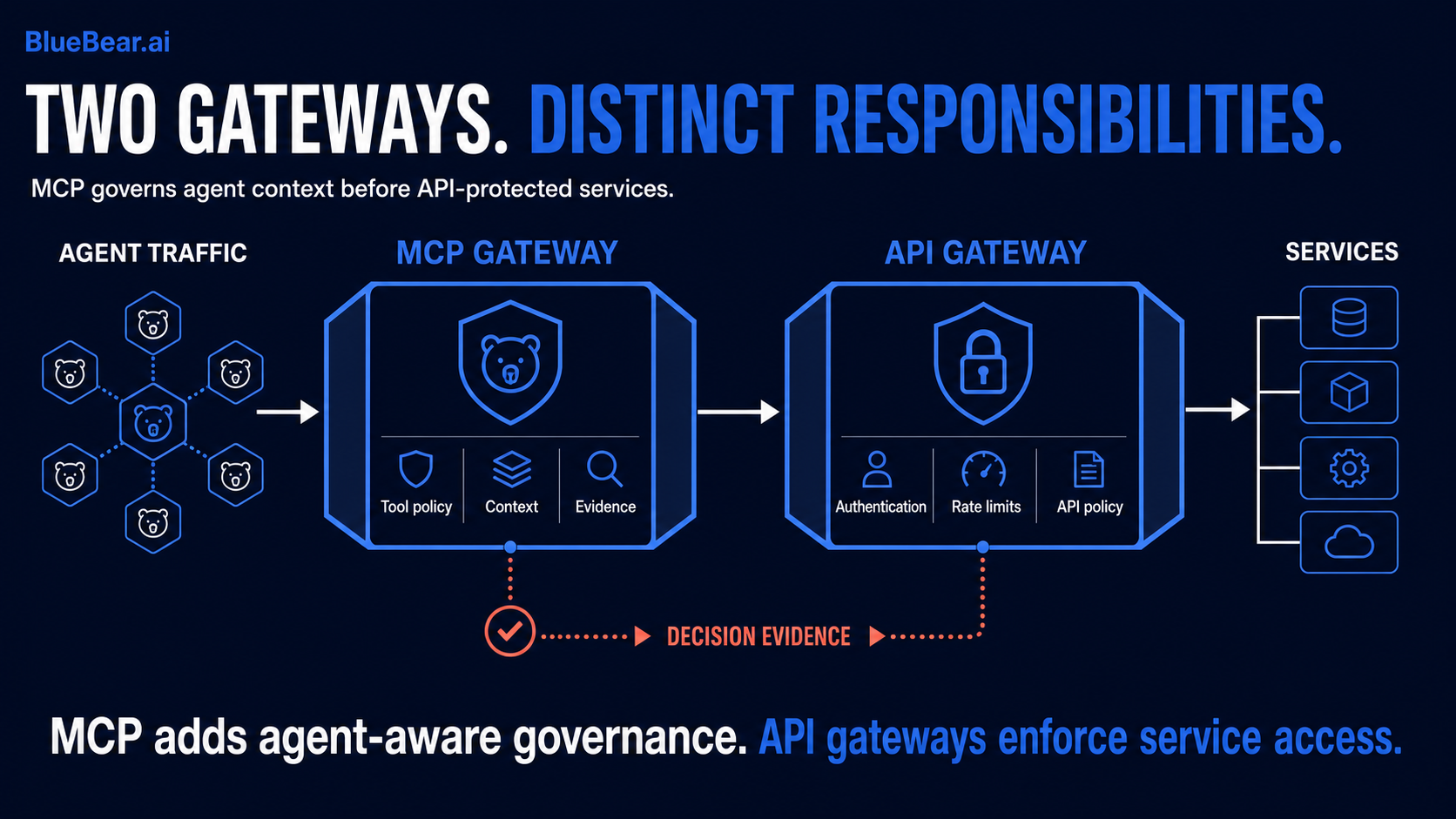
Managing AI agent access to critical enterprise services introduces new security and governance challenges, demanding fresh architectural thinking.
Enterprises have long relied on API gateways to manage and secure access to their backend services. These gateways excel at governing requests from applications and users, ensuring proper authentication, authorization, and rate limiting. However, the rise of autonomous AI agents introduces a different kind of traffic and control problem. API gateways govern service requests, but agent tool use carries model context, delegated identity, tool semantics, and dynamic plans. This fundamental shift means the control points for AI agent traffic must evolve.
This article compares the distinct roles of API gateways and MCP gateways, highlighting how they serve different needs without replacing one another. We will examine critical distinctions in traffic shape, identity, discovery, policy context, observability, and audit.
Understanding API Gateways
An API gateway acts as a single entry point for all client requests into an application. It handles routing, composition, and protocol translation. For instance, an API gateway can aggregate multiple service calls into a single response, simplifying client-side development. It also enforces security policies like authentication and authorization based on the client's identity.
Understanding MCP Gateways
An MCP gateway governs interactions for AI agents that use tools and access resources. MCP stands for Model Context Protocol, a specification designed for stateful session protocols focused on context exchange and sampling coordination between AI clients and servers. Unlike traditional API calls, agent interactions involve dynamic plans, delegated identities, and rich context about the agent's goals and previous actions.
Traffic Shape: Request-Response vs. Contextual Sessions
API Gateway Traffic
API gateways primarily handle discrete, stateless request-response traffic. Each request is typically independent, carrying enough information for the server to process it. For example, a mobile app requests user data, and the API gateway routes it to the correct microservice.
MCP Gateway Traffic
MCP gateways manage session-oriented, stateful interactions. AI agents often engage in multi-turn conversations or execute complex workflows. These interactions build context over time, which influences subsequent actions and tool use. The traffic shape reflects this continuous exchange of context, delegated identity, and dynamic plans, rather than isolated calls.
Identity: User/Application vs. Delegated Agent
API Gateway Identity
API gateways primarily deal with human user or application identities. Authentication confirms who is making the request, and authorization determines what resources they can access. Credentials and permissions are scattered across various systems, making comprehensive management a challenge. This often leads to a pain point where credentials and permissions are scattered, complicating security posture.
MCP Gateway Identity
MCP gateways manage delegated identities. An AI agent acts on behalf of a human user or another system, inheriting certain permissions. This means the gateway must validate not just the agent's identity, but also the context of the delegation. MCP security guidance forbids token passthrough and recommends validating that tokens are issued specifically for the receiving MCP server 1. This prevents an agent from simply reusing an unverified token, ensuring robust security.
Discovery: Static Endpoints vs. Dynamic Tooling
API Gateway Discovery
API gateways manage access to a set of well-defined, often static API endpoints. Service discovery is about finding the correct backend service for a known API path. Developers configure these routes, and they change less frequently.
MCP Gateway Discovery
MCP gateways facilitate dynamic tool discovery for AI agents. Agents explore and utilize various tools and resources based on their current task and available capabilities. This requires a gateway that can understand tool semantics and manage access to a continually evolving set of functionalities. Tool autonomy expands faster than policy coverage, presenting a significant pain point for governance. The MCP gateway helps to align this autonomy with defined policies.
Policy Context: Resource Access vs. Agent Intent
API Gateway Policy
API gateway policies typically focus on resource access. Can this user/application read this data or invoke that function? Policies are often granular to specific API endpoints or data schemas.
MCP Gateway Policy
MCP gateways operate on a richer context, including agent intent, model context, and tool semantics. Decisions are not just about what an agent can access, but why it's trying to access it and how it plans to use the information. The MCP architecture assigns hosts responsibility for connection permissions, authorization decisions, policy enforcement, and isolation while servers expose focused resources, prompts, and tools 2. This enables more intelligent and context-aware governance.
Observability: Request Logs vs. Session Traces
API Gateway Observability
API gateways provide request logs, detailing who accessed what, when, and with what result. These logs are crucial for monitoring and troubleshooting. However, a pain point exists because logs do not preserve authorization context, making it harder to understand the full security implications of an action.
MCP Gateway Observability
MCP gateways offer richer session traces. These traces capture the entire interaction history of an AI agent, including its reasoning, tool choices, and delegated actions. This deep visibility is essential for understanding agent behavior, debugging complex workflows, and providing comprehensive audit trails that preserve full authorization context.
Audit: Transactional Records vs. Contextual Evidence
API Gateway Audit
API gateway audit trails consist of transactional records. They prove that a specific API call occurred at a certain time with particular parameters. These records are fundamental for compliance but may lack the broader context of a multi-step operation.
MCP Gateway Audit
MCP gateways provide contextual evidence for audit. This includes not just the final action, but the entire chain of reasoning and delegated authority that led to it. This level of detail is critical for AI governance, especially in regulated operations, enterprise software, and managed services, where proving the 'why' behind an agent's action is as important as the 'what'.
BlueBear's Approach: Complementary Governance
BlueBear understands that enterprises do not operate in a vacuum. Instead of replacing existing infrastructure, BlueBear positions MCP governance alongside existing API management, preserving established service controls. This approach allows organizations to leverage their current investments in API gateways while introducing the specialized control points needed for AI agent platforms.
The BlueBear AI agent platform leverages MCP gateways to specifically address the unique governance requirements of autonomous agents. This includes managing delegated identity, enforcing context-aware policies, and providing comprehensive session traces for audit. By separating these concerns, BlueBear ensures that traditional API traffic remains protected by established API gateway controls, while agent traffic receives the nuanced governance it requires.
For example, when an AI agent operating on the BlueBear platform needs to access a customer database through an API, the request first passes through the MCP gateway. Here, the agent's intent, delegated permissions, and interaction context are evaluated. Once approved, the request then proceeds to the existing API gateway, which applies its established controls for the backend service. This layered approach ensures both types of traffic are optimally governed.
Practical Diagnostic Checklist
To evaluate your current workflow and determine the need for specialized MCP governance, consider these questions:
- Are your current logs capturing the full authorization context for AI agent actions?
- Do you have clear policies governing an AI agent's dynamic tool discovery and use?
- Are you able to trace the full chain of delegated identity from a human user to an AI agent's final action?
- Is your current security posture adequately addressing the pain point where credentials and permissions are scattered across agent tools and backend services?
- Can you confidently audit the 'why' behind an AI agent's decision to use a specific tool or access sensitive data?
- Does your current gateway infrastructure struggle with the pain point of tool autonomy expanding faster than policy coverage?
If you answered no to several of these, it's time to re-evaluate your architecture.
Next Steps
Understanding the distinct roles of API and MCP gateways is crucial for securing and governing AI agent operations effectively. The differences in traffic shape, identity, discovery, policy context, observability, and audit capabilities necessitate a dual-gateway strategy for comprehensive control. Before adding another tool, it's essential to understand where these control points sit in your enterprise. Diagram where API and MCP gateways sit in one enterprise request path.
Questions people actually search for
- what is the difference between an mcp gateway and an api gateway
An API gateway governs service traffic such as routes, tokens, rates, and network policy. An MCP gateway additionally understands agent tools, delegated identity, tool schemas, action scope, approvals, credential resolution, and evidence about why an agent invoked an operation.
- do ai agents need both an api gateway and an mcp gateway
Often yes because they control different layers. The API gateway remains useful for network and service policy, while the MCP gateway governs which agent may use which named tool operation, under whose authority, and with what evidence.
- is an api gateway enough to secure ai agent tool calls
Not by itself when authorization depends on agent, workspace, delegated purpose, tool semantics, material parameters, or human approval. A conventional gateway can enforce a route and token without understanding whether the planned agent action was permitted.
- where should mcp authorization be enforced
Enforce it at the execution boundary before resolving the upstream credential or invoking the tool. Revalidate token audience, actor, tenant, workspace, agent, operation, resource, approval, and policy there, then record the decision and downstream receipt.