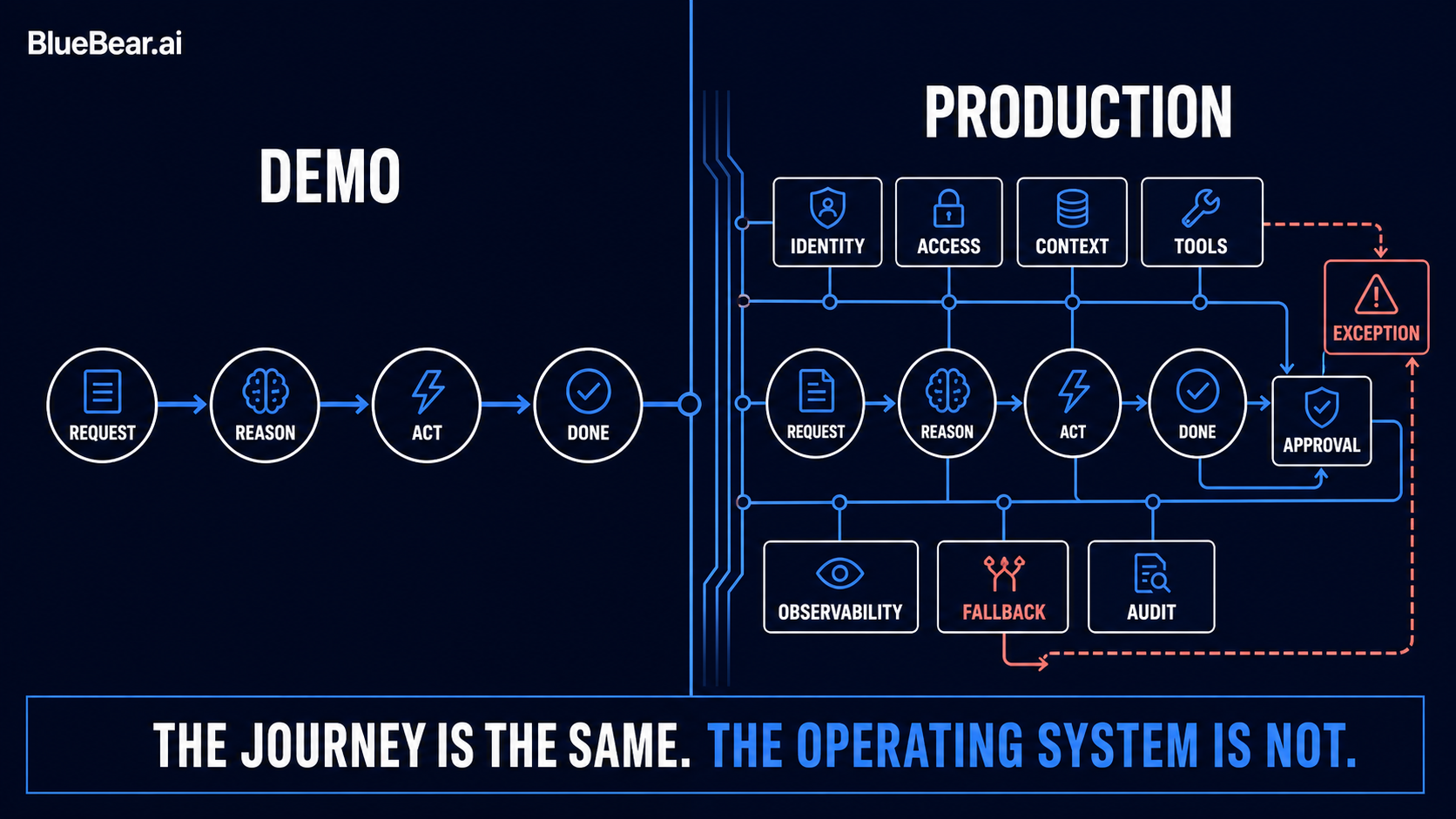
AI agent demos dazzle with potential, but real operations often expose a complex, costly reality that stalls adoption.
For many organizations, the promise of AI agents is immense. These autonomous software programs, designed to perform tasks or achieve goals with minimal human intervention, offer visions of seamless automation and unprecedented efficiency. An AI agent can perceive its environment, make decisions, and take actions, leveraging large language models (LLMs) to reason through tasks and orchestrate tools. Demos showcase these agents completing complex workflows flawlessly, with impressive speed. However, the critical leap from a captivating demonstration to a production-ready, scalable, and cost-effective operation is frequently fraught with unseen challenges. What appears simple in a controlled environment can become deeply complex and expensive under the pressure of real-world operations.
The Representative Operating Scenario: A Launch Day Reality Check
Consider a familiar scenario: a new AI agent, designed to automate initial customer support triage, has just been deployed. During development, rigorous testing and polished demonstrations revealed an agent capable of expertly routing inquiries, summarizing customer issues, and even suggesting potential resolutions. Project stakeholders, from AI Product Directors to Operations Directors, were genuinely impressed; the path to broad launch seemed not only clear but also exceptionally promising.
On the day of its full operational rollout, however, the AI agent’s smooth demo performance begins to unravel. Customer inquiries queue unexpectedly, creating backlogs. Some requests time out, requiring urgent manual intervention and costly retries. The agent encounters intermittent permissions issues, blocking access to crucial customer databases or internal knowledge bases. Unforeseen exceptions, triggered by unusual request formats, flood the system, demanding immediate human review to prevent service disruption.
Critically, throughout this escalating situation, there is no clear, comprehensive operational evidence. It is unclear *why* issues occur, *which* specific tool call failed, *what* data was missing, or *who* owns the immediate resolution. This scenario illustrates a core tension:
A compelling demo hides queues, retries, permissions, exception handling, handoffs, and ownership that appear under real operating pressure.
The dazzling front-end performance, so convincing in a controlled demo, inadvertently masked the intricate, often fragile, operational scaffolding required to sustain the agent's functionality at scale.
The Hidden Costs of "Demo Success"
Operational complexities are more than technical glitches; they translate directly into significant, often overlooked, business costs, especially for FinOps Leads and Heads of AI.
Provider Invoices Lack Workflow Attribution
When an AI agent workflow spans multiple cloud services and APIs, correlating charges back to specific agent workflows becomes nearly impossible. Cloud provider invoices often present a consolidated bill. Without granular, workflow-specific telemetry, FinOps Leads struggle to answer fundamental questions: What is the true cost of completing a single customer support ticket via our agent? Which external API calls drive the most expense? Are we overpaying? This lack of attribution makes accurate cost optimization speculative, and budgeting for AI agent operations an ongoing exercise in estimation.
Demo Success is Confused with Production Readiness
A successful demonstration proves technical feasibility in ideal conditions. It rarely validates an AI agent's true production readiness. Production demands far more: resilience to outages, comprehensive observability for real-time diagnosis, strict security and compliance adherence, and scalable performance under load. Without robust operational controls for these factors, technically sound agents will falter in real-world scenarios, leading to disruptions and eroded trust.
Retries and Review Labor Hide True Unit Cost
Every agent failure, retry, or human intervention for review or correction adds costs. These hidden activities inflate the true unit cost of an AI agent's operation. An agent designed for automation can become an unmanaged cost center if it demands constant human oversight, manual data correction, or repeated reruns. This includes time spent diagnosing failures, compute resources for retried executions, and labor hours for manual output review. Organizations need precise, evidence-backed insights into these overheads to control AI investments.
Leading industry frameworks underscore these concerns. The Microsoft Cloud Adoption Framework states that centralized oversight and lifecycle management are essential "to address shadow agent proliferation, budget overruns, security gaps, retirement, and resource allocation." Similarly, the AWS Agentic AI Lens treats "prototypes-to-production operations, modularity, observability, graceful degradation, human oversight, and cost awareness" as "durable design concerns." These frameworks signal a clear industry consensus: rigorous operational discipline is an absolute prerequisite for successful AI agent deployment at scale.
Bridging the Gap: The BlueBear Approach to Governed AI Agent Operations
The transition from demo to scalable, production-ready AI agents requires a shift in focus. It moves beyond observing an agent's final output to understanding its complete operational journey. BlueBear offers a distinct advantage as an AI agent platform.
Unlike systems offering only a transcript of an agent's final answer, BlueBear begins with the session, runtime, tool, approval, and recovery evidence a production operator needs—not the demo transcript alone. Our approach provides:
- **Granular Workflow Visibility:** BlueBear’s governed agent runtime captures every step: tool invocations, inputs, outputs, and human-in-the-loop decisions. This audit trail offers unparalleled transparency into agent behavior.
- **Accurate Cost Attribution and Control:** With detailed session evidence, BlueBear’s MCP gateway enables FinOps Leads to connect compute and API costs directly to specific agent tasks and business workflows. This eliminates opaque billing, providing transparency into true, granular costs for precise optimization.
- **Proactive Exception Handling and Recovery:** Engineered for resilience, the BlueBear platform logs and surfaces exceptions with rich context for faster diagnosis and resolution. This reduces constant manual oversight and minimizes costly retries.
- **Auditable Handoffs and Permissions:** BlueBear securely records all human approvals, interventions, and permission checks. Operations Directors gain confidence that agents operate within predefined boundaries and regulatory requirements, maintaining a clear audit chain.
BlueBear reframes AI agent deployment as an ongoing, disciplined operational process. It provides the infrastructure to run agents with governed infrastructure, secure integrations, comprehensive evidence, and rigorous cost controls, transforming potential chaos into managed, measurable, and reliable AI operations.
BlueBear Demo-to-Production Release Gate
A persuasive demo proves that a happy path can work. A production release decision needs evidence that the workflow remains bounded, recoverable, affordable, and owned when the happy path stops. BlueBear uses the following gate against one versioned workflow.
| Gate | Pass evidence | Stop condition |
|---|---|---|
| Outcome | Accepted-output definition, sample window, rejection reasons, and downstream reconciliation. | Agent completion is treated as business acceptance. |
| Authority | Actor, tenant, workspace, tool/action scope, credential boundary, and denied-action test. | The agent can expand scope through prompt instructions. |
| Failure | Timeout, retry, duplicate-side-effect, approval expiry, and downstream repair tests. | No owner or safe terminal state exists for an exception. |
| Economics | Model, tool, runtime, retry, review, and exception cost per accepted outcome. | Only provider-call cost is measured. |
| Operations | Named service owner, queue owner, incident path, budget authority, and retirement procedure. | A committee is accountable but no person can stop the workflow. |
The gate is deliberately binary for release: missing evidence is a production risk, not a feature that can be inferred from the demo.
A Practical Diagnostic Checklist for AI Agent Production Readiness
Before moving any AI agent from demo to full production, a thorough operational assessment is crucial. Consider these questions to evaluate your readiness and identify potential gaps:
- **Evidence Collection:** Can you retrieve a complete, immutable audit trail of every agent decision and action, including tool calls, intermediate outputs, and system interactions?
- **Cost Visibility & Attribution:** Can you accurately attribute every dollar spent on an agent's operation—compute, API calls, human review—to a specific business workflow or outcome?
- **Exception Management & Recovery:** What happens when your agent encounters an error or unexpected input? Is there an automated recovery path, or does it require manual intervention?
- **Human-in-the-Loop Processes:** How are human approvals and interventions managed, logged, and integrated into the agent's workflow? Is this process auditable?
- **Performance Monitoring & Alerting:** Can you continuously track and alert on critical metrics like agent latency, throughput, error rates, and manual intervention frequency?
- **Ownership and Accountability:** Is there a clearly defined owner for each stage of the agent's lifecycle, from deployment to maintenance and retirement?
- **Security, Compliance & Governance:** Are all agent interactions with sensitive data and systems comprehensively logged, secured, and compliant with regulations?
Conclusion & Your Next Practical Step
The transformative promise of AI agents is within reach, but their successful operationalization demands meticulous rigor. Moving beyond the captivating allure of a seamless demonstration means directly confronting the complex realities of production environments. It requires a deep understanding of the queues, retries, permissions complexities, and comprehensive exception handling that define true, reliable, and cost-effective real-world performance.
To truly unlock the value of AI agents, your next practical step should be clear and focused: Map one successful demo against the operational controls it would need for a real launch. Take the time to evaluate the current workflow before adding another tool. This critical, evidence-led assessment will illuminate the true effort required for AI agent success at scale, setting a solid foundation for sustainable innovation.