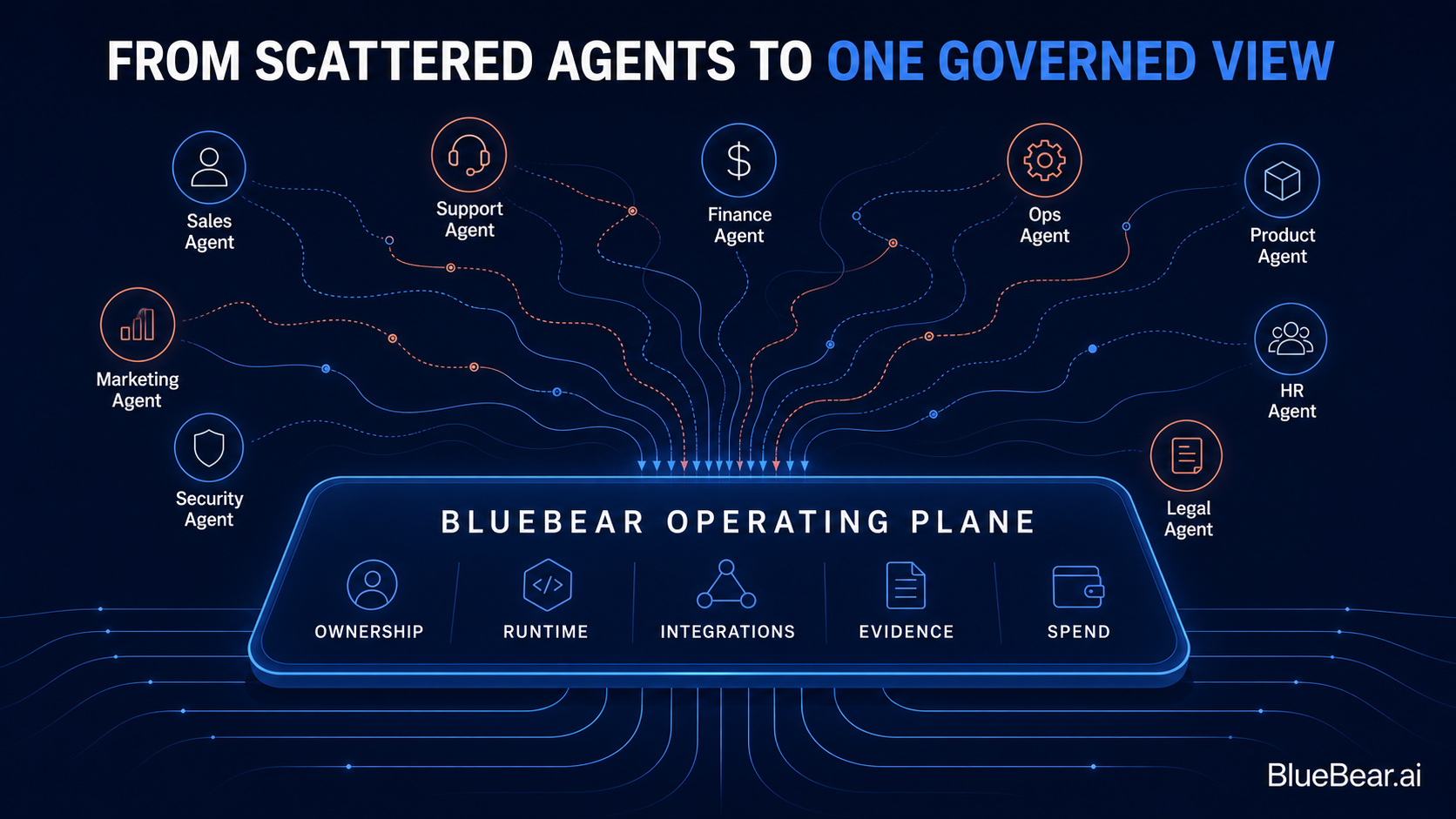
Teams launch AI agents faster than operations can track ownership, tools, costs, or retirement plans.
The rapid adoption of artificial intelligence (AI) agents across enterprises brings both promise and peril. While these intelligent automation tools offer significant productivity gains, their proliferation often outpaces central IT and finance's ability to govern them. This creates a growing problem: shadow AI agents. These are AI agents, or automated systems leveraging AI models, developed and deployed by individual teams without formal oversight or integration into the company's central operational framework. The result is a significant visibility gap, transforming isolated pilot projects into an unmanaged, costly, and risky portfolio.
This article explores the challenges posed by shadow AI agent sprawl, from hidden costs to operational inefficiencies. We will outline a framework for viewing agents as a managed operational estate and introduce a practical approach to gain control. Understanding these dynamics is crucial for any Head of AI, AI Product Director, FinOps Lead, or Operations Director aiming for scalable, secure, and cost-effective AI adoption.
The Unseen Estate: Understanding Shadow AI Agent Sprawl
The ease with which modern AI tools enable teams to build and deploy agents is a double-edged sword. While it democratizes innovation, it also bypasses established processes for inventory, management, and cost attribution. This leads directly to several critical pain points:
- Provider invoices lack workflow attribution: Without a central system to link agent usage to specific business workflows, cloud and model provider invoices become opaque. Finance teams struggle to attribute costs accurately, leading to budget overruns and difficulty in demonstrating return on investment for AI initiatives.
- Demo success is confused with production readiness: A successful proof-of-concept or departmental demo often masks the complexities of production deployment. Factors like scalability, security, compliance, and ongoing maintenance are frequently overlooked in the enthusiasm of initial success. This can lead to unexpected failures and increased operational burden later.
- Retries and review labor hide true unit cost: Agents operating outside central governance often incur hidden costs. Manual interventions, repeated attempts to complete tasks, and extensive human review labor inflate the true cost of an agent's operation. These inefficiencies remain invisible when not tracked against a clear operational baseline.
Microsoft’s Cloud Adoption Framework highlights this precise challenge. It stresses that centralized oversight and lifecycle management are essential. This is critical for addressing shadow agent proliferation, preventing budget overruns, closing security gaps, and ensuring proper resource allocation and retirement processes Microsoft Learn. Without such a framework, the enterprise loses control over a rapidly expanding and critical operational surface area.
From Isolated Pilots to a Governed Portfolio
The journey from experimenting with individual AI agent pilots to operating a mature, governed portfolio is not automatic. It requires a deliberate shift in mindset and operational strategy. Initial successes often come from agile, independent teams. But scaling these agents introduces new complexities. These include data privacy, security vulnerabilities, performance monitoring, and consistent cost tracking.
The AWS Agentic AI Lens provides valuable insights here. It treats the transition from prototypes to production operations as a key concern. Key considerations include modularity, observability, graceful degradation, human oversight, and acute cost awareness. These are durable design concerns that persist throughout an agent’s lifecycle AWS Well-Architected. Simply put, what works for a small team in isolation rarely scales effectively without a robust operational foundation.
Representative Operating Scenario: The Customer Support Triage Agent
Consider a scenario within a large enterprise software company. A customer support team, seeking to reduce response times, independently develops an AI agent. This agent triages incoming support tickets, categorizing them and suggesting relevant knowledge base articles. Initial tests are promising. The team celebrates reduced initial response times. The agent moves into a limited production rollout within their department. However, this success happens in a silo. The agent runs on a departmental cloud account. Its exact operational costs are buried in a larger invoice. Security reviews are minimal. When the agent occasionally misclassifies a critical ticket, the manual correction effort adds invisible labor. There is no central record of who built it, what tools it integrates with, or its true consumption profile. Expanding this agent to other support teams, or integrating it with new systems, becomes a series of ad-hoc challenges, not a streamlined process.
Bringing Order to the Agent Estate: The BlueBear Approach
Solving the shadow AI agent problem requires treating agents not as isolated scripts, but as a critical operational estate. This means establishing a clear framework for their lifecycle, governance, and cost. BlueBear, an AI agent platform, offers a distinct operating story here. BlueBear treats agents as an operational estate. Every agent belongs to a workspace, a governed agent runtime, an integration set, a session history, and a defined cost boundary.
How BlueBear Differs
BlueBear addresses the visibility gap by consolidating the operational aspects of AI agents. Instead of disparate teams managing their own uninventoried agents, BlueBear provides a central operating view. This platform ensures that an agent’s ownership, runtime environment, and integrations are transparent from day one. Crucially, its MCP gateway and governed agent runtime offer control over resource consumption and expenditure. This means that session history and cost boundaries are not afterthoughts but integral components of each agent’s lifecycle. This convergence of ownership, runtime, integrations, evidence, and spend transforms scattered team-owned agents into a governable portfolio.
This approach directly tackles the pain points of unallocated costs and ambiguous production readiness. By enforcing structured deployment within a controlled environment, BlueBear provides the evidence needed to move beyond demo success. It ensures that the true unit cost of an agent, including retries and review labor, becomes measurable and manageable. BlueBear acts as the central intelligence for your AI agent operations, fostering both innovation and accountability.
Practical Diagnostic Checklist: Managing Your Agent Estate
Gaining control over shadow AI agents starts with understanding your current landscape. Use this checklist to audit your enterprise’s agent estate:
- Identify agent owners: Can you name the owner and responsible team for every AI agent currently in use, whether in pilot or production?
- Inventory agent tools and technologies: Do you have a comprehensive list of the underlying AI models, platforms, and third-party tools each agent utilizes?
- Track agent credentials and access: Are all agent credentials and access permissions centrally managed and regularly audited for security compliance?
- Monitor agent runtime environments: Can you pinpoint where each agent is hosted and its specific runtime environment?
- Attribute agent costs: Do your financial systems allow for granular attribution of AI agent spend to specific teams, projects, or workflows? Are provider invoices transparent enough to break down agent-specific costs?
- Assess production readiness: For agents currently in use, have they undergone formal security, compliance, and scalability reviews beyond initial demos?
- Measure true operational cost: Are you accurately measuring the combined cost of compute, model usage, and any associated manual review or retry labor for each agent?
- Define retirement policies: Do you have clear guidelines and processes for decommissioning agents that are no longer needed or performing effectively?
If you find significant gaps in these areas, your enterprise is likely experiencing the hidden costs and risks of shadow AI agent sprawl. Addressing these gaps is not about stifling innovation but about building a sustainable and secure foundation for your AI strategy.
The proliferation of AI agents presents a profound opportunity for enterprise transformation. However, unmanaged agent sprawl carries significant hidden costs and operational risks. Moving from isolated, ad-hoc deployments to a governed, observable agent estate is imperative. This requires a shift towards treating agents as a core operational asset, one that demands the same rigor and visibility as any other critical piece of enterprise infrastructure. Understanding the full lifecycle of your agents—from inception to retirement, including their ownership, runtime, integrations, performance, and cost—is the only way to harness their full potential safely and effectively.
Audit your current agent estate and identify unmanaged owners, tools, and spend before the next rollout.