AI agent failures cause costly delays; traditional logs offer few answers.
Organizations are rapidly deploying AI agents to automate complex tasks, from customer support to data analysis. Yet, as these systems move from pilots to production, a critical challenge emerges: how do you diagnose and resolve incidents when an AI agent behaves unexpectedly? Conventional logging systems, designed for deterministic software, often fall short. This leaves engineering leaders, platform leads, and AI architects struggling with fragmented infrastructure and elusive root causes when failures are difficult to reconstruct end to end.
The problem is not merely a lack of data. It is a lack of the right context. To effectively manage and secure an AI agent platform, you need a comprehensive view of every decision and action an agent takes.
Why Conventional Logs Fall Short for AI Agents
Traditional application logs record events. They tell you *that* something happened. For AI agents, however, we need to understand *why* it happened. This requires visibility into the agent’s reasoning process, which conventional logs routinely omit.
Missing Critical Data Points
When an AI agent malfunctions, the standard log stream typically lacks crucial details necessary for incident investigation. These include:
- Changing prompts: How did the user's initial request evolve, or how did the agent iteratively refine its prompts?
- Tool arguments: What exact parameters were passed to external tools or APIs?
- Approvals: Was human intervention requested or provided? What was the approval decision?
- Retries: How many times did an action fail and get reattempted? What changed between attempts?
- Artifact lineage: Which intermediate outputs or data assets were created or modified by the agent? How do they relate to the final outcome?
Without this session-level evidence, reconstructing an incident becomes a forensic nightmare. It is like trying to solve a crime by only looking at door alarms, ignoring every conversation and decision made inside the building.
The Need for End-to-End Traceability
The complexity of AI agents, which combine large language models (LLMs), external tools, and dynamic decision-making, demands a new approach to observability. The AWS agentic design principles highlight this, calling for "end-to-end traceability across reasoning, tools, memory, and agent handoffs." This comprehensive telemetry supports critical analysis for cost, quality, security, and reliability. This is especially vital when agent infrastructure is fragmented across teams, making a unified view challenging.
Reconstructing an AI Agent Incident: A Minute-by-Minute Scenario
Consider a representative operating scenario involving an AI agent designed to automate a routine IT support task: provisioning a new software license based on a user request. Let us trace an incident where the license was not provisioned correctly.
The Incident Timeline
09:00 AM - User Request: A user submits a ticket: "I need a new license for DataViz Pro."
- Evidence needed: User ID, initial prompt text.
09:01 AM - Agent Initiates: The BlueBear governed agent runtime receives the request. The initial agent, a "Request Clarifier," analyzes the prompt to identify missing information.
- Evidence needed: Agent ID, session ID, initial prompt, model used, timestamp.
09:02 AM - Clarification Loop: The Request Clarifier agent determines "DataViz Pro" is ambiguous. It uses a tool to query the approved software catalog and finds "DataViz Pro Standard" and "DataViz Pro Enterprise." It formulates a follow-up question to the user.
- Evidence needed: Tool call (name, arguments), tool output, agent's generated prompt for the user, retry count (if any), cost associated with tool call and model inference.
09:03 AM - User Responds: User replies: "Standard version, please."
- Evidence needed: User response, correlation to previous agent prompt.
09:04 AM - Handoff to Provisioning Agent: The Request Clarifier agent, having gathered sufficient information, hands off the refined request ("Provision DataViz Pro Standard for User X") to a "License Provisioner" agent via the BlueBear MCP gateway.
- Evidence needed: Handoff event (source agent, target agent, payload), revised prompt, context passed between agents, confirmation of MCP gateway routing.
09:05 AM - Provisioning Attempt: The License Provisioner agent attempts to use an internal API tool to provision the license. The tool returns an error: "Insufficient permissions for requested license type."
- Evidence needed: Tool call (name, arguments), tool error message, API response, model inference attempting to interpret the error.
09:06 AM - Escalation: The License Provisioner agent, unable to self-correct, escalates the issue. It generates a summary of the problem and suggests a human approval step to a team lead.
- Evidence needed: Escalation event (target human/team, generated summary), proposed action, model inference leading to escalation.
09:07 AM - Human Approval: The team lead reviews the escalation and approves the provisioning with elevated privileges.
- Evidence needed: Approval event (approver ID, timestamp, decision), authorization context change.
09:08 AM - Retry & Success: The License Provisioner agent retries the provisioning tool call, this time successfully. It then generates a confirmation message to the user.
- Evidence needed: Retry event, successful tool call, final tool output, final user message, end-to-end cost for the session.
This representative incident highlights why conventional logs are inadequate. To truly understand the failure at 09:05 AM and the subsequent resolution, you need to connect the dots across multiple agent interactions, tool calls, and even human approvals. BlueBear uses session-centered evidence to connect context, tool calls, costs, approvals, errors, and outputs, providing this crucial linkage.
The BlueBear Approach: Session Replay for True Traceability
The core problem for VP Engineering, Platform Engineering Leads, and AI Infrastructure Architects is that agent infrastructure is fragmented across teams. This fragmentation makes reconstructing failures end to end an almost impossible task. BlueBear addresses this by providing a governed agent runtime that centralizes the observability of agent sessions.
Comprehensive Session-Centered Evidence
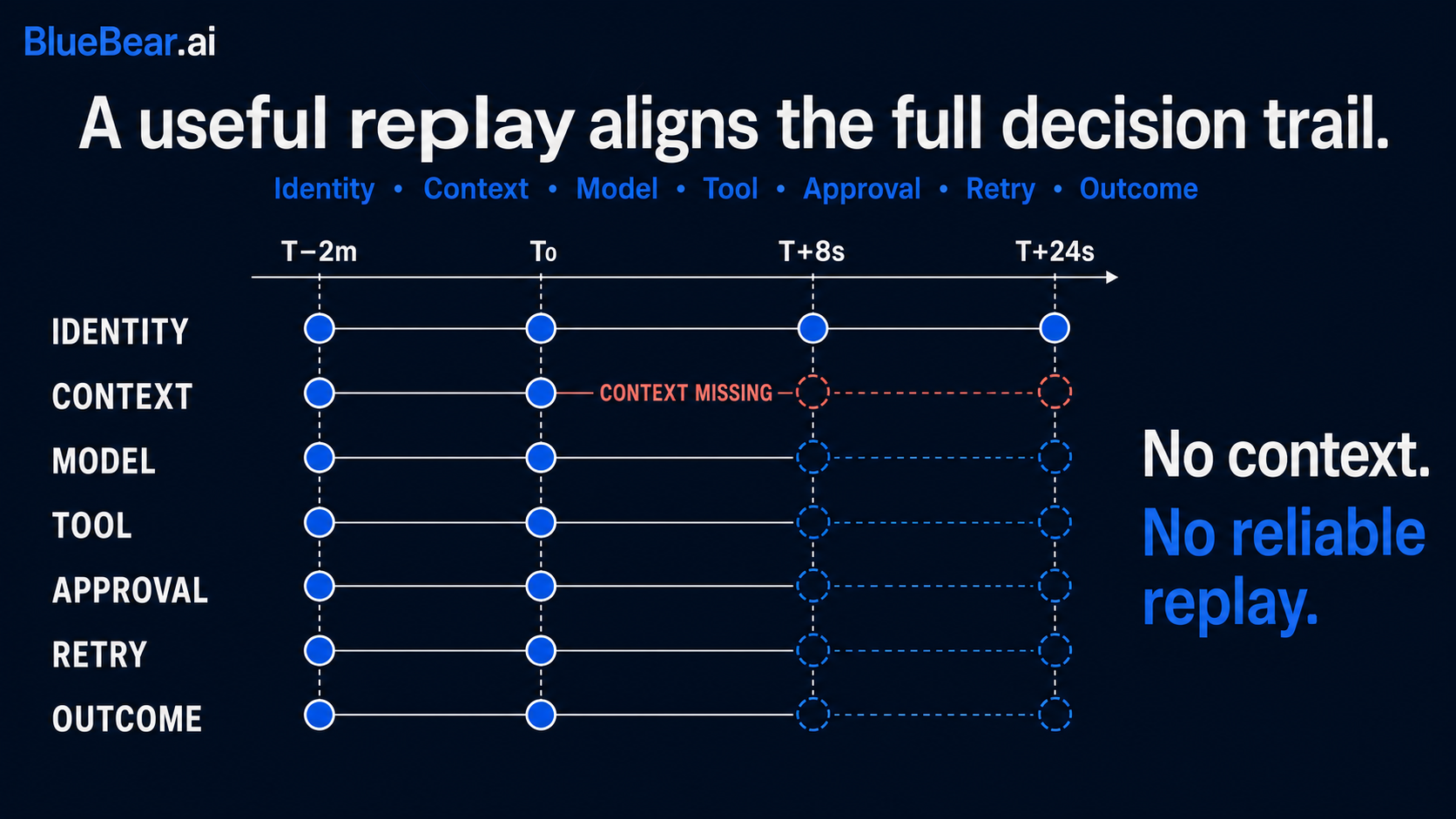
Unlike simple log aggregators, BlueBear's platform captures a rich, session-centered stream of evidence. This includes:
- Identity: Who initiated the session, and which agents participated?
- Context: What was the full state, including evolving prompts and dynamic memory?
- Model: Which LLMs were used at each step, and with what parameters?
- Tool: Every tool call, its arguments, and its precise output or error.
- Approval: Records of all human interventions and their impact.
- Retry: Detailed history of failed attempts and subsequent retries.
- Outcome: The final result and any artifacts generated.
This approach moves beyond mere logging. It creates a comprehensive "session replay" that allows engineers to literally step through an agent's entire decision path, minute by minute. This unified view directly tackles the pain point of failures being difficult to reconstruct end to end.
Built for Reliability and Governance
The AWS Agentic AI Lens outlines practices crucial for reliability, such as "behavior versioning, rollback, anomaly monitoring, fault isolation, human escalation, automated recovery, and break-glass runbooks" (AWS Agentic AI Lens - Reliability). BlueBear's MCP gateway and governed agent runtime are designed with these principles in mind. By providing a centralized control plane for agent execution, BlueBear helps ensure predictable agent behavior and robust incident response capabilities. Tenant isolation and capacity controls, often delayed in fragmented infrastructures, are core to the BlueBear platform, ensuring enterprise-grade stability and security.
What BlueBear Preserves for Session Reconstruction
A useful replay is not a screen recording. BlueBear correlates the state required to answer who requested the work, which policy applied, what the model and tools did, where the run changed state, and which outcome was accepted. The table below is the evidence contract; it is not presented as a sanitized customer trace.
| Evidence group | Fields to preserve | Incident question answered |
|---|---|---|
| Request context | Session, tenant, workspace, actor, agent, workflow version, and correlation ID. | Whose boundary and which version produced the run? |
| Policy and routing | Effective model policy, eligible route, exclusions, fallback rule, and policy result. | Why was this model or fallback allowed? |
| Tool execution | MCP connection, tool/action, credential reference, request receipt, status, and result metadata. | What external action ran, and under which authority? |
| Human control | Approval requirement, reviewer, decision, reason, and elapsed time. | Where did a person permit, change, or reject the work? |
| Economics and outcome | Tokens, estimated cost, retries, terminal state, accepted outcome, and downstream identifier. | What did the incident cost and did it create a valid result? |
A customer-safe annotated trace should be published only after source selection and redaction approval. Until then, this explicit contract is more trustworthy than presenting invented production telemetry.
A Practical Diagnostic Checklist for Your AI Agent Workflow
Before adding another tool to a fragmented stack, evaluate your current workflow against these diagnostic questions:
- Can you trace a user request from its inception through every agent interaction and tool call, even across different teams?
- When an agent fails, can you instantly see the exact prompt, all tool arguments, and the raw tool output that led to the error?
- Are human approvals and overrides captured and linked to the agent's decision path?
- Do you have visibility into retry attempts and what changed between a failed attempt and a successful one?
- Can you reconstruct the full lineage of data artifacts generated or modified by an agent during a session?
- Is your AI agent infrastructure providing clear tenant isolation and capacity controls?
- Can you calculate the end-to-end cost of a single agent session, encompassing all model inferences and tool calls?
If your answers to these questions are "no," your organization faces significant blind spots in managing AI agent incidents.
Conclusion
The operational demands of AI agents are fundamentally different from traditional software. Relying on conventional logs creates unacceptable risks and delays in incident response. A true AI agent session replay provides the end-to-end traceability required to quickly diagnose problems, understand complex agent behaviors, and maintain the reliability of your AI agent platform. This shift is not merely about better debugging; it is about establishing a foundation for trust and control over your autonomous systems.
Next Step: Run a tabletop incident and test whether the full agent decision path can be reconstructed.
Questions people actually search for
- what should an ai agent session replay capture
Capture stable run and step IDs, effective agent and workflow versions, model routes, tool arguments and receipts where permitted, approvals, retries, failures, artifacts, policy decisions, timing, cost, and final reconciliation state.
- does ai agent session replay require chain of thought
No. Incident replay should use structured decisions and observable events rather than hidden chain-of-thought. Preserve the inputs, plans, policy results, tool activity, approvals, outputs, and outcomes needed to explain what the system did.
- how do you protect sensitive data in ai session replay
Collect the minimum content needed, reference source records where possible, redact secrets, separate access to payloads from operational metadata, encrypt retained content, apply purpose-based retention, and record what was omitted.
- how does session replay help ai incident response
Replay creates a correlated timeline for containment and reconstruction. It helps responders identify affected sessions, credentials, tools, duplicate effects, missing evidence, and the last trusted state before deciding how to recover.