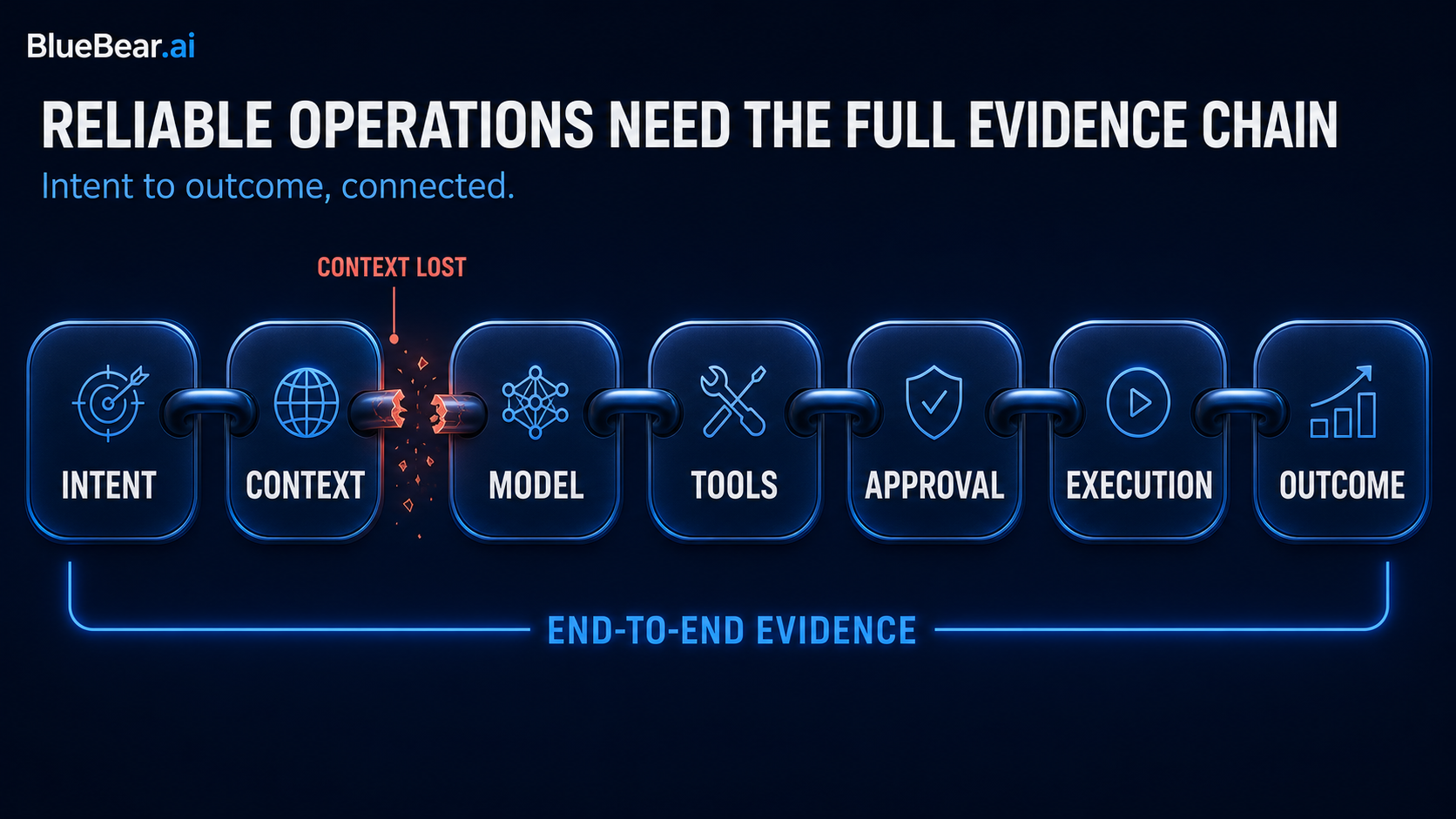
AI Agent Reliability Starts with an Evidence Chain, Not an Accuracy Score
An AI agent failure often lacks a clear culprit, disrupting operations and trust.
For VP Engineering, Platform Engineering Leads, and AI Infrastructure Architects, ensuring reliable AI agent operations is paramount. Many teams currently rely on aggregate accuracy scores. These scores, however, fail to explain which prompt, model, tool, approval, or artifact produced a failed business outcome. This lack of granular visibility creates significant challenges when diagnosing issues in complex, multi-component AI agent systems. Agent infrastructure, in many organizations, remains fragmented across teams. This fragmentation complicates end-to-end failure reconstruction.
The Illusion of Aggregate Accuracy Scores
An AI agent is an autonomous software entity that perceives its environment, makes decisions, and performs actions using tools and models. Evaluating its performance with a single aggregate accuracy score offers a high-level view. However, this metric masks the underlying mechanisms and potential points of failure. When an agent system does not deliver the expected result, an aggregate score offers no actionable insight. It cannot pinpoint if the large language model (LLM) misinterpreted the prompt, if a tool returned incorrect data, or if an approval step was missed. This opacity means failures are difficult to reconstruct end to end, leading to extended troubleshooting cycles and frustrated engineering teams.
The Need for an Evidence Chain: A Failed Operation Scenario
Consider a representative operating scenario: an AI agent is tasked with automating a customer support interaction. The agent uses an LLM to understand the customer’s query, a knowledge base tool to find relevant information, and an external API tool to update a customer record. Despite showing high accuracy in initial testing, a production agent fails to update a critical customer status. The aggregate accuracy score for the agent remains high overall. Yet, this specific failure is costly.
Without an evidence chain
, debugging this scenario is a significant challenge. An evidence chain provides a reconstructable record of every step an AI agent takes during a session. This includes the initial intent, the contextual information provided, the specific model invoked, the tools called, any human approval steps, the execution details, and the final outcome. Each link in this chain is crucial.
If the team only sees a failed outcome and a good aggregate score, they cannot determine if the LLM hallucinated, the knowledge base returned outdated information, or the external API call failed silently. This is why AWS agentic design principles emphasize the need for "end-to-end traceability across reasoning, tools, memory, and agent handoffs." This detailed telemetry is essential for understanding cost, quality, security, and reliability.
BlueBear's Approach: Governed Agent Runtimes and Reviewable Sessions
BlueBear addresses these challenges by organizing runtime activity around reviewable sessions
. A reviewable session explicitly connects model calls, tool usages, associated costs, human approval workflows, and generated artifacts. This approach transforms fragmented operational data into a cohesive, traceable narrative for every AI agent interaction.
Many enterprises struggle with agent infrastructure that is fragmented across teams. Different teams may use various tools, models, and deployment methods, making centralized visibility and governance nearly impossible. BlueBear offers a governed agent runtime that standardizes this infrastructure. This includes a robust MCP gateway (Multi-Cloud Proxy) for consistent access and control, regardless of where models or tools are hosted.
Furthermore, concerns around tenant isolation and capacity controls arriving late often plague early AI agent deployments. BlueBear's platform is designed with these enterprise-grade requirements in mind, providing the necessary controls from the outset. This ensures that agents operate within defined parameters, reducing unexpected behaviors and improving overall system stability.
The Anatomy of a BlueBear Session
A BlueBear session is more than just a log file. It’s a comprehensive record designed for full reconstructability. For each agent action, it captures:
- Intent: The initial goal or prompt given to the agent.
- Context: All relevant information available to the agent at the time of decision-making.
- Model Calls: Which LLM was invoked, with what parameters, and its exact response.
- Tool Usages: Details of every external tool call, including inputs, outputs, and any errors.
- Costs: Granular cost associated with each model inference and tool execution.
- Approvals: Records of any human-in-the-loop interventions or approvals.
- Artifacts: Any generated documents, code snippets, or data modifications.
This detailed record allows Platform Engineering Leads and AI Infrastructure Architects to replay a failed session, identify the exact point of deviation, and understand why the outcome occurred. It shifts the focus from broad accuracy metrics to precise, evidence-backed diagnostics.
BlueBear Reliability Evidence Packet
Reliability is the ability to explain and recover a workflow outcome, not a single aggregate accuracy number. BlueBear correlates the following evidence where each capability is enabled; the customer defines the acceptance and service thresholds.

| Layer | Minimum fields | Reliability question |
|---|---|---|
| Request | Correlation ID, tenant, workspace, actor, agent, and workflow version. | Which bounded system received the work? |
| Decision | Policy version, eligible route, selected model, exclusions, and fallback rule. | Why was this execution path allowed? |
| Action | MCP connection, tool/action, approval, idempotency key, attempt, and receipt. | Did an external side effect occur once, more than once, or not at all? |
| Terminal state | Success, denial, timeout, repair, rejection, or accepted outcome with downstream ID. | Did the workflow create a valid business result? |
| Economics | Latency, tokens, tool/runtime cost, retries, review, and exception handling. | Was recovery reliable at an acceptable operating cost? |
Reliability SLOs That Include the Business Outcome
Agent reliability is the probability that a versioned workflow produces an accepted outcome inside its authority and safety boundaries, within time and cost objectives. HTTP availability is necessary but insufficient.
| Indicator | Calculation |
|---|---|
| Accepted outcome rate | Business-accepted outcomes / initiated workflows. |
| Unsafe action rate | Executed actions outside policy or approval; this should be a stop condition. |
| Time to accepted outcome | Elapsed time including queue, retries, approvals and repair. |
| Recovery success | Failed runs reconciled without duplicate side effects / recoverable failures. |
| Evidence completeness | Runs with required identity, policy, tool, approval and outcome records / runs. |
Segment these indicators by workflow version, model route, tool, tenant and risk tier; aggregate averages hide regressions.
Practical Diagnostic Checklist for AI Agent Reliability
To move towards a truly reliable AI agent infrastructure, consider the following:
- Establish End-to-End Traceability: Can you reconstruct every step of an agent's decision-making and action sequence? This includes reasoning, tool calls, memory access, and inter-agent handoffs.
- Implement Behavior Versioning: Are prompts, tool definitions, and model selections versioned and auditable? The AWS Agentic AI Lens highlights behavior versioning as a key reliability practice.
- Monitor Anomalies: Do you have mechanisms to detect unexpected agent behaviors or outputs beyond simple error codes?
- Plan for Human Escalation: What are your established workflows for human intervention when an agent encounters an unrecoverable state or requires approval?
- Define Automated Recovery: Are there automated procedures for common failure modes, such as retries or fallbacks to alternative tools or models?
- Ensure Tenant Isolation: Is your agent infrastructure designed to prevent interference between different applications or users? This is critical for security and predictable performance, especially when tenant isolation and capacity controls arrive late in adoption.
- Centralize Observability: Do you have a unified view across all agent components, rather than siloed logs and metrics?
Moving Beyond Blind Trust
Shifting from reliance on high-level accuracy scores to a detailed evidence chain is not just a technical upgrade. It's a fundamental change in how enterprises approach AI agent reliability. It enables engineering leaders in enterprise software, AI platforms, and managed services to build and operate AI agent systems with confidence. The ability to precisely diagnose failures, understand agent behavior, and ensure governance transforms AI agents from experimental pilots into trusted, production-grade assets.
To truly understand the operational state of your AI agents, you need more than a score. You need an indisputable record.
Next Step: Choose one critical outcome and define the minimum evidence required to explain or replay it.
Questions people actually search for
- what is an ai agent reliability evidence chain
It is a linked record connecting the request and identity to policy, plan, model and tool execution, approvals, artifacts, failures, recovery, and accepted outcome. The links let an operator reconstruct one run without guessing across disconnected logs.
- why is an accuracy score not enough for ai agent reliability
An aggregate score cannot show which version, tool call, credential, approval, retry, or artifact caused one failed outcome. Reliability requires outcome-level evidence about authority, execution, recovery, latency, cost, and whether the business accepted the result.
- what records belong in an ai agent evidence chain
Record the initiating actor, tenant and workspace, agent and workflow version, effective policy, plan, model route, tool requests and receipts, approvals, retries, artifacts, terminal status, and accepted business outcome under stable identifiers.
- how do you test an ai agent evidence chain
Select one failed or denied workflow and reconstruct it from the outcome back to the requester. The test fails if a reviewer cannot identify authority, effective versions, executed side effects, missing events, and the final reconciliation state.