The problem
You run a freight brokerage with 25 people. Three AI vendors have pitched you a quoting tool this quarter. Each one sent a deck. Each deck says "secure", "accurate" and "enterprise-grade". None of them says what happens when a quote is wrong.
You pull out the vendor questionnaire your insurer gave you years ago. Half of it is about server rooms and password rules. None of it asks what the tool may do inside your load board, who checks its work, or how you get your money back.
So you do what most owners do. You pick the vendor whose salesperson answered fastest.
Why this keeps happening
Old software checklists were written for tools that sat there until a person used them. AI tools are different in four ways. They do work on their own. They can reach into your systems and change things. They often bill per use. And they usually rely on other companies underneath.
Some of what you are shown is not new at all. As of June 2025, Gartner warned about "agent washing": older chatbots and automation tools relabeled as AI agents. It estimated only about 130 of the thousands of companies selling AI agents are the real thing. It also expects more than 40 percent of AI agent projects to be canceled by the end of 2027, because of rising costs, unclear value or weak risk controls.
| What you did not check | What it costs you |
|---|---|
| What the tool may touch | A quoting tool that can also edit customer records |
| Whether you could try it first | A year of payments for something that did not fit |
| What happens to a wrong result | You absorb the bad quote and still pay for the tool |
| Who owns the output and your data | Your rate history improving someone else's product |
| How you leave | Months of notice, no export, and a login left open |
How to fix it
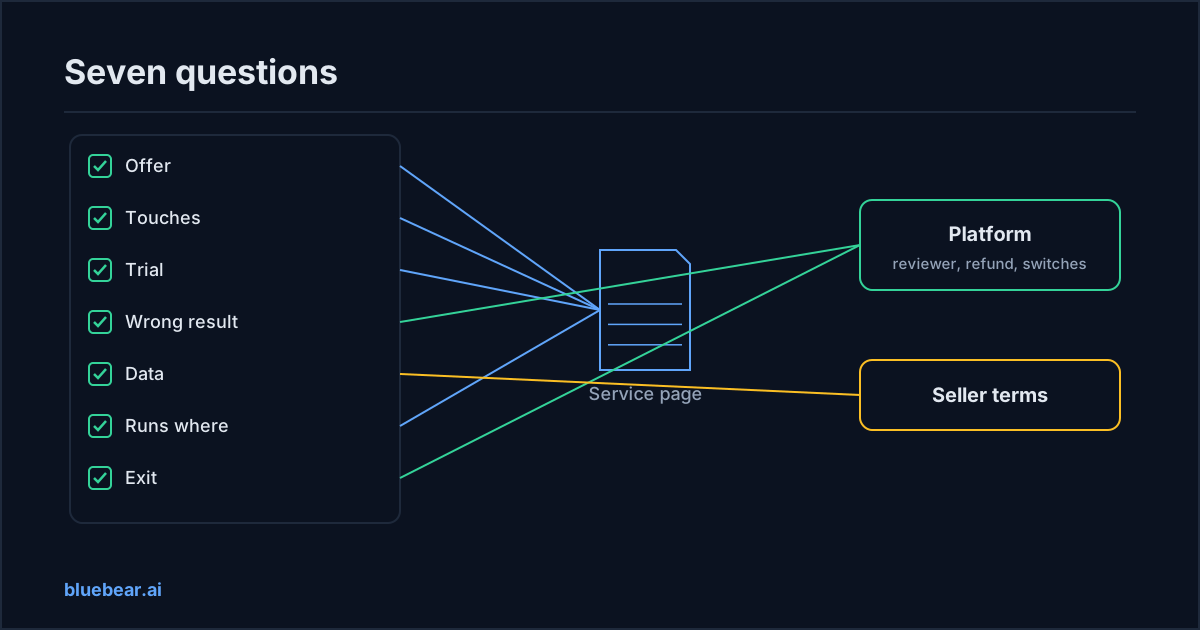
Ask every vendor the same seven questions, and write down where each answer came from. An answer on their website or in the contract is worth more than one in an email. AI Policy Desk's checklist for small teams covers similar ground and says it takes under 30 minutes.
- What exactly do I get, and at what price? The result in one sentence, the price, and what the price is based on.
- What can it touch in my systems? A list of actions, one per line. "Read loads" is an answer. "Integrates with your load board" is not. Ask which actions need a person to approve first.
- Can I try it on sample data before paying? A good trial needs none of your live systems.
- What happens when it is wrong? Who decides it was wrong, how fast, and what you get back.
- Who owns the output and my data? Can my data be used to improve their product? How long do they keep it?
- How will we measure it? Plain numbers, agreed before launch.
- How do I leave? Can I cancel, switch off its access myself, and keep the records of what it did?
Question five needs extra care. Mayer Brown, a law firm that writes these contracts, puts it this way:
"Standard work-product assignment clauses drafted for consulting and systems integration engagements may not map cleanly onto outputs from AI agents because those clauses often assume human authorship."
For question six, the same firm suggests measuring completion rate, human-handoff rate and rework rate. In plain words: how often it finishes, how often it passes work to a person, and how often its work gets redone.
Treat big promises with care. As of September 2024, the FTC had brought five cases over misleading AI claims. Its chair said there is "no AI exemption from the laws on the books." A vendor who promises results should be able to show them.
If your IT person wants to go deeper on security, the AI agent security evaluation checklist covers it. For question two, why AI tools should get the least access they need explains what a good answer looks like.
What BlueBear does to help
Many AI services are built and run by agencies. If yours runs on BlueBear, some of these answers are part of how the platform works today.
Each client has their own workspace. Connections to your tools are held by the platform instead of being pasted into the vendor's code. Workflows can pause for a person to approve a step. And every run leaves a record of what happened, which helps with questions four and seven.
BlueBear does not replace your contract. Ownership of output, refunds and response times still belong in writing with the company you hire.
What to do next
Take the seven questions to the vendors on your list this week. Score each one on where its answers came from: website, contract, email, or nowhere. The vendor with the most answers in writing usually has the least to hide. When a vendor passes, what an AI audit trail should record helps you check the records they promise.
Hiring an agency that builds on BlueBear, or want to ask us these questions directly? Get in touch.
Questions people actually search for
- what questions should i ask an ai vendor before paying
Ask what result you get and at what price, exactly what it can touch in your systems, whether you can try it on sample data, what happens when it is wrong, who owns the output and your data, how it will be measured, and how you leave. Get the answers in writing.
- how do i check an ai vendor's claims
Ask for a trial on your own sample data and a record of what the tool did on each job. Claims without proof are a red flag. As of September 2024, the FTC has said there is no AI exemption from the laws against misleading claims.
- who owns the work an ai tool produces for my business
Only what your contract says. As of June 2026, the law firm Mayer Brown warns that standard work-product clauses often assume a human did the work, so they may not cover AI output. Ask for a sentence that names AI output directly.
- how should an ai vendor be measured after launch
By plain numbers you can check: how often it finishes the job, how often it hands work to a person, and how often its work needs redoing. Uptime alone says little about whether an AI tool is doing its job.