Disclosure: BlueBear builds a gateway that sits at exactly the join described below, so we have a commercial interest. Four of the five controls are architecture decisions rather than purchases; the article says which one is not, and quotes our own field names only where a concrete mechanism makes the point clearer.
The short answer: the join is where integrity is decided, and there are five controls
Most discussion of AI security concentrates on the model. But when an agent integrates with an enterprise system, the risks that actually materialise are at the join — the point where the agent reaches a CRM, an ERP, a ticketing system, a database. That is where data can be corrupted, where more data can leave than intended, and where an action can happen twice.
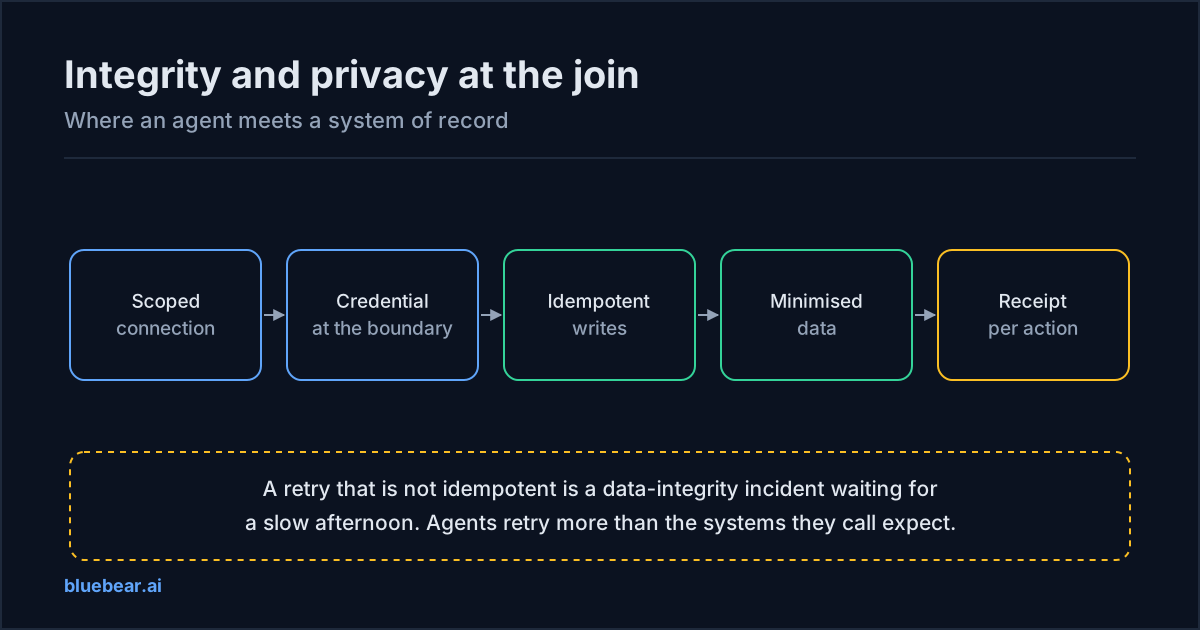
Five controls hold up. Each is verifiable, which is what distinguishes them from a policy statement.
| Control | What it prevents | How to verify it |
|---|---|---|
| 1. Scoped connection — named operations, not system access | Confusion or manipulation reaching far beyond the job | Ask for the list of operations the agent may invoke. If the answer is a system name, it is not scoped. |
| 2. Credential at the boundary — the agent never holds it | Credential exposure through prompts, logs or output; revocation requiring a deploy | Ask where the secret lives at the moment of the call. |
| 3. Idempotent writes | A retry doubling an effect — the most common corruption path | Ask what happens if the same action runs twice. Then run it twice. |
| 4. Minimisation — send and retain the least that works | More data leaving the boundary, and staying, than the task required | Look at one real outbound payload and one stored record. |
| 5. A receipt per action | Integrity being assumed rather than checkable | Ask to see one, from a failed action. |
1. Scope the connection to operations, not to systems
"The agent has access to the CRM" is not a security posture, it is a description of a risk. The useful unit is the operation: this agent may look up an order by identifier, may update a shipping address, and may do nothing else.
The Model Context Protocol — an open standard for describing a connection to a tool or data source and the named operations inside it — is what makes this tractable at scale, because it turns an integration into an enumerated list a policy can be written against rather than a credential with implied reach. MCP for business leaders covers what it changes commercially, and designing a governed integration catalogue covers running many of these.
The verification is simple and worth doing literally: ask for the list. If nobody can produce an enumerated list of the operations an agent may invoke, the scoping does not exist regardless of what the design document says.
2. Keep the credential at the boundary
The agent should ask for an operation and receive a result. It should never receive a secret.
Three things follow from that arrangement, and all three are lost if the agent holds the credential. Revocation becomes a configuration change rather than a deploy. The credential cannot leak through a prompt, a log line, or a model response. And the record of the action is written by something other than the actor.
Our own evidence records treat the credential as a reference and a state rather than as a value: an action's evidence carries a credential block with required, source and a status that is one of available, missing or not_required. The point of that shape is that "this action needs a credential and does not have one" is a recorded, blocking condition — not a runtime surprise, and not a secret written into a record. MCP token security covers why passing a token through to the agent fails.
3. Make writes idempotent, because agents retry
This is the control most often missing and the one that causes actual data corruption, and it has nothing to do with AI being unpredictable. It is arithmetic.
Agents retry: on a timeout, on a malformed response, on a transient failure, on their own judgement that a step did not work. They retry more than the systems they call were designed to expect, because those systems were designed for humans and for deterministic clients. If a write is not idempotent — if running it twice produces two effects — then an ordinary network timeout becomes a duplicate invoice, a double refund, a second email.
The mechanism is well understood: the caller supplies a key that identifies the intended effect, and the target system commits it once. What is worth insisting on is that the requirement is recorded, not merely intended. In our gateway, an action's evidence carries an idempotency block with required, key, scope and a status of claimed_by_gateway, missing or not_required, with the scope formed from the action identifier and the key. An action that requires idempotency and has no key is a blocking condition with a name, rather than a race waiting for a slow afternoon.
There is a related discipline for actions that cannot be made idempotent: they need a status reader — a read-only way to ask the target system whether the effect already happened — so recovery can check rather than guess. Our reconciliation audit exists specifically to find mutating actions that have neither an idempotent replay path nor a usable status reader, and it classifies each one so the gap is a listed item rather than a discovery during an incident.
4. Minimise what leaves, and what stays
Two separate decisions that get conflated.
What leaves the boundary. Send the fields a step needs, not whole records. This is unglamorous work — it means the integration returns a projection rather than a row — and it is the single most effective privacy control at the join, because data that never left cannot be retained anywhere downstream.
What is retained. Default to identifiers and content hashes rather than content. A hash proves that a specific output is the one the run produced without keeping a second copy of the data.
The design principle worth stealing here is that retention should be a decision someone makes, not a default someone forgets. In our own invocation records the columns for request and response content exist and are deliberately not written — the shape is reserved so that turning retention on later is a write-path change rather than a schema migration, and the choice belongs to the tenant rather than to the platform. GenAI telemetry without leaking prompts, tool arguments or customer data is the existing deep dive.
5. Write a receipt for every action
A receipt names the actor, the connection, the operation, the target, the policy that permitted it, whether an idempotency key was claimed, and the result — written by the boundary at the moment the action executes.
This is what makes integrity checkable rather than assumed. Without it, "the agent updated 400 records correctly" is a belief. With it, it is a query. And it is the artefact that makes the scoping exercise in an incident a lookup rather than an estimate.
The requirement that matters is that failures are recorded as fully as successes, and this is where most systems are thin. It is worth being concrete about our own gap rather than describing an ideal: our session records carry a field for the error that ended a failed session, and in our production data it is populated in none of the error rows. The schema is correct; the producer never writes it. When you evaluate any system — ours included — ask to see a receipt from a failed action rather than a successful one.
If you operate in a regulated industry
Two additions specific to regulated data. Classify the connection, not just the agent — the same agent touching two systems may cross two different data boundaries, and the control that matters attaches to the connection. And make the fail-closed behaviour explicit: a privacy or compliance dependency that cannot be resolved should stop the action rather than continue without it. Our own tenant privacy resolution works this way deliberately: a privacy-classified tenant whose policy baseline cannot be resolved raises an error rather than falling back to a permissive default. The audit trail requirements list covers what the receipt must contain.
If you are a platform or engineering lead
Do control 3 first. Idempotency is the one with a mechanical failure mode that does not require anybody to be attacked, it is the cheapest to implement against a specific integration, and it is the one that will otherwise be discovered by a customer. What breaks when agents get production access covers the wider set of changes.
If you resell this to customers
Each customer's connections and credentials must be separate objects, not the same connection with a customer field. The difference shows up the first time you need to revoke one customer's integration without touching anyone else's. What a secure workspace boundary is covers the containing structure.
Do this next
Take your most consequential integration and answer one question in writing: what happens if this action runs twice? If the answer is not "nothing", you have found the first thing to fix, and it is a smaller piece of work than anything else on this page. Then read least privilege for AI agents for control 1, or the security evaluation checklist if a vendor is involved.
When an agent reads data before acting, how old that data may be is a separate rule: data freshness for AI agents.
Questions people actually search for
- what security measures ensure data integrity and privacy during ai integration with enterprise systems
Five that hold up in practice. Scope the connection to named operations rather than granting system-wide access. Keep the credential at the execution boundary so the agent never holds it. Make every write idempotent, because agents retry more than the systems they call expect. Minimise what leaves the boundary and what is retained, defaulting to identifiers and hashes rather than content. And write a receipt for every action so integrity can be checked afterwards rather than assumed. Each is verifiable, which is what distinguishes them from a policy statement.
- how do you stop an ai agent corrupting production data
Three controls, in order of effect. Make writes idempotent so a retry cannot double an effect - this is the most common corruption path and it is entirely mechanical. Scope the connection so the agent can only invoke the operations its job needs, which bounds what any confusion can reach. And require approval on the irreversible action classes. Notice that none of these involve making the model better; corruption is a containment property rather than an accuracy one.
- is it safe to give an ai agent access to a crm or erp
It can be, and the question to answer first is what specifically it may do there rather than whether it may connect. A connection scoped to three named operations against records the agent already has a reason to touch is a very different proposition from a service account with write access to everything. Ask what the credential can reach if the agent is confused or manipulated, because that is the real exposure, not the intended workflow.
- how do you keep customer data out of ai model calls
Minimise before the boundary, not after. Send identifiers and the specific fields a step needs rather than whole records; strip or tokenise anything the step does not require; and default retention to off, storing hashes rather than content where you need to prove what was produced. Filtering after the call has already sent the data, and a retention setting you can turn on later is a much safer default than one you must remember to turn off.
- what is an integration receipt for ai agents
A record written at the point an action executes, naming the actor, the connection, the operation, the target, the policy that permitted it, whether an idempotency key was claimed, and the result. It is what turns "the agent updated a record" into something you can verify afterwards rather than reconstruct. The important property is that it is written by the boundary rather than reported by the agent, because an agent reporting on itself is both the actor and the witness.