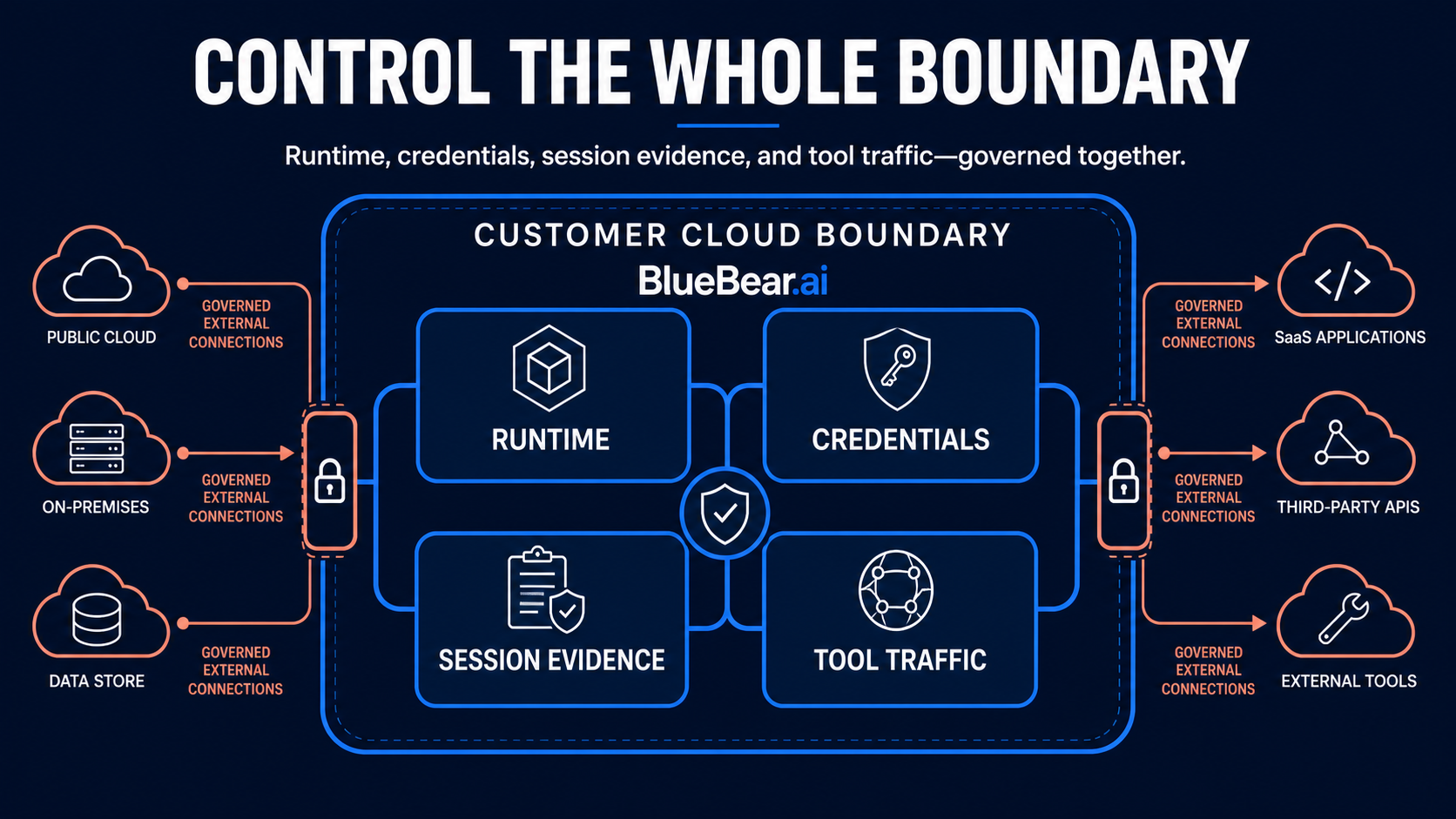
AI agent workflows quickly blur data residency lines, creating unforeseen compliance and security challenges.
The rise of artificial intelligence (AI) agents promises transformative business efficiency. These autonomous systems can interact with various tools, access diverse data sources, and even make decisions. For Chief Information Security Officers (CISOs), AI Governance Leads, Security Architects, and Risk and Compliance Leads in regulated operations or enterprise software, this power introduces complex questions about data residency. Where does sensitive information actually reside when an AI agent is at work? The answer is rarely a single, static location.
Data residency refers to the physical or geographic location where an organization's data is stored and processed. Traditionally, this meant selecting a cloud region or data center. With AI agents, the concept of a "data boundary" extends beyond simple hosting. It becomes a dynamic challenge across an entire workflow, impacting credentials, logs, and tool interactions.
The Shifting Sands of AI Agent Data Residency
Unlike monolithic applications, AI agents are designed to be composable. They stitch together large language models (LLMs), internal enterprise tools, and external services to perform complex tasks. This modularity, while powerful, makes data governance significantly more intricate. The core problem is clear: agent workflows cross models, tools, files, and session stores, making data residency a workflow boundary rather than one hosting checkbox.
Key pain points emerge rapidly for organizations adopting AI agents:
- Credentials and permissions are scattered: Each tool an agent uses requires authentication. Managing these credentials and their associated permissions across disparate systems becomes a significant security burden, increasing the attack surface.
- Logs do not preserve authorization context: When an agent acts, it often does so through a series of delegated calls. Audit logs may show *what* action occurred and *which* tool performed it, but frequently fail to capture the original authorization context or the specific data involved, hindering compliance investigations.
- Tool autonomy expands faster than policy coverage: As agents gain more autonomy and access to a wider array of tools, the ability to extend and enforce data residency policies across this expanding operational scope struggles to keep pace.
A Representative Operating Scenario: The Customer Service Agent
Consider a customer service AI agent assisting with a sensitive financial inquiry. This scenario, common in regulated industries, highlights how data residency can quickly become elusive. We will trace a sensitive record through a typical agent session.
Data Ingestion
A customer initiates a chat, providing personally identifiable information (PII) and details about a financial transaction. This initial data might enter through a customer-facing application hosted in your controlled cloud environment.
Agent Orchestration and Tool Interaction
The AI agent, running within its dedicated environment, begins processing the request. It first needs to verify the customer's identity and access their account history. To do this, the agent might:
- Call an internal Customer Relationship Management (CRM) system API. This CRM might be a SaaS solution hosted by a third party in a different geographic region.
- Access a secure knowledge base for policy lookups. This knowledge base could be hosted on a separate internal server or another cloud provider.
- If the issue involves a specific financial product, the agent might interact with a financial service API, potentially operated by a partner or another internal department, each with its own data storage.
At each of these steps, sensitive customer data is transmitted to, processed by, and potentially temporarily stored within these various tools and their underlying infrastructure. The credentials used for these API calls must be managed securely, often requiring access to a secret management system.
Model Inference
To generate a coherent response or summarize complex information, the agent sends relevant portions of the conversation and retrieved data to a large language model (LLM). This LLM could be:
- A model hosted within your private cloud.
- A managed service provided by a major cloud vendor, where the specific data center location for inference might vary based on load or region selection.
- A third-party commercial LLM, whose data processing and retention policies are entirely outside your direct control, even if data is theoretically "processed at rest" in a specific region.
The input prompts and the LLM's responses contain segments of the sensitive record, and their residency is now tied to the LLM's operational environment.
Session State and Log Generation
Throughout the interaction, the AI agent maintains a session state, storing conversation history, intermediate results, and tool outputs. This session data is often persisted to a session store, which could be an in-memory database, a file system, or a dedicated database service. The location of this session store directly impacts data residency.
Crucially, every action, tool call, and model interaction generates logs. These logs are vital for auditing and troubleshooting, but they also capture sensitive data. If these logs are pushed to a centralized logging platform, their final resting place must comply with residency requirements. Furthermore, if these logs do not preserve authorization context – detailing *who* requested the agent action and *what* permissions allowed it – their utility for compliance diminishes significantly.
Output and Archiving
Finally, the agent provides a resolution, which might involve updating the CRM or sending a secure message. The conversation transcript and any generated artifacts are archived. The storage location for these archives must also adhere to data residency policies.
In this single, representative operating scenario, the sensitive record has traversed numerous systems, each with its own hosting, processing, and logging characteristics. Pinpointing its residency requires understanding the entire workflow, not just the initial data entry point.
Beyond the Hosting Checkbox: True Data Boundaries for AI Agents
The complexity of AI agent workflows demands a shift from thinking about data residency as a simple hosting decision to understanding it as a continuous workflow boundary. Organizations must ensure that every point where data is accessed, processed, or stored aligns with their geographical and regulatory obligations.
Architecting for true data boundaries requires more than just selecting a cloud region. It involves establishing granular controls and visibility across the entire agent lifecycle. This is not a new concept in complex distributed systems. Kubernetes multi-tenancy guidance separates logical namespace boundaries from authorization, quotas, networking, storage, and data-plane isolation decisions. This highlights that even at the infrastructure layer, robust data separation requires careful consideration of many interconnected architectural decisions. Similarly, The AWS Agentic AI Lens frames reliability, security, cost, performance, operational excellence, and sustainability as connected architecture decisions for production agent workloads. Security and data residency are not isolated concerns; they are intrinsically linked to the entire operational excellence of agentic AI systems.
The BlueBear Difference: Your Cloud, Your Controls
BlueBear understands that robust AI agent governance starts with controlled infrastructure. Our Bring-Your-Own-Cloud (BYOC) approach is designed to give enterprises complete sovereignty over their AI agent data boundaries. BlueBear’s BYOC approach keeps governed deployment connected to customer-controlled cloud boundaries and explicit workspace access.
This means your AI agent platform operates within your existing cloud environment, leveraging your established security controls and compliance posture. It directly addresses the pain points identified:
- Centralized credential management: BlueBear’s governed agent runtime operates within your cloud, allowing you to manage and secure credentials for agent tools using your existing secret management solutions and identity providers. Access policies are enforced directly within your controlled boundaries, not scattered across third-party services.
- Comprehensive logging with preserved authorization context: The BlueBear AI agent platform, including the BlueBear MCP Gateway—its governance layer around Model Context Protocol connections—, generates detailed audit logs within your environment. These logs inherently preserve the full authorization context, showing not just what an agent did, but precisely under what authority and with what input data, providing a defensible audit trail.
- Policy enforcement that scales with tool autonomy: By deploying BlueBear within your cloud, you extend your existing cloud governance frameworks directly to your AI agents. This ensures that tool autonomy expands with, rather than outpaces, your policy coverage. You maintain explicit workspace access controls for all agent interactions.
With BlueBear, your organization retains full control over where data resides, how it’s processed, and by whom it’s accessed throughout the entire AI agent workflow.
Practical Diagnostic Checklist: Securing Your Agent Workflows
To assess your current exposure and strengthen your AI agent data boundaries, consider the following:
- Where does sensitive data enter your AI agent workflows, and where does it ultimately exit or get archived?
- List every tool an agent uses. For each, where does it process and store data, even temporarily?
- Are the credentials and permissions for all agent-accessed tools managed centrally within your controlled cloud boundaries, or are they distributed across multiple external services?
- Do your audit logs for agent actions capture granular authorization context, including the original requestor, the agent's permissions, and the specific data manipulated?
- How quickly and effectively can you extend your data residency and access policies to new tools or models integrated into your agent workflows?
- Is your AI agent runtime isolated within your controlled cloud environment, or is it operating in a shared or external infrastructure?
Conclusion
The promise of AI agents is immense, but their effective and compliant deployment hinges on understanding and controlling data residency across complex workflows. It is no longer enough to simply check a hosting box. Organizations must build comprehensive data boundaries that encompass runtime, credentials, session evidence, and tool traffic.
By taking a BYOC approach, you can ensure your AI agents operate within a framework of strong governance and explicit control. This provides the confidence needed to leverage AI agents securely, even with the most sensitive data.
Next Step: Trace one sensitive workflow and document where data, credentials, and logs are stored.