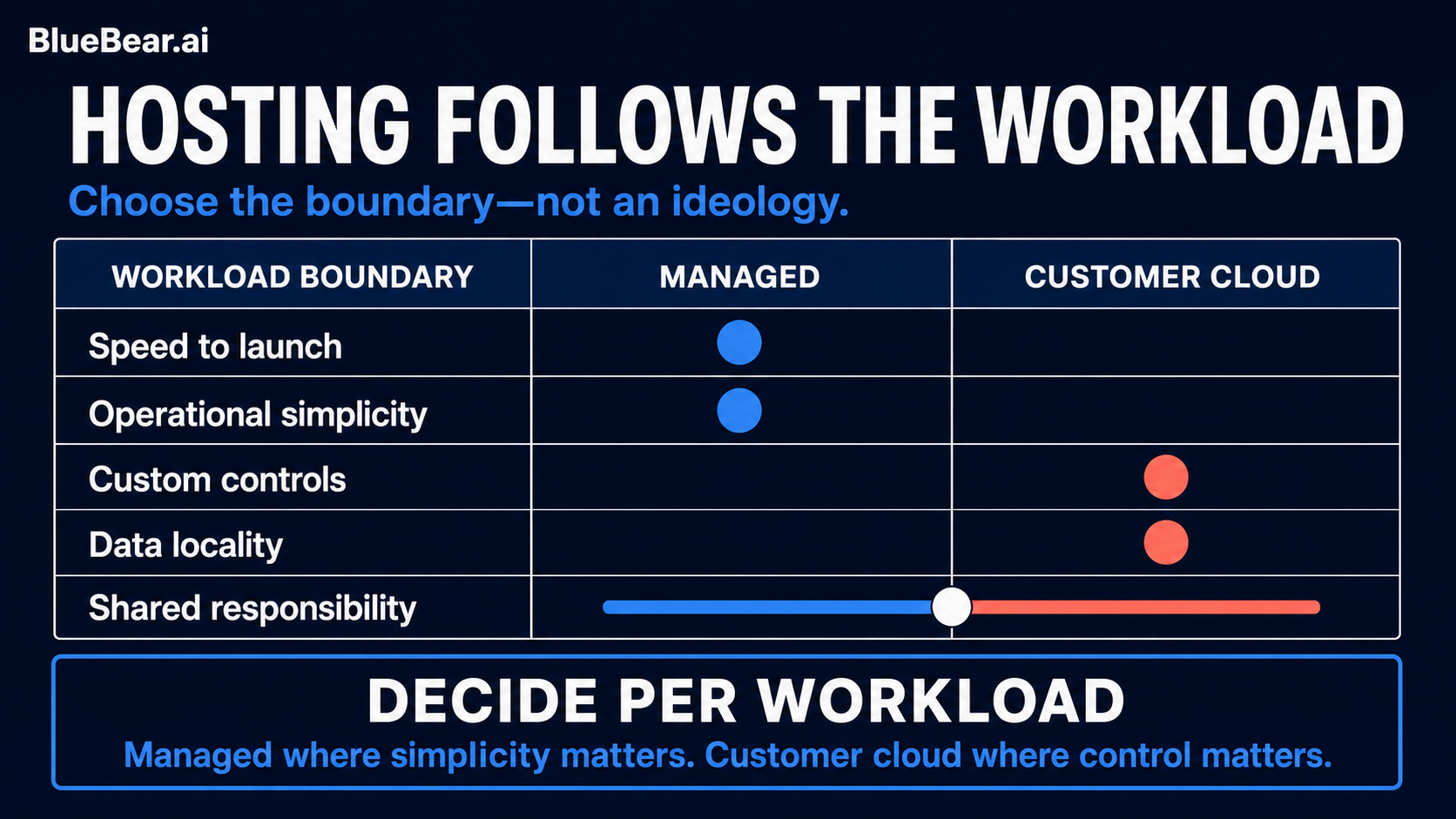
Managing diverse AI agent workloads with a single hosting strategy often creates friction.
As enterprises scale artificial intelligence initiatives, platform engineering leaders face a critical decision: should they build and operate their own AI agent infrastructure (BYOC) or opt for a managed hosting solution? This choice is rarely straightforward. One hosting answer rarely fits internal agents, regulated workflows, customer-facing tenants, and bursty automation.
BYOC, or Bring Your Own Cloud, involves deploying and managing AI agents directly on your existing cloud infrastructure. This means you control the underlying compute, storage, and networking. Managed hosting for AI agents, conversely, offloads much of this operational burden to a third-party provider, who manages the platform and often the underlying infrastructure.
The Core Challenge: Fragmented AI Agent Infrastructure
Agent infrastructure is fragmented across teams, leading to inconsistencies and inefficiencies. Teams often spin up AI agent pilots in isolated environments, making it difficult to consolidate and standardize. This fragmentation complicates governance and creates silos.
A significant pain point for Platform Engineering Leads and AI Infrastructure Architects is that failures are difficult to reconstruct end to end. Without a unified view or consistent tooling, diagnosing issues across different agent deployments becomes a time-consuming, resource-intensive task. Furthermore, tenant isolation and capacity controls often arrive late in the deployment cycle, creating security risks and performance bottlenecks as agent usage grows.
A "one-size-fits-all" approach to AI agent hosting can quickly fall short. Internal development agents, for instance, have different requirements than customer-facing conversational agents. Highly regulated workflows demand strict data residency, while bursty automation tasks prioritize elasticity and cost efficiency. Each workload presents unique trade-offs.
Weighing Your Options: BYOC vs. Managed Hosting for AI Agents
Choosing between BYOC and managed hosting requires a deep understanding of your specific AI agent workloads. This decision matrix compares key criteria to help VP Engineering and other leaders make informed choices that align with business outcomes before infrastructure considerations.
Control: Granularity vs. Abstraction
Control refers to the level of access and customization you have over the hosting environment. With BYOC, your team has complete control over the infrastructure stack. This includes selecting specific hardware, operating systems, and network configurations. This granular control is vital for highly specialized AI models or strict security postures.
Managed hosting, by contrast, offers abstraction. The provider handles infrastructure details, allowing your team to focus on agent development. While this reduces direct control, it can simplify operations. For multi-tenancy environments, careful consideration of control planes is crucial. Kubernetes multi-tenancy guidance separates logical namespace boundaries from authorization, quotas, networking, storage, and data-plane isolation decisions. source.
Launch Speed: Agility vs. Setup Overhead
Getting AI agents into production quickly is a common goal. Managed hosting typically offers faster launch speeds because the underlying infrastructure is pre-configured and ready for deployment. This allows teams to onboard agents and begin iterating almost immediately.
BYOC can involve significant initial setup overhead. Provisioning resources, configuring security, and establishing CI/CD pipelines for a new AI agent platform can delay time-to-market. The advantage of BYOC in this area comes with deep automation and existing cloud expertise.
Operations Burden: Your Team vs. The Provider
The operational burden includes maintenance, patching, monitoring, and troubleshooting. With BYOC, your internal platform engineering team assumes full responsibility for these tasks. This demands dedicated resources and specialized skills, which can strain teams already managing fragmented infrastructure.
Managed hosting significantly reduces this burden. The provider takes on the day-to-day operations, including ensuring uptime, scaling resources, and applying security updates. This frees your team to focus on higher-value agent development and application logic. The AWS Agentic AI Lens frames reliability, security, cost, performance, operational excellence, and sustainability as connected architecture decisions for production agent workloads. source.
Data Residency and Compliance
For industries like finance or healthcare, data residency requirements are non-negotiable. BYOC provides complete assurance over data location, as agents run within your own cloud accounts. This is crucial for meeting regulatory compliance standards.
Managed hosting solutions vary. Some providers offer specific regional deployments or dedicated instances to address residency needs. However, it's essential to verify their compliance certifications and data handling policies thoroughly before committing.
Integration Proximity
AI agents rarely operate in isolation. They need to integrate with existing enterprise systems, data sources, and other AI services. BYOC allows for direct, low-latency integration with your current cloud services and custom APIs. This proximity can be beneficial for performance-sensitive workflows.
Managed hosting platforms often provide a suite of pre-built integrations. While convenient, this might limit customization or introduce additional network hops for connecting to systems outside the managed environment. Understanding the integration ecosystem is key.
Elasticity and Scaling
AI agent workloads can be highly variable, with sudden spikes in demand. Elasticity—the ability to scale resources up and down quickly—is vital. Managed hosting platforms are typically designed for inherent elasticity, automatically adjusting resources to meet demand without manual intervention.
Achieving robust elasticity with BYOC requires careful architecture and implementation. While cloud platforms offer scaling capabilities, configuring them effectively for bursty AI agent workloads, especially with tenant isolation, demands significant expertise from AI Infrastructure Architects.
Economics: Total Cost of Ownership
The total cost of ownership (TCO) extends beyond direct infrastructure costs. With BYOC, TCO includes personnel expenses for engineering, operations, and security, as well as the cost of tooling and licensing. These hidden costs can accumulate rapidly, particularly as agent infrastructure becomes fragmented.
Managed hosting often involves a more predictable subscription model. While the per-unit cost might seem higher initially, it offloads significant operational expenses and can provide better cost predictability. The economic decision should always weigh direct costs against the cost of internal labor and the opportunity cost of delayed deployments.
Representative Operating Scenario: Internal Tools vs. Customer-Facing Agents
Consider a large enterprise developing two distinct types of AI agents. First, an internal data analysis agent helps engineering teams query complex datasets. This agent handles sensitive internal data, is used by a limited, trusted audience, and has predictable usage patterns. For this, a BYOC approach often makes sense. The engineering team retains full control over the environment and data residency, leveraging existing cloud infrastructure and security policies.
Second, the same company builds a customer-facing support agent for millions of users. This agent experiences unpredictable traffic spikes, integrates with various customer relationship management (CRM) systems, and must adhere to strict performance SLAs. Here, a managed AI agent platform is often the better fit. It handles the operational burden, scales automatically to meet demand, and provides robust tenant isolation for external users, freeing internal teams to focus on agent logic and user experience.
BlueBear's Distinct Approach: Governed Control for Customer-Cloud Deployment
Many organizations struggle to connect the need for governed control with the reality of customer-cloud deployment. BlueBear addresses this directly. BlueBear connects governed control to customer-cloud deployment when workload boundaries justify it. This means enabling enterprises to operate AI agents with governed infrastructure, integrations, evidence, and cost controls, even when deploying into their own cloud environments.
The BlueBear AI agent platform offers capabilities like the BlueBear MCP Gateway—a governance and control layer around Model Context Protocol connections— and a governed agent runtime. This allows platform teams to standardize runtime isolation and integrations while providing the necessary guardrails. For example, the BlueBear MCP Gateway can enforce policies across different cloud deployments, ensuring consistent governance even for BYOC scenarios. This helps mitigate the pain point of tenant isolation and capacity controls arriving late by embedding these controls from the outset.
Furthermore, the BlueBear platform aids in troubleshooting sessions across models and tools, helping to solve the problem of failures being difficult to reconstruct end to end. By providing a unified visibility layer and control plane, BlueBear helps engineering teams move agents from pilots to reliable shared infrastructure, bridging the gap between development and production.
BlueBear BYOC Responsibility and Cost Matrix
| Area | Managed path | Customer-cloud path | Evidence required |
|---|---|---|---|
| Cloud account and billing | Platform-managed account and service boundary. | Customer account, quotas, commitments, and cloud invoice. | Account owner, allocation rule, budget, and escalation. |
| Network and keys | Defined by the managed service architecture. | Customer architecture may own network, key, and egress policy. | Responsibility matrix and validated connectivity. |
| Runtime operations | Managed upgrade, capacity, and incident responsibilities. | Responsibilities split across BlueBear and customer operations. | Runtime version, health, support path, and rollback owner. |
| Agent governance | BlueBear tenant/workspace, model, MCP, budget, and session controls where configured. | The same logical controls with deployment-specific integrations and assurance. | Effective policy, denial tests, approvals, and outcome trace. |
| Assurance | Request current service evidence and agreements. | Combine BlueBear evidence with customer cloud controls. | Current documents; never infer certification from hosting choice. |
A Practical Diagnostic Checklist for Your AI Agent Workloads
Before deciding on a hosting strategy for your next AI agent, evaluate your workloads against these critical factors:
- **Control Needs:** How much direct access and customization do you require over the underlying infrastructure? Is granular control essential for specialized models or strict security?
- **Data Residency:** Do specific regulations or internal policies mandate where your data must reside? Can your chosen solution guarantee this?
- **Operational Capacity:** Does your current team have the bandwidth and expertise to manage infrastructure, scaling, security, and troubleshooting for this agent?
- **Scaling Needs:** Will the agent experience bursty traffic or predictable, consistent loads? How critical is automatic, dynamic scaling?
- **Integration Landscape:** What existing systems does the agent need to connect with? Are pre-built integrations sufficient, or do you require deep custom integration capabilities?
- **Cost Tolerance:** What is the true total cost of ownership, including both direct infrastructure spend and indirect operational expenses?
Conclusion
The choice between BYOC and managed hosting for AI agents is a strategic one, not a binary "either/or." It demands a clear understanding of your specific workloads, their unique requirements, and the long-term operational impact. Relying on a single hosting answer for every AI agent will inevitably lead to bottlenecks, compliance gaps, or unnecessary operational overhead.
Evaluating your current workflow before adding another tool is crucial. The right decision minimizes fragmentation, improves traceability for troubleshooting, and ensures tenant isolation and capacity controls are inherent from day one. Take the time to align your hosting strategy with each agent's distinct needs.
Score three workloads against control, residency, operational capacity, and scaling needs.