AI Agent Memory Is a Data-Governance Decision
AI agent memory decisions directly impact data integrity and regulatory standing.
Artificial intelligence (AI) agents are increasingly taking on complex tasks, often operating with autonomy. These systems need memory to learn from interactions, maintain continuity, and adapt. This introduces significant challenges for data governance, security, and compliance leaders. CISOs, AI Governance Leads, Security Architects, and Risk and Compliance Leads in regulated operations, enterprise software, and managed services must address key questions: How is agent memory handled? What are its retention policies? Who accesses it, and when is it deleted?
An AI agent is a software program designed to perceive, decide, and act toward specific goals, often without constant human oversight. Its "memory" is the information it stores and retrieves to guide these actions. Controlling agent memory is not just a technical detail; it is a fundamental data-governance decision with direct commercial and legal consequences.
The Unseen Challenge of Agent Memory Governance
The rise of AI agents introduces new complexities into existing security and compliance frameworks. Traditional data governance models often struggle to adapt to the dynamic, distributed, and sometimes opaque nature of agentic systems.
A significant pain point is that credentials and permissions are scattered across the diverse tools and data sources an agent might access. An agent’s operational memory, if not meticulously managed, can inadvertently retain or expose sensitive access tokens. This creates new attack vectors if memory stores are compromised. Scattered access details make a unified security posture difficult to achieve.
Furthermore, during investigations, logs do not always preserve authorization context. When an AI agent takes an action, the audit trail shows the agent's identity but often lacks the detailed memory leading to that decision or the specific permissions leveraged. This missing context hinders incident response and the ability to demonstrate compliance, leaving gaps in the chain of evidence.
The adaptability of AI agents compounds these issues. Tool autonomy expands faster than policy coverage. As agents gain power to discover new tools or access new data streams, they generate memory that falls outside pre-existing governance policies. This uncontrolled expansion can lead to unmanaged data proliferation, increased shadow IT risks, and direct compliance failures in regulated environments.
Four Classes of Agent Memory, Four Governance Needs
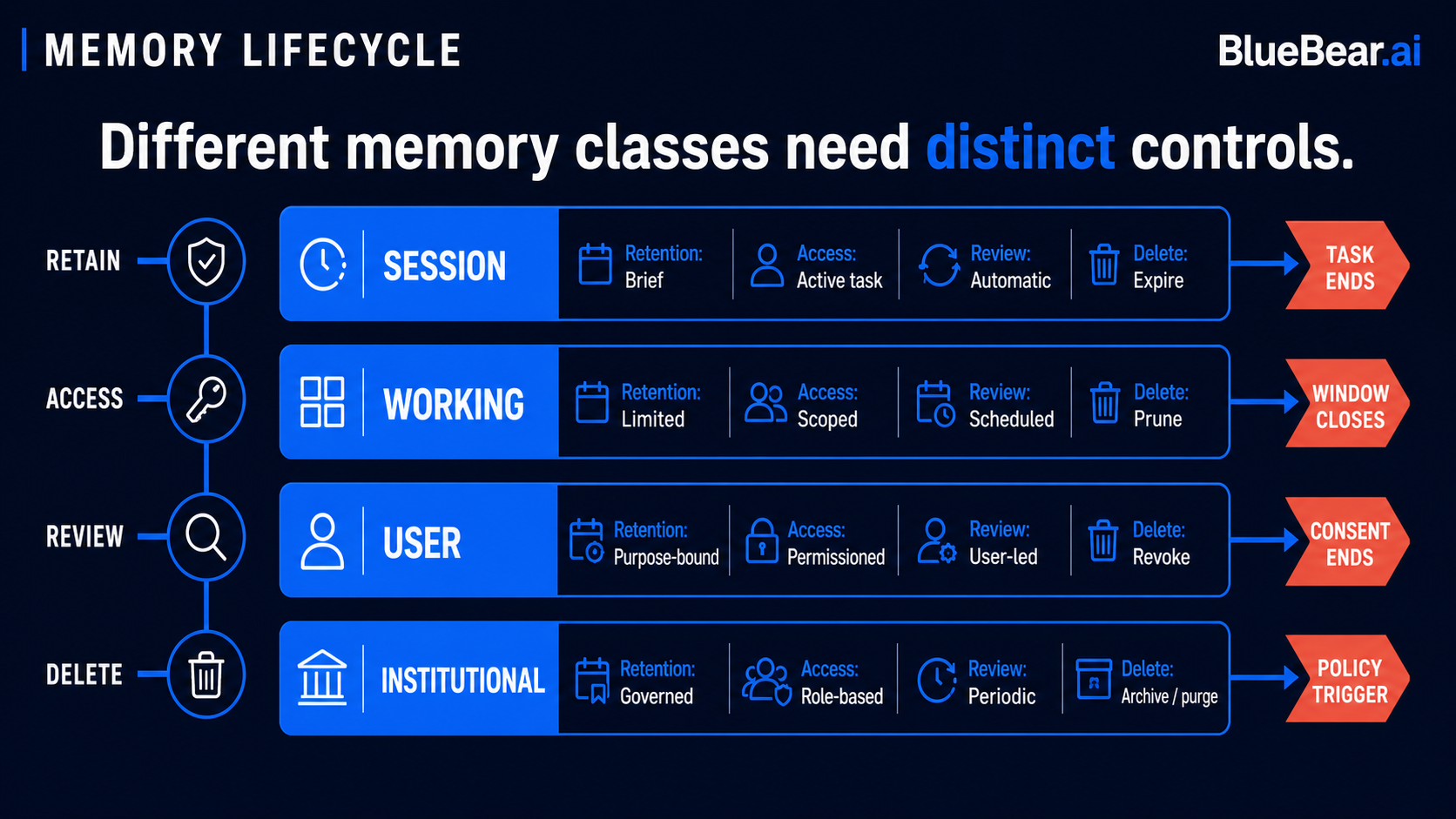
Effective agent governance requires distinguishing between different memory classes. Each class demands specific policies for its purpose, retention, access, and deletion authority. Separating working context, session history, durable memory, and business records is crucial for maintaining granular control and achieving defensible compliance.
Working Context: Ephemeral and Immediate
This is the most transient form of agent memory, including immediate inputs, scratchpad data, and intermediate reasoning steps relevant only to the current task. It should be deleted immediately upon task completion or failure. Access should be restricted to the executing agent and necessary oversight for debugging or analysis. Its ephemeral nature minimizes long-term risks.
Session History: Context for Continuity
Session history captures the sequence of interactions, prompts, and responses within a single conversation or operational session. It is crucial for maintaining conversational flow or task progression. While more persistent than working context, its lifespan is limited. Retention should align with user session durations or short-term operational needs. Access should be limited to the involved user and authorized auditors for compliance reviews.
Durable Memory: Long-Term Knowledge and Adaptation
Durable memory consists of long-term learned knowledge, preferences, and facts retained across sessions. This includes domain-specific knowledge, user profiles, or common procedures. It has the longest retention period, governed by business value and regulatory requirements. Access must be tightly controlled, with clear policies for updates, deprecation of outdated information, and removal of sensitive facts. This is where persistent memory can improve continuity while potentially retaining sensitive facts, outdated context, and permissions beyond their purpose if not managed carefully.
Business Records: Auditable and Compliant
This class includes agent-generated data that constitutes a formal business record, such as transaction confirmations or official reports. These have specific legal or regulatory retention requirements and demand the most stringent governance, mirroring policies for human-generated records. This includes immutable storage, long-term retention, strict access controls, and defensible deletion processes.
The BlueBear Approach: Governed Continuity by Design
BlueBear addresses these governance challenges by distinguishing workspace and session evidence from unconstrained memory. This ensures continuity remains governed and reviewable, preventing unmanaged data proliferation.
Our AI agent platform integrates a governed agent runtime with an MCP gateway. This architecture provides explicit controls over how agents access tools, interact with data, and manage memory. It helps solve the problem where tool autonomy expands faster than policy coverage by enforcing policy at the interaction layer.
This approach aligns with leading industry guidance. Microsoft's agentic Center of Excellence guidance assigns lifecycle roles for enablement, risk-based governance, release gates, reusable patterns, cost and value monitoring, and retirement. [Source 1] BlueBear's platform provides the operational framework to implement these lifecycle controls for agent memory.
Furthermore, Microsoft recommends governing agents by side effects and consequence, applying heavier controls to systems that execute changes than to assist-only systems. [Source 2] BlueBear's MCP gateway enables organizations to apply granular governance based on the risk profile of agent actions and the sensitivity of the memory involved.
BlueBear ensures that even as agents learn and adapt, their memory remains subject to defined retention, access, and deletion authorities. This prevents the accumulation of sensitive or outdated information while supporting the operational benefits of persistent memory.
A Practical Diagnostic for Your Agent Memory
Before deploying new AI agents or expanding existing ones, conduct a thorough inventory of how agent memory is currently managed. This diagnostic helps identify gaps and areas of non-compliance.
- What specific data does each agent remember? (e.g., user preferences, prior conversations, external knowledge snippets, credentials)
- Why is this data retained? (e.g., for continuity, auditing, personalization, learning)
- Who can inspect this data, and under what circumstances? (e.g., developers, auditors, compliance officers, end-users)
- How is this data deleted when no longer needed or when a retention policy expires? (e.g., automatic, manual, cryptographically shredded)
- Are different memory types treated distinctly regarding retention, access, and deletion?
- Does your current logging capture the full authorization context for agent actions?
- Do you have clear policies covering agent interactions with all integrated tools?
Business CTA: Inventory what each agent remembers, why it is retained, who can inspect it, and how it is deleted. This is a critical first step for secure and compliant AI agent operations.
Conclusion
AI agent memory is a strategic governance frontier. Proactive management of working context, session history, durable memory, and business records is essential for maintaining control and trust.
By defining clear policies and implementing platforms that enforce those distinctions, organizations can leverage AI agents without compromising data integrity or regulatory compliance. Evaluate your current workflow and governance capabilities before introducing more tools. A thoughtful, framework-driven approach ensures long-term success and security.