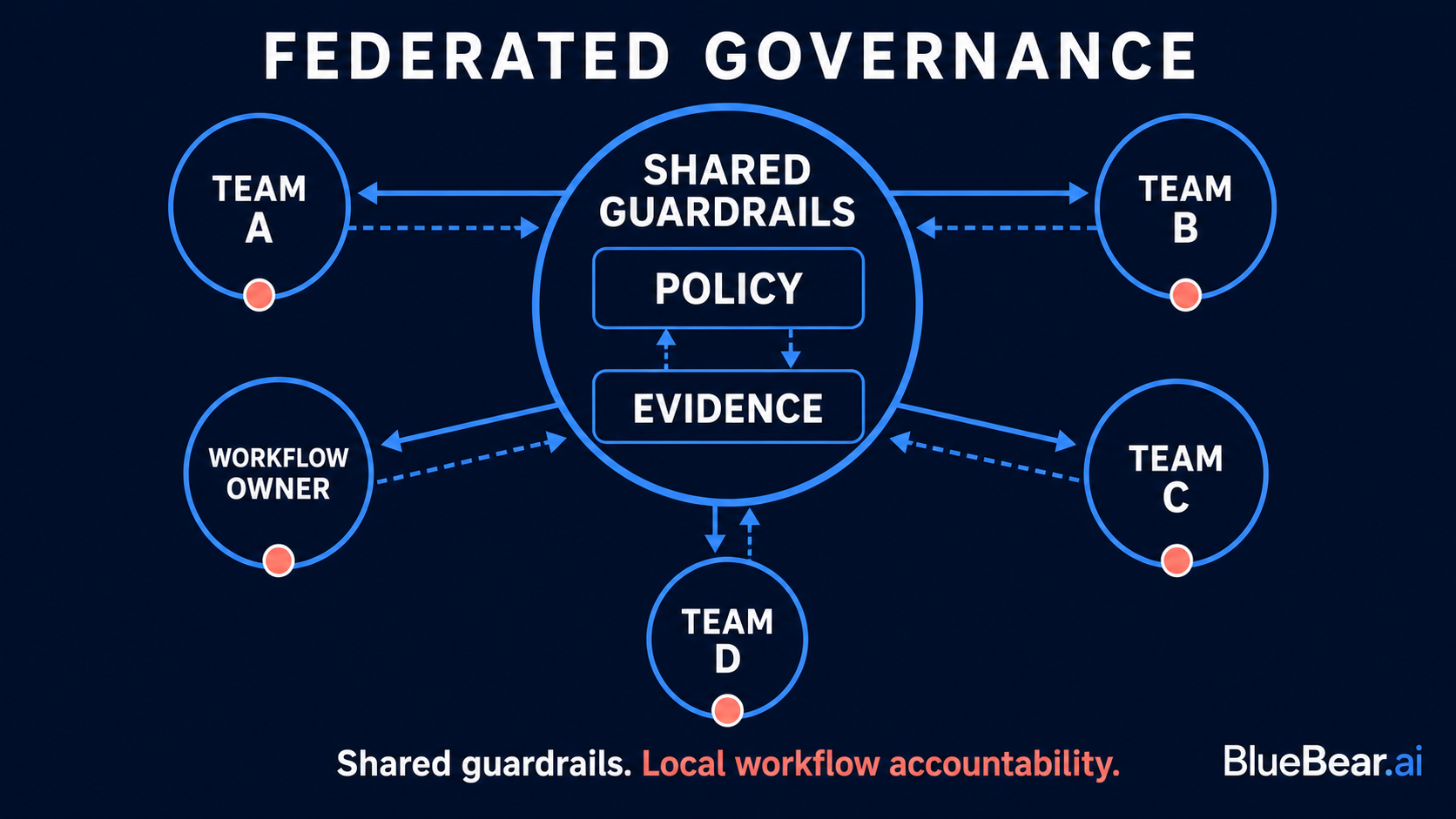
Central teams need consistent controls, but product teams demand autonomy to ship. This tension defines AI agent governance challenges.
As AI agents move from experimental tools to core operational assets, ensuring their secure and compliant operation becomes critical. Leaders in regulated operations, enterprise software, and managed services—especially CISOs, AI Governance Leads, Security Architects, and Risk and Compliance Leads—face increasing pressure. Credentials and permissions are often scattered. Logs do not always preserve full authorization context. Tool autonomy expands faster than policy coverage. This article explores how to balance centralized control with distributed innovation.
Understanding AI Agent Governance Models
Effective AI agent governance ensures that autonomous agents operate within defined boundaries, adhering to security, compliance, and ethical standards. It’s about establishing a framework that guides agent development, deployment, and monitoring. This framework becomes crucial when agents interact with sensitive data or execute actions in production systems.
Centralized Governance: The Command-and-Control Approach
In a centralized model, a single team or department dictates all governance policies and implements controls. This approach typically involves a dedicated AI governance committee or a Center of Excellence (CoE) that establishes a uniform set of rules for all agent development and deployment.
Advantages of Centralized Governance:
- Policy Consistency: Ensures uniform application of security and compliance policies across the entire organization. This reduces policy fragmentation.
- Simplified Auditing: Easier to demonstrate compliance when all agents follow the same central rules. Audit trails are consolidated.
- Resource Efficiency: Centralized teams can develop and maintain a single set of tools and processes for governance, potentially reducing overhead.
Disadvantages of Centralized Governance:
- Response Speed: Can slow down innovation. Product teams must wait for central approvals, delaying agent deployment and iteration.
- Domain Expertise: Central teams may lack specific domain knowledge required for nuanced governance decisions in various business units.
- Tool Autonomy: Product teams often face delays, feeling that "tool autonomy expands faster than policy coverage."
Embedded Governance: Decentralized and Agile
Embedded governance distributes governance responsibilities directly to the product or development teams building the AI agents. Each team integrates governance controls into their development lifecycle, making it an inherent part of their workflow.
Advantages of Embedded Governance:
- Response Speed: Accelerates development and deployment. Teams make governance decisions quickly within their context.
- Domain Expertise: Teams possess deep understanding of their agents’ functions and risks, leading to more relevant controls.
- Ownership: Fosters a sense of accountability within development teams for agent behavior and compliance.
Disadvantages of Embedded Governance:
- Policy Consistency: Can lead to inconsistent policy application across the organization. Different teams might interpret or implement rules differently. This often means "credentials and permissions are scattered."
- Evidence Ownership: Gathering consolidated audit evidence can be challenging when governance processes are fragmented across many teams. Often, "logs do not preserve authorization context."
- Duplication of Effort: Multiple teams might develop similar governance tools or processes, leading to inefficiencies.
Federated Governance: Shared Guardrails, Local Accountability
Federated governance blends the strengths of centralized and embedded models. A central team sets overarching policies and provides shared services, while individual product teams implement those policies and manage their agents within those guardrails. Microsoft’s guidance for an agentic Center of Excellence (CoE) highlights this approach, assigning lifecycle roles for enablement, risk-based governance, release gates, and reusable patterns (source).
Advantages of Federated Governance:
- Policy Consistency with Flexibility: Central policies provide guardrails, while local teams adapt implementation to their specific needs.
- Improved Response Speed: Development teams can move quickly within established boundaries without constant central approval.
- Leverages Domain Expertise: Product teams apply their deep knowledge, ensuring practical and effective controls.
- Clear Evidence Ownership: Central services can aggregate evidence while local teams contribute specific operational logs.
Comparison of Governance Models
| Feature | Centralized | Embedded | Federated |
|---|---|---|---|
| Policy Consistency | High | Low to Medium | High (with local adaptation) |
| Response Speed | Slow | Fast | Medium to Fast |
| Domain Expertise Leverage | Low | High | High |
| Evidence Ownership | Centralized | Distributed/Fragmented | Shared/Aggregated |
Addressing Pain Points: Credentials, Logs, and Policy Coverage
Regardless of the model chosen, key pain points persist. Scattered credentials and permissions lead to security gaps. Logs that do not preserve authorization context hinder incident response and auditing. The rapid expansion of tool autonomy without matching policy coverage introduces significant risks.
The BlueBear Approach: Global Guardrails, Local Workflow Decisions
BlueBear supports shared platform guardrails and evidence with tenant- and workflow-specific operating ownership. Our approach is designed for organizations operating AI agents in regulated environments. BlueBear provides a governed agent runtime and an MCP gateway that enables central teams to define and enforce global policies, such as access controls and data handling rules. At the same time, it empowers product teams to make local workflow decisions within those established guardrails.
Microsoft recommends governing agents by side effects and consequence, applying heavier controls to systems that execute changes than to assist-only systems (source). This principle aligns with BlueBear’s federated model. BlueBear allows central governance leads to establish high-level risk tiers, ensuring that agents performing high-impact actions receive more stringent oversight, while assist-only agents have lighter controls.
Representative Operating Scenario: Financial Services Compliance
Consider a large financial institution where a central AI governance team must ensure compliance with strict industry regulations. Simultaneously, individual product teams are developing AI agents for fraud detection, customer service, and market analysis. Each agent interacts with different data sets and external systems, requiring unique configurations and permissions.
With BlueBear, the central team defines core compliance policies, data residency rules, and audit logging standards. These become the "shared guardrails." Product teams then deploy their agents within a governed agent runtime. They configure agent-specific permissions and tool access through the MCP gateway, all while operating within the established global policies. This ensures that while "credentials and permissions are scattered" at a micro-level, they are centrally discoverable and auditable. Importantly, "logs preserve authorization context" by default within the BlueBear platform, providing a unified view for auditors without hindering product team agility.
Is Federated Governance Right for You? A Diagnostic Checklist
To determine if a federated governance model, such as that supported by BlueBear, is appropriate for your organization, consider the following questions:
- Do your central security and compliance teams struggle to keep pace with rapid AI agent development?
- Are product teams experiencing delays due to complex or opaque governance approval processes?
- Is there a perceived lack of ownership or accountability for AI agent behavior within development teams?
- Are you concerned about inconsistent policy application across different AI agent initiatives?
- Do you currently lack a unified way to collect and review audit evidence for all your AI agents?
- Are credentials and permissions for your AI agents scattered across various systems without a consolidated view?
- Do your existing logs fail to provide clear authorization context for agent actions?
- Do you observe that "tool autonomy expands faster than policy coverage" in your organization?
If you answered yes to several of these questions, a federated approach could significantly improve your AI agent governance posture.
Conclusion
Navigating the balance between centralized control and team autonomy is a critical challenge in AI agent governance. The federated model offers a robust solution, combining the necessary consistency of central policies with the agility and domain expertise of product teams. By adopting this approach, organizations can mitigate risks like scattered credentials, incomplete logs, and expanding tool autonomy while fostering innovation.
To move forward, evaluate your current AI agent workflows and governance practices. Understand where the friction points lie and how a federated model could address them.
Choose global guardrails and local workflow decisions for one agent program.