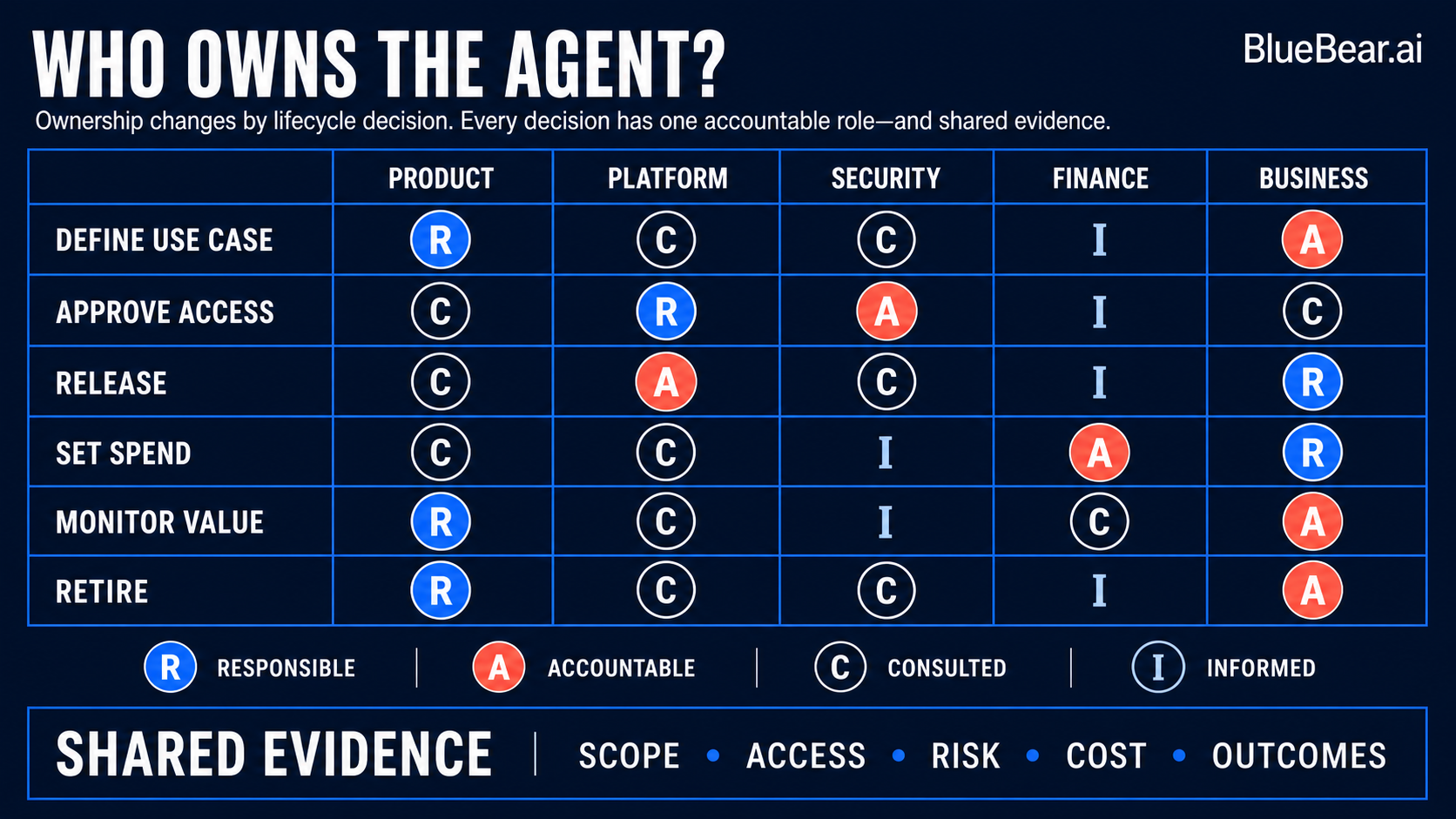
AI agent deployment often creates organizational friction after launch. Unclear decision rights quickly hinder progress and expose hidden costs.
As AI agents move from pilot to production, product, platform, security, finance, and business teams all share responsibility. Yet, incidents and budget decisions frequently expose unclear decision rights. This article provides a practical framework for assigning ownership, ensuring accountability, and driving value from your AI investments.
Leading organizations are moving beyond siloed teams. They recognize that operational clarity is crucial for scaling AI safely and efficiently. A robust operating model helps define who is Responsible, Accountable, Consulted, and Informed (RACI) across the entire AI agent lifecycle. This clarity reduces redundant effort, improves incident response, and reveals the true cost of operations.
The AI Agent Lifecycle: Defining RACI Roles
An AI agent’s journey involves distinct phases, each requiring specific ownership. Microsoft’s agentic Center of Excellence guidance, for instance, assigns lifecycle roles covering enablement, risk-based governance, release gates, reusable patterns, cost and value monitoring, and retirement [1]. This comprehensive approach is vital for enterprise-grade AI.
Intake: Strategic Alignment and Feasibility
The intake phase evaluates new agent proposals. Here, the business team is Accountable for defining the problem and desired outcome. Product teams are Responsible for initial scoping. Finance is Consulted on potential costs and ROI. Security and platform teams are Informed about technical requirements and potential risks.
- Pain Point Addressed: Starting with a clear intake process prevents "Demo success is confused with production readiness" by aligning business goals with technical capabilities early.
Deployment: From Development to Production
Deployment moves a validated agent into a production environment. The platform team is Accountable for secure and scalable infrastructure. Product teams are Responsible for agent configuration and integration. Security is Consulted on compliance and vulnerability assessments. Operations and business teams are Informed of rollout plans and potential impact.
Access: Governing Agent Usage
Managing who can use an AI agent, and how, is critical. Security is Accountable for defining and enforcing access policies. Platform teams are Responsible for implementing technical access controls. Business and product teams are Consulted to ensure access meets operational needs. All stakeholders are Informed of changes to access rights.
- Proof Point: Microsoft recommends governing agents by side effects and consequence, applying heavier controls to systems that execute changes than to assist-only systems [2]. This highlights the importance of granular access control.
Monitoring: Performance and Health
Continuous monitoring ensures agents perform as expected. Operations teams are Accountable for agent health and performance. Product teams are Responsible for defining key performance indicators (KPIs) and business metrics. Platform teams are Consulted for infrastructure metrics. Business teams are Informed of operational status and value delivery.
- Pain Point Addressed: Effective monitoring surfaces "Retries and review labor hide true unit cost" by providing visibility into operational inefficiencies.
Incident Response: When Things Go Wrong
Rapid and effective response to agent failures is paramount. Operations teams are Accountable for incident management and resolution. Platform teams are Responsible for diagnosing infrastructure issues. Product teams are Consulted on agent behavior and impact. Security is Informed of any security-related incidents, and business teams are Informed of service disruptions.
Optimization: Enhancing Performance and Cost-Efficiency
Optimization drives continuous improvement. Product teams are Accountable for identifying opportunities to enhance agent value. Finance is Responsible for tracking and optimizing cost-efficiency. Platform teams are Consulted on infrastructure improvements. Operations and business teams are Informed of changes and their impact.
- Pain Point Addressed: Clear ownership for optimization directly tackles "Provider invoices lack workflow attribution" by linking costs to specific improvement initiatives and responsible teams.
Retirement: Sunset and Archiving
Eventually, agents reach the end of their useful life. Platform teams are Accountable for decommissioning agents and archiving data securely. Product and business teams are Responsible for defining retirement criteria. Security and legal teams are Consulted on data retention and compliance. Operations teams are Informed of the retirement schedule.
The BlueBear Difference: Shared Evidence for Shared Responsibility
Many organizations struggle to implement a RACI model effectively because underlying data and controls are fragmented. Different teams operate from different versions of the truth. This leads to disputes, delays, and a lack of accountability.
BlueBear, an AI agent platform, solves this by providing shared evidence and controls that let each owner act from the same operational record. Its governed agent runtime ensures consistent execution and data capture. The BlueBear MCP gateway offers unified policy enforcement and cost attribution across agents.
This approach means that when a FinOps Lead reviews provider invoices, they see workflow attribution directly linked to specific agents and business processes. When an AI Product Director assesses an agent's readiness, they have transparent metrics, not just demo success. When an Operations Director looks at retries, the true unit cost of an agent's operation is clear, not hidden by manual labor.
BlueBear separates standards guidance, observed product evidence, hypotheses, and unknowns. This ensures decisions are always grounded in verifiable facts, not assumptions or isolated reports.
Representative Operating Scenario: The Customer Support Agent
Consider an enterprise deploying an AI agent to assist customer support. Initially, the product team champions its development. Once launched, the Operations Director becomes Accountable for its uptime and performance. The FinOps Lead is Responsible for its ongoing cost-efficiency, ensuring provider invoices accurately attribute spend. The Security Lead is Accountable for its data handling and compliance. BlueBear provides the shared operational record – from session logs and cost breakdowns to policy adherence reports – enabling each role to fulfill their RACI responsibilities with confidence and unified insight.
BlueBear AI Agent Ownership Matrix
This operating template maps each production decision to one accountable owner and the evidence BlueBear should preserve. It is an implementation guide, not a claim about a particular customer organization.
| Decision | Accountable owner | Responsible operator | Required evidence |
|---|---|---|---|
| Approve the workflow and acceptable outcome | Business workflow owner | Product or operations lead | Workflow version, acceptance criteria, risk tier |
| Approve models, routing, and fallback | AI platform owner | Platform engineering | Effective routing policy, eligible models, fallback decision |
| Approve tools, credentials, and scopes | Security owner | Integration owner | Connection ID, scopes, policy evaluation, credential reference |
| Operate runtime isolation and capacity | Platform engineering lead | Runtime operations | Workspace, tenant boundary, runtime version, quota state |
| Review exceptions and human approvals | Business workflow owner | Named review queue | Exception reason, reviewer, decision, elapsed time |
| Declare and coordinate an incident | Service owner | Incident commander | Session IDs, timeline, affected tools/models, containment action |
| Attribute cost and approve continued operation | Business sponsor | FinOps or operations analyst | Cost per accepted outcome, retry cost, review cost, budget decision |
| Retire the agent and revoke access | Service owner | Platform and integration operations | Retirement approval, disabled routes, revoked connections, retention state |
Escalation rule
Do not use a committee as the accountable owner. If a row has no named accountable role, the agent is not ready for production. BlueBear can preserve the workspace, routing, integration, session, approval, and cost evidence, but the organization must assign the human decision rights.
Practical Diagnostic Checklist: Is Your AI Agent Operating Model Clear?
Use these questions to evaluate your current workflow before adding another tool or deploying more agents:
- Can you precisely link AI agent spend on provider invoices to specific business workflows or outcomes?
- Are your criteria for production readiness clearly distinct from demo success metrics?
- Do you have transparent visibility into the true unit cost of agent operations, including retries and review labor?
- Is there a single, shared source of truth for agent performance, security, and cost data across all relevant teams?
- Are RACI roles explicitly defined and understood for each stage of your AI agent's lifecycle, from intake to retirement?
- Can you quickly identify the accountable owner for an AI agent in the event of an incident or an urgent optimization need?
- Does your current system allow different owners to access and act on the same operational evidence without manual reconciliation?
If you answered no to several of these questions, your organization likely faces significant operational blind spots and inefficiencies. These gaps will only widen as your AI agent footprint grows.
Next Steps: Achieve Operational Clarity
Effective AI agent operations demand clear ownership and shared, verifiable evidence. Without these, even the most innovative AI agents can become costly liabilities. Assign accountable owners for one agent across its full lifecycle before expanding access.
Evaluating your current workflow to identify ownership gaps is a critical first step. Tools like the BlueBear AI agent platform can provide the governed infrastructure, integrations, evidence, and cost controls needed to empower each owner and streamline your operations.