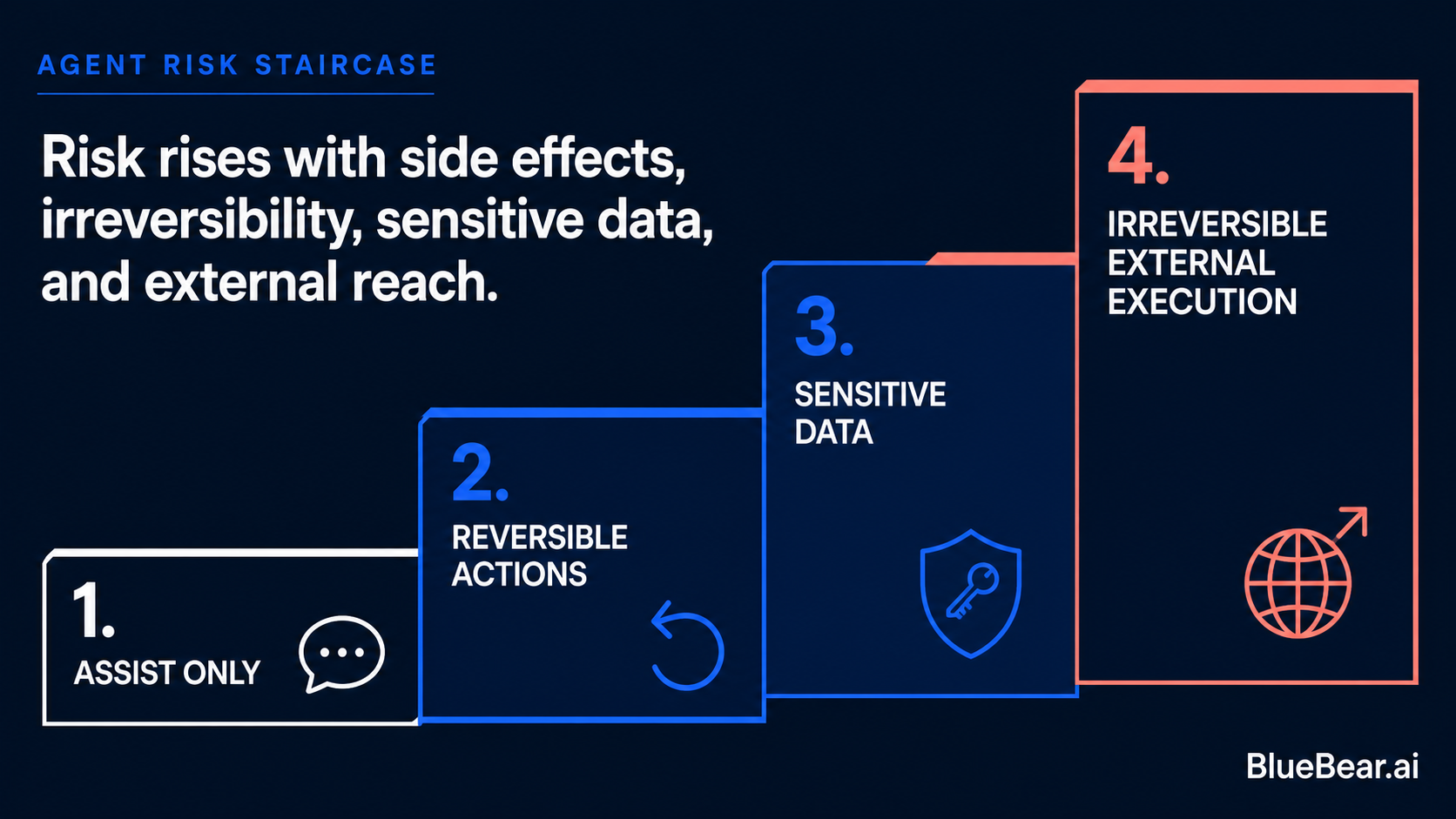
Labels like "assistant" or "autonomous agent" obscure real operational risk. What truly matters is what an AI system can actually do.
Chief Information Security Officers (CISOs), AI Governance Leads, Security Architects, and Risk and Compliance Leads in regulated operations, enterprise software, and managed services face a critical challenge. The rise of AI agents promises efficiency. Yet, without clear governance, these systems introduce new vulnerabilities. Credentials and permissions are scattered across an expanding ecosystem. Crucial logs often fail to preserve authorization context. Most concerning, tool autonomy often expands faster than an organization's policy coverage.
This article provides a practical framework to evaluate and tier AI agent risk. We will shift focus from ambiguous labels to concrete capabilities: what can an agent change, and how reversible are those changes? By understanding an agent's true impact, organizations can align controls to prevent unintended side effects, data exposure, and compliance breaches.
The Illusion of "Autonomous" vs. "Assistant"
The distinction between an "AI assistant" and an "autonomous agent" often feels more semantic than practical. Both can perform actions. An assistant might generate an email draft, while an autonomous agent might send it. The real risk differentiator lies not in the perceived "intelligence" or level of independence, but in the inherent capabilities and potential side effects of its actions. Can the system expose sensitive data, contact customers, change production records, deploy code, or spend company money? These are the questions that truly define risk.
Without clear risk-tiering based on these factors, organizations struggle with inconsistent governance. Policies designed for human users often fail to map effectively to AI agent behavior, leaving gaps in audit trails and increasing the attack surface. As AI agents gain more access to internal systems and external services, the ability to control and monitor their actions becomes paramount.
A Practical Framework: Tiering Risk by Consequence
Effective AI agent governance requires a new approach. BlueBear places approvals and evidence boundaries around consequential execution rather than conversational sophistication. This framework tiers AI agent risk based on five key dimensions: side effects, reversibility, data sensitivity, reach, and required approval authority. This practical lens allows organizations to apply appropriate controls, ensuring safety and compliance.
Side Effects and Reversibility
Consider the potential downstream impacts of an agent's actions. A side effect is any unintended or indirect consequence of an agent's operation. Reversibility refers to the ease with which an agent's action can be undone without lasting damage. An agent that only suggests code changes has minimal side effects and high reversibility. An agent that deploys code to production has significant side effects and low reversibility.
A representative operating scenario might involve two agents. One agent summarizes customer feedback, creating internal reports. Its actions have minimal external side effects and are highly reversible (reports can be edited or deleted). Another agent, however, is tasked with automatically adjusting inventory levels based on supply chain signals. If this agent makes an error, the side effects could include overstocking or stockouts, with financial and customer service impacts. Reversing these physical inventory changes is far more complex and costly.
Data Sensitivity and External Reach
The type of data an agent can access or modify is a critical risk factor. Highly sensitive data, such as personally identifiable information (PII), protected health information (PHI), or financial records, demands stricter controls. An agent with access to customer databases or internal financial systems presents a higher risk profile than one limited to public information or internal, non-sensitive data.
External reach refers to an agent's ability to interact with systems or entities outside the organization's immediate control. This includes sending emails to customers, posting on social media, or executing transactions with third-party vendors. When agents operate with high external reach and access sensitive data, existing credentials and permissions, which are often scattered, become severe vulnerabilities. Logs that do not preserve authorization context for these external interactions compound the problem, making incident response and audit nearly impossible.
Required Approval Authority
This dimension evaluates the level of human oversight or explicit approval required before an agent executes a consequential action. Actions that demand senior management approval when performed by a human should require similar, if not more stringent, approval processes for an AI agent. The challenge is that tool autonomy expands faster than policy coverage. Governance frameworks must evolve to embed these approval gates directly into the agent's workflow, rather than relying on after-the-fact reviews.
For instance, an agent proposing a minor website content update might only need a peer review. An agent initiating a significant financial transfer, however, must pass through a multi-stage approval workflow involving financial controllers and C-level executives. Mapping these human-centric approval hierarchies to automated agent actions is crucial for maintaining control and accountability.
Governing Agents: Insights from Microsoft
Leading industry voices advocate for structured governance around AI agents. Microsoft’s agentic Center of Excellence guidance assigns lifecycle roles for enablement, risk-based governance, release gates, reusable patterns, cost and value monitoring, and retirement. This comprehensive approach emphasizes that successful agent deployment relies on a robust organizational structure. Organizations must define clear responsibilities and processes to manage agents throughout their operational lifespan. See more at: Microsoft Learn on Agentic CoE.
Furthermore, Microsoft recommends governing agents by side effects and consequence, applying heavier controls to systems that execute changes than to assist-only systems. This aligns directly with the BlueBear risk-tiering framework. It underscores the importance of prioritizing the real-world impact of agent actions over their perceived sophistication. Rather than a one-size-fits-all approach, governance should be dynamic and proportional to risk. Explore this guidance further: Microsoft Learn on Governing Agents by Risk.
The BlueBear Approach: Governed Agent Runtime
BlueBear offers an AI agent platform designed to address these governance challenges head-on. Our approach provides a governed agent runtime, an environment where AI agents operate under explicit controls. This is not about stifling innovation, but about enabling secure, auditable, and compliant agent deployment, especially in regulated operations.
Through our MCP gateway, BlueBear places approvals and evidence boundaries around consequential execution. This means every high-impact action an agent attempts — whether it's changing records, contacting customers, or deploying code — can be intercepted, reviewed, and approved based on predefined policies. This directly solves the pain point where logs do not preserve authorization context, as BlueBear's runtime explicitly captures these decisions. It also ensures that tool autonomy expands with robust policy coverage, preventing unmanaged sprawl.
BlueBear’s platform provides the infrastructure to map human-centric approval workflows to automated agent actions. This allows CISOs and AI Governance Leads to ensure that critical operations maintain the same level of oversight and accountability, whether performed by a person or an AI agent. Our focus is on providing tangible workflow evidence, not just abstract feature claims.
Your Diagnostic Checklist for Agent Risk
To begin classifying and controlling your AI agents, consider the following:
- Does the agent have access to sensitive data (PII, PHI, financial)?
- Can the agent initiate external communications (email, social media, third-party APIs)?
- Are the agent's actions irreversible, or difficult and costly to undo?
- Can the agent modify production systems or customer-facing records?
- Does the agent operate with broad permissions, or are its credentials tightly scoped?
- Do existing logs clearly capture authorization context for every agent action?
- Is your policy coverage keeping pace with the expanding autonomy of your agents?
- What level of human approval would this action require if performed by a human?
Each "yes" to these questions indicates a higher risk tier and a greater need for robust governance controls.
Conclusion
The true risk of an AI agent lies in its capacity to effect change, not in its conversational abilities. By focusing on side effects, reversibility, data sensitivity, reach, and required approval authority, organizations can build a resilient governance framework. BlueBear provides the governed agent runtime needed to implement this framework effectively, ensuring that AI agent adoption enhances operations without compromising security or compliance.
Classify agents by side effect and reversibility, then align controls to each tier. Evaluate your current workflow before adding another tool, and ensure your AI agent platform provides the granular control and auditability you need.