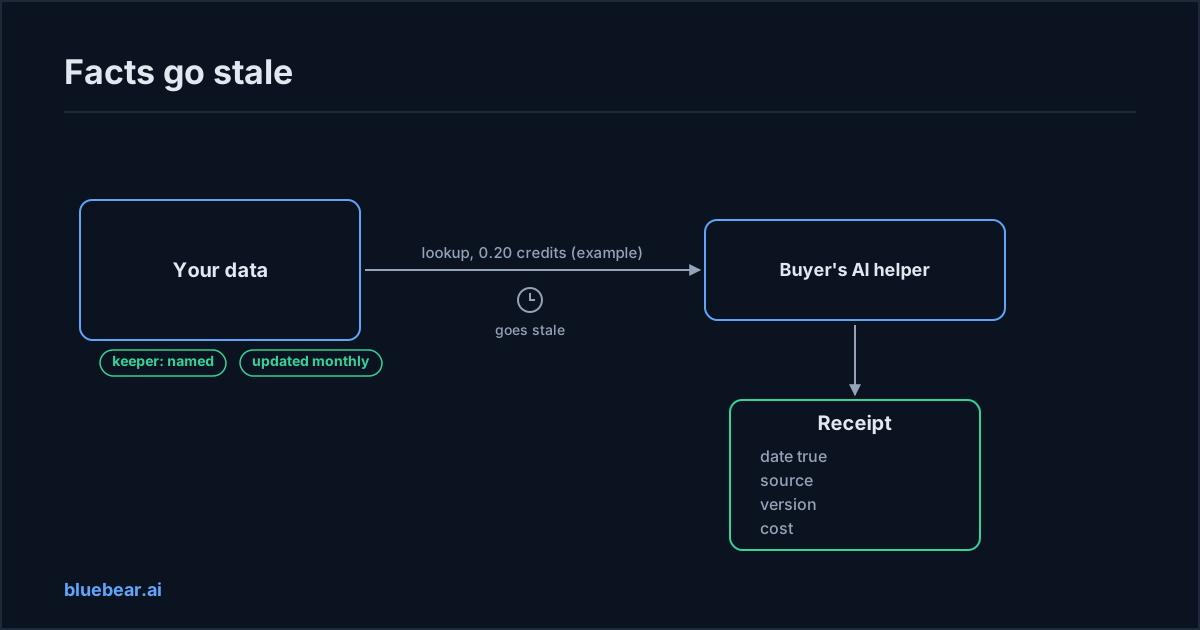
You publish a price book for building supplies. Contractors have paid for it for twenty years. Last month one of them called, angry. His AI helper quoted a job using a price from three weeks ago. He lost money on the job. He blamed you.
The problem
You update the book every week. His helper was not using your current copy; it was using a copy someone saved in the spring. But he did not know that, and neither did his helper. To him, "your price" was wrong.
Meanwhile the thing you actually do, keeping the list current, is the thing nobody pays you for. Buyers pay once for access. The weekly work of chasing suppliers and fixing entries is invisible. When it slips, you get blamed. When it does not slip, nobody notices.
The helper itself is part of the problem. Researchers at Google described it plainly.
"Most large language models (LLMs) are trained once and never updated; thus, they lack the ability to dynamically adapt to our ever-changing world."
The helper cannot keep up on its own. Someone has to supply the fresh fact, every week. That someone is you, and that is the product.
So you are asking two questions. How do I stop being blamed for old copies? And how do I get paid for the freshness that is my real product?
Why this keeps happening
AI helpers have three clocks, and buyers mix them up. The first is when the model learned things; anything after that date is invisible unless someone supplies it. The second is when the helper fetched a record. The third is when the fact was true at the source. Your buyer's helper needs the third clock, stamped on each record. Most data does not carry it.
Even the first clock is shaky. As of 2024, researchers at Johns Hopkins found that the date a model vendor reports often differs from the date its knowledge really stops. One reason is that old copies of data get mixed into new training sets. So the only clock a buyer can act on is the one you stamp on the record.
When people ask what is data freshness in ai agents, that third clock is the answer. Without it, a helper asked for a price it cannot look up will make up a likely one. That is the real ai data integrity problem for helpers. It is not data getting corrupted in transit. It is data being invented at the source because the true source was not there.
Your data is a kind of thing a model must never guess. So are permit records, registries, payer rules and product lists. That kind of data has one awkward trait: it does not get better with use. It goes stale.
| Kind of thing sold to AI helpers | What happens over time | Natural way to charge |
|---|---|---|
| Facts a model must look up (prices, permits, registries) | Goes stale, usually monthly | Per lookup or per month |
| How another system behaves this month | Changes with each release of that system | Per month |
| A checker that passes or fails an answer | Gets better with every case it sees | Per check |
| Rules with an effective date and a named keeper | Changes when the rules change | A keeper's retainer |
The first row is you. What it costs you when freshness is not the product: one angry contractor becomes a story other contractors hear. Stale copies spread and carry your name. And the weekly work that prevents all of this is unpaid. The buyer-side view of this is in how businesses keep AI from corrupting their data. Your job as the seller is to make the honest path cheaper than the invented one.
How to fix it
- Stamp every record with the date it was true. Not the date it was fetched. Add where it came from. Make both travel with every answer.
- Publish your update schedule and keep it. "Updated every Monday" is a promise buyers can build on. Missing it is a breach.
- Move your last-updated date only when the data changed. Not when the server restarted. Buyers' helpers read that date to decide whether to trust you.
- Number your versions. A buyer's helper that pinned version 12 should never wake up to a new layout in version 13 without being told.
- Announce when a source changes under you. A county replaces its permit portal, a supplier changes its catalogue. Say so in a release note.
- Price per lookup or per month, not per download. A download goes stale in a drawer. A lookup is always the current answer, and you get paid every time it is useful.
- Attach a check to the data. Data alone goes stale. Data plus a checker that says "this quote used a current price" gets more valuable with use.
Here is the pricing choice, in BlueBear's unit. One credit is $1. The figures are examples, not a price list.
| Charge | Fits when | Example |
|---|---|---|
| Per lookup | Calls are now and then, and each answer stands alone | 0.20 credits per price check |
| Per month | The helper needs the whole set current or reads it all day | 40 credits a month per team |
| Both | Heavy users want a flat rate, light users want to pay by the call | Offer both; the buyer's helper picks within its budget |
Buyers ask how do you handle data freshness requirements for time-sensitive ai agents. Their answer is a rule that rejects any fact older than a limit. This guide to those rules shows the buyer's side. Your schedule and your date stamps are the inputs those rules read. Agent data freshness is a two-sided deal, and your half is the promise.
Some buyers will say a free web search fixes freshness well enough. The Google researchers did find that adding search helps with questions about recent events. Your price book is not a recent event. It is not on the open web, and a search cannot tell the spring copy from this week's. A lookup with a date on it can.
Per-lookup pricing has one risk for both sides. A helper stuck in a loop can call you a thousand times before anyone notices. As of December 2025, OWASP's guide to AI agent risks lists over-calling paid services as a known failure. Ask that every buyer set a cap per job, and set your own rate limit too.
What BlueBear's marketplace does about it
On BlueBear's marketplace your data is sold as an offer with a public page. The page can show the keeper, the update schedule and the last-updated date. The price is per lookup or per month, in credits. A buyer's AI helper reads the price and the schedule, checks its own budget, and either goes ahead or asks a person. Nobody negotiates by email.
Every lookup gets a receipt: who paid, which version, what it cost. For data, the receipt also carries the date each fact was true and where it came from, if you include them in your answers. Three things follow. The buyer can prove months later that their helper used a fact that was right on that date. A dispute about a wrong quote is settled by reading the receipt: if your source said that price on that date, you did your job. And your share of each job is a line tied to the same receipt, so the record that protects the buyer is the record that pays you.
Buyers never get your key; they get proof they paid, limited to their budget, and access you can switch off per buyer. A named reviewer can check and sign off a result before it is released, and if a result is rejected the buyer is refunded. The receipt is the same record buyers keep of what their helper did.
What is manual or not built. The marketplace is a pilot, and listing is by invitation; BlueBear lists the offer for you. Payouts are done by hand. Choosing between two data sellers automatically is future work. The kinds in the table above, and the keeper and schedule fields, are guidance during the pilot, not a gate. An offer that fits none of them can still be sold.
What to do next
This week, add a date-true stamp and a source to every record you serve. Write your update schedule down where buyers can see it. Then decide per lookup, per month, or both.
If you have not yet solved the key problem, read how to sell data access without handing out keys. To see how offers show their schedule, price and keeper today, browse the BlueBear marketplace. Data an AI helper must not guess is the inventory a marketplace like this most needs.
Questions people actually search for
- how do you handle data freshness for time-sensitive ai agents
From the seller's side, three things. Stamp every record with the date it was true at the source, not the date it was fetched. Publish an update schedule and keep it, and change your last-updated date only when the data really changed. Make sure the date stamp and the source travel with each answer, so the buyer's helper can reject anything older than its own limit. Buyers write rules that read your schedule. Agent data freshness is a two-sided deal, and the schedule is your half.
- should i charge per lookup or per month for data
Per lookup fits buyers who ask now and then and each answer stands alone, such as one permit record or one price check. They pay only for decisions that needed your fact. Per month fits buyers whose AI helper needs the whole set current or reads it all day, such as a weekly list of every new permit in a county. They are paying for freshness itself. Many sellers offer both and let the buyer's helper pick within its budget.
- why do ai helpers make up prices and dates
Because a language model asked for a fact it cannot look up will produce a likely-sounding one. It learned from text up to a cutoff date, and everything after that is invisible unless someone supplies it. Prices, permits, rules and product lists change after that date. The only cure is a maintained source the helper must check, with a date on every answer. That is the product a data owner sells.
- what do i owe buyers if i sell live data
An update schedule you keep. A last-updated date that moves only when the data moves. Numbered versions, so a buyer's helper that pinned one version does not see a silent change in the layout. And a note when a source changes under you, such as a county replacing its permit portal. On BlueBear's marketplace, a material change to how data is handled needs the buyer to approve again, so the schedule is a contract, not a label.