You are a bookkeeper who got good with AI helpers. You built a routine that turns a shoebox of receipts into a clean expense report. You posted it free in a forum. Six months later it has spread to firms you have never heard of.
The problem
Every time your routine runs, it calls a paid service to read the receipts and another to check the totals. Those two services get paid on every run. You know this because their owners thanked you for the traffic.
You earned nothing. Not because anyone cheated you. Because nothing anywhere records that your routine sent the work. The service owners see a call. They do not see where it came from.
You have thought about charging for the file instead. But it is already out there. Charging now would just push people to the free copy, and you would lose the spread that makes it useful.
The one big store that ever promised to pay people like you tied the money to attention, not to work done.
"In Q1 we will launch a GPT builder revenue program. As a first step, US builders will be paid based on user engagement with their GPTs."
Pay by attention rewards whatever is popular. It cannot see which routine sent the paid work.
Why this keeps happening
A routine is a text file. It runs inside the buyer's AI helper, where you cannot see it or count it. If you have written Claude Code skills, you know the feeling: the work happens somewhere else. What can be counted is the paid work underneath, because it runs on someone's server.
So people ask how to monetize skill.md skills, and how to sell claude skills, and the answers are all versions of "put a zip file in a store". A store sells the file once. It records nothing about what the file calls afterward. That is the gap between what you built and what you get paid for.
Look at who pays creators today. As of September 2026, the picture is thin.
| Where you could post it | What you get | Records what your routine calls? |
|---|---|---|
| OpenAI's app store | Approves paid transactions only for physical goods, through the seller's own checkout | No |
| Anthropic's plugin and connector lists | No revenue share | No |
| PromptBase | Keeps 20 percent on sales through its site, 0 through your own link | No |
| Gumroad | Charges 10 percent plus 50 cents per sale | No |
| Apify | Pays 80 percent of pay-per-event revenue to the developer after platform costs | No |
| Relevance AI | Takes 0 percent on templates priced up to $1,000 | No |
The last column is the whole story. People search for "how to make money building ai agents" and find gpt store revenue sharing threads from two years ago. None of these places can pay you when your free routine drives someone else's paid tool, because none of them can see it happen.
How to fix it
- List every paid service your routine calls. Name, what it does, rough price per use. This list is your income statement in waiting.
- Ask each service owner for a referral deal, in writing. "You pay me 5 percent of what my routine sends you for the first year" is a normal ask. They already thanked you for the traffic.
- Put a referral code in your routine where the service supports one. Then every copy of your routine carries your code, and copies work for you instead of against you.
- Decide free or paid with a clear rule. If the paid steps underneath are expensive and used often, stay free. If the know-how in your steps is the rare part, charge.
- Keep a paid, maintained edition for teams. A firm with a purchasing process needs a licence and someone to call. They will pay for that even when a free copy exists.
- Track runs, not downloads. Downloads tell you who was curious. Runs tell you who is making money with your work.
Here is the arithmetic, in BlueBear's unit. One credit is $1. Every number below is an example, not a price list, and the referral share is a deal between you and the service owner, not a fixed rule.
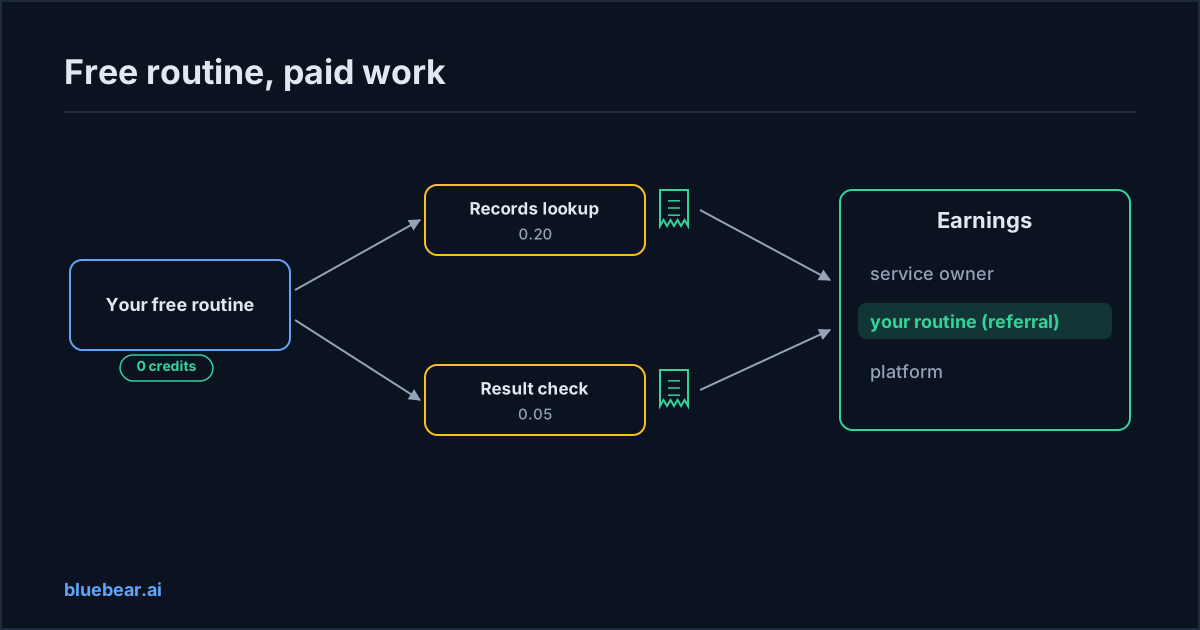
Say your free routine calls a records lookup at, for example, 0.20 credits per use and a result check at 0.05 credits. One firm runs it 500 times in a month.
| Line | Uses in a month | Price each (example) | The firm pays |
|---|---|---|---|
| Records lookups | 500 | 0.20 credits | 100 credits |
| Result checks | 500 | 0.05 credits | 25 credits |
| Your routine | 500 runs | free | 0 credits |
| Total | 125 credits ($125) |
If both service owners agreed to pay you 5 percent of what your routine sends them, that firm is worth 6.25 credits a month to you. One firm is not a business. Two hundred firms at that volume is 1,250 credits a month, from a file you gave away, with no support duty for the data underneath.
Compare selling the same routine once, at 9 credits, to those two hundred firms. That is 1,800 credits, once, and then nothing, while every buyer is free to share the file. The two are not either-or. Many people sell a maintained edition and still collect on the paid work underneath.
Some sellers charge a few dollars for the file alone and do fine. Their buyers pay for the time saved, not for a secret. If that is your buyer, charge for the file. The free model is for routines where the paid steps underneath are the expensive part.
A plain rule for choosing.
| Your situation | Better model |
|---|---|
| Steps are simple, paid services underneath are costly and used often | Free routine, share of the paid work |
| Steps hold rare know-how, services underneath are ordinary | Paid routine or paid updates |
| Routine tracks a tool that changes every month | Paid subscription to the current version |
| Buyers are firms with a purchasing process | Licence per team, plus a share of the paid work |
What BlueBear's marketplace does about it
BlueBear's marketplace lists routines and the paid services they call in the same place. A routine can be free. When a buyer's AI helper runs it and calls a paid service, that job gets a receipt. The receipt records who paid, what ran, and what it cost. It can also carry your routine's name or your referral code.
Your earnings are written down as a line tied to that receipt. The line can be added to but never edited. If there is ever a dispute, both sides read the receipt. Nobody argues from memory. The buyer, meanwhile, sees one total price, and they use the same receipt as the record of what their helper did.
The plain limits. The marketplace is a pilot, and listing is by invitation; BlueBear lists your routine for you. The referral code is optional. Payouts are done by hand. BlueBear does not sort or promote listings, so a free routine spreads because you spread it. A finer split, where each rule inside a service earns on each decision, is not built.
That is a smaller machine than the example above. What it proves during the pilot is the chain from a run, to a receipt, to a line with your name on it. That chain is the part every store in the table is missing. It also lets buyers see what a finished job actually costs them, with your routine and its paid steps on one bill.
What to do next
Write your list of paid services today. Email the owners and ask for the referral deal. Decide, with the table above, whether the file stays free. Then read what it takes to list a routine without running a store. The paid services a routine can call today are on the BlueBear marketplace.
Questions people actually search for
- how does a free ai routine earn money
Two things have to be true. The paid service your routine calls must agree to share a cut with whoever sends the work. And something has to record that your routine sent it. On a marketplace that does this, each paid job leaves a receipt that names your routine or your referral code, and your share is written down as a line you can read. Copies of your routine that keep the same paid steps still earn for you.
- what is gpt store revenue sharing today
As of September 2026, OpenAI's app rules say digital goods and subscriptions cannot be sold inside ChatGPT. Physical goods are handled by linking out to your own site. The earlier revenue program for custom GPT builders was US-only and its terms were never published. Neither records what a GPT or app depends on, so there is no way to pay you when your routine drives use of someone else's paid tool.
- what is an ai agent revenue share
It is a cut of the money a paid job earns, paid to the people who made that job happen. In practice the buyer pays one price. Underneath, that price is split between the owner of the data, the person who built the service, any human who checked the result, whoever sent the work, and the platform. If your routine sent the work, your cut is the referral line. Regulated professionals such as lawyers take a fee instead of a share.
- should i sell my ai routine or give it away
Give it away when the paid services it calls are the expensive part and get used often, because more copies mean more paid runs you share in. Charge for it when the know-how in the steps is rare and the tools underneath are ordinary, or when it tracks something that changes monthly. Teams with a purchasing process often need a licence more than a download. Many people do both: a free edition and a paid, maintained one.