What changed: Updated 18 August 2026: added the record fields that make a completed-workflow denominator defensible, and the reliability-versus-routing trade-off that becomes visible once failed work is counted.
Token prices alone misrepresent the true cost of AI agents in production environments.
The Hidden Costs of AI Agent Workflows
Organizations developing and deploying AI agents often fixate on the per-token cost of large language models (LLMs). This focus is understandable. LLMs, the core technology powering AI agents, bill based on tokens—units of text input and output. Yet, focusing solely on token price creates a critical blind spot for operations leaders, heads of AI, and FinOps leads.
The core problem is clear: token price excludes retries, failed tools, review labor, idle infrastructure, and work that never reaches an approved outcome. This incomplete view obscures the actual economic impact of AI agent deployments.
Consider the common pain points:
- Provider invoices lack workflow attribution. Current billing models from AI providers often aggregate costs at a high level. They do not typically break down spending by individual agent workflows or their outcomes. This makes it nearly impossible to connect specific business processes to their operational AI costs.
- Demo success is confused with production readiness. An AI agent performing well in a controlled demo environment does not reflect its cost efficiency or reliability in a real-world production setting. Demos rarely account for the iterative failures, retries, and human oversight often needed for complex tasks.
- Retries and review labor hide true unit cost. When an AI agent fails a task, the tokens for that attempt are still consumed. If a human has to review and correct an agent's output, that labor adds a significant, often unmeasured, cost. These factors inflate the true unit cost of a successful AI agent workflow.
An AI agent is an autonomous software program that uses large language models and other tools to perceive its environment, make decisions, and take actions to achieve a goal. A workflow defines the sequence of steps and tools an agent uses to complete a task. Understanding the economics of these workflows is crucial for scaling AI initiatives responsibly.
Building a True Unit Cost Equation for AI Agents
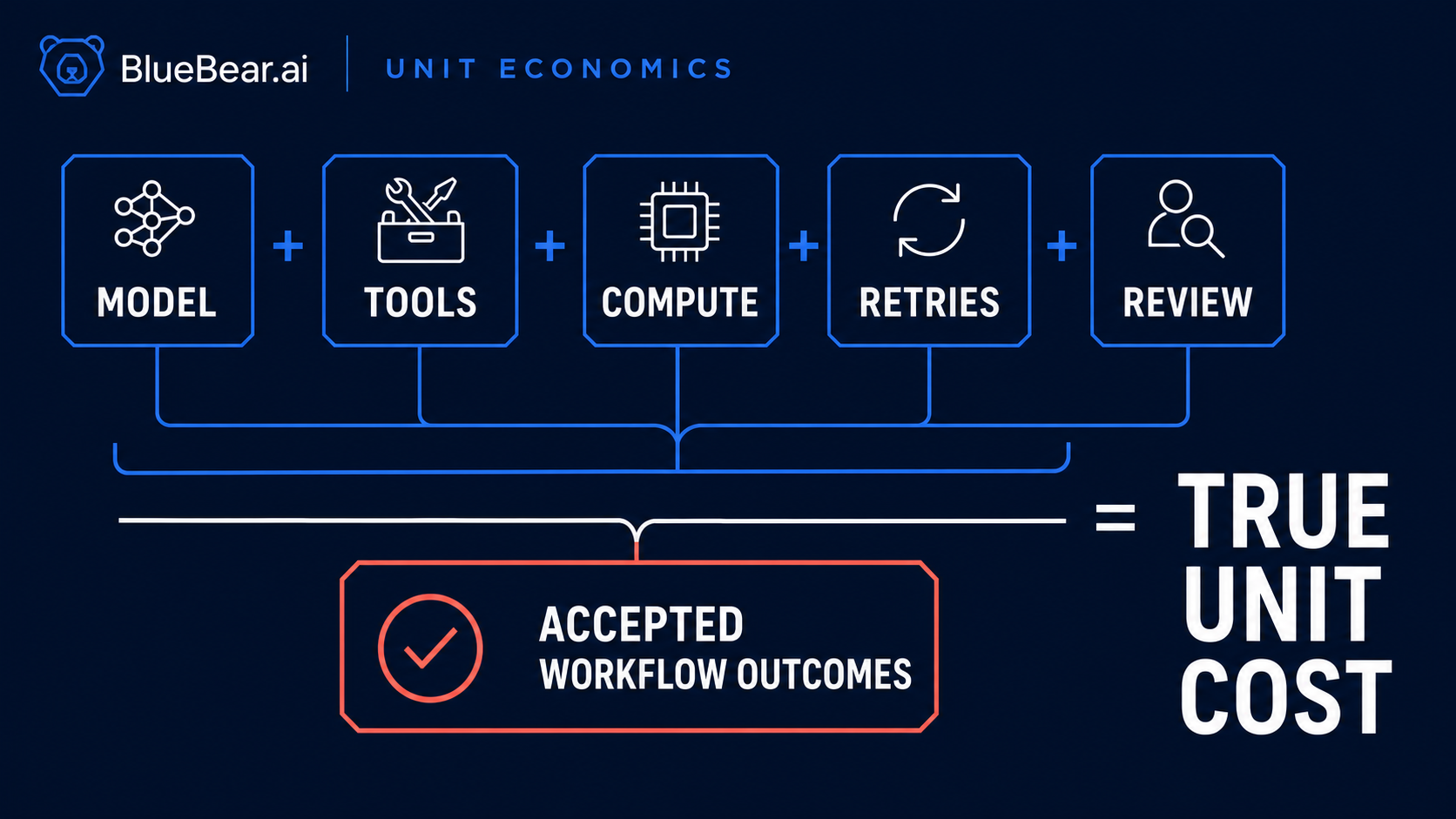
To accurately measure AI agent economics, organizations must move beyond raw token consumption. A practical unit-cost equation for AI agents focuses on the cost per completed, accepted workflow. This approach captures all resources expended to achieve a desired, validated business outcome.
The true unit cost of an AI agent workflow can be framed as:
True Unit Cost = (Total Model Cost + Total Tool Cost + Total Compute Cost + Total Retry Cost + Total Review Labor Cost + Total Idle Infrastructure Cost) / Number of Accepted Workflow Outcomes
- Total Model Cost: This includes all token consumption across all attempts, including those that failed or were retried.
- Total Tool Cost: Many AI agents interact with external tools or APIs. These interactions incur costs, whether for database queries, API calls, or specialized microservices.
- Total Compute Cost: Running AI agents requires computational resources, even if only for orchestration or specific processing tasks.
- Total Retry Cost: Failed attempts are not free. Each retry consumes additional tokens, tool usage, and compute cycles.
- Total Review Labor Cost: Human intervention for quality assurance, correction, or validation represents a direct operational cost. This often goes unquantified.
- Total Idle Infrastructure Cost: Infrastructure provisioned for agents but not actively used still incurs costs.
- Number of Accepted Workflow Outcomes: This is the crucial denominator. It represents only those agent tasks that successfully delivered the intended and validated business result.
This equation provides a commercially literate view of AI agent operations, linking expenditure directly to tangible value.
Industry Perspectives on AI Cost Management
The complexity of AI agent costs is a recognized challenge in the industry.
AWS guidance specifically highlights that "iterative reasoning loops and multi-agent handoffs create cost dynamics that require explicit termination conditions, token budgets, and separate orchestration-versus-execution measurement." This guidance underscores the need for granular control and visibility beyond basic token counts. Agentic systems, by their nature, can accumulate significant costs through extended or inefficient reasoning processes.
Similarly, the FinOps Foundation, a leading authority on cloud financial management, describes AI costs as "granular and unpredictable." They advocate for comprehensive strategies encompassing "allocation, forecasting, optimization, policy, and governance" to manage these emerging expenditures effectively. This perspective reinforces the necessity of robust financial operations practices for AI, extending far beyond simple API pricing.
The BlueBear Approach: Cost Visibility at the Operating Unit
The challenge for enterprises is to implement a system that provides this level of detailed cost attribution. This is where BlueBear offers a distinct advantage.
BlueBear connects session usage, tool activity, runtime cost, and final workflow status so teams can examine cost at the operating-unit level. Unlike generic monitoring solutions, BlueBear provides specific visibility into every step of an AI agent's operation.
Our AI agent platform integrates an MCP gateway (Multi-Cloud Proxy) and a governed agent runtime. The MCP gateway provides a unified control plane across various AI models and cloud providers. The governed agent runtime ensures that agents operate within predefined cost and performance parameters. This combination allows for a precise accounting of all resources consumed by each workflow.
With BlueBear, every token, every tool call, every compute cycle, and every retry is associated with a specific agent session and its ultimate outcome. This granularity enables Head of AI, AI Product Director, FinOps Lead, and Operations Director roles to understand exactly where costs are incurred and for which business results.
A Representative Operating Scenario
Imagine an enterprise AI agent designed to process customer support inquiries. Without granular tracking, a single customer interaction might appear as a low token cost. However, a true unit cost analysis would reveal:
- The agent failed twice before successfully escalating the issue, consuming tokens on all three attempts.
- It invoked an external CRM tool four times, each with a micro-transaction fee.
- A human agent spent five minutes reviewing the escalation notes due to the initial failures.
- The dedicated compute cluster for this agent ran idle for several hours overnight.
BlueBear's platform surfaces these details, attributing all costs to that single customer support workflow, whether it resulted in a successful resolution or an escalation requiring human intervention. This transparency makes the true cost of each customer interaction visible.
Your AI Agent Cost Diagnostic Checklist
To begin evaluating your current AI agent economics, consider these practical questions:
- Can you attribute LLM token spend directly to specific agent workflows and their outcomes?
- Do your cost reports differentiate between successful workflow completions and failed attempts?
- Are you tracking the cost of external tool usage by your AI agents?
- Have you quantified the labor costs associated with human review and correction of agent outputs?
- Do you have visibility into idle compute resources provisioned for AI agents?
- Can you set and enforce token budgets or spend limits per agent or workflow?
- Are you able to compare the cost-effectiveness of different agent designs or LLM providers for the same business task?
If your answers to these questions reveal gaps, it signifies an opportunity to gain better control over your AI agent investments.
Next Steps for Cost-Optimized AI Agents
Understanding the full economic picture of your AI agent initiatives is no longer optional. It is a strategic imperative for any enterprise serious about scaling AI responsibly. Before adding another tool, take the time to evaluate the current workflow and its true cost.
Calculate a baseline cost per completed workflow for one high-volume agent process. This concrete step will illuminate your current spend dynamics and highlight areas for optimization.
The fields that make a cost-per-outcome number defensible
A cost-per-outcome figure is only as good as the record behind it. These are the fields BlueBear's gateway attaches to a routed request; the point is not the platform but that each one is unrecoverable after the fact. None of them can be reconstructed from a provider invoice, which knows an API key and nothing else.
| Field | What it prevents | Recoverable later? |
|---|---|---|
| Tenant or customer identifier, resolved from the authenticated caller | Blended margins that hide which accounts are unprofitable. Deriving it from the credential rather than trusting the application to supply it means a background job cannot forget it. | No |
executionSucceeded | Counting failed work as delivered work. Failed runs cost full price. | No |
userRegenerated | Declaring a saving that was actually a quality regression. A change that cuts model cost by 20% and raises regenerations by 30% reads as a win on any cost dashboard. | No |
toolCallFailed | Missing the failure mode that separates models most sharply, and moves first after a model change. | No |
| Input and output tokens, held separately | Applying an input-side fix to an output-heavy problem. Output tokens are priced above input tokens by every major provider. | Sometimes |
| Cost projection with its derivation source | Presenting a heuristic estimate with the same confidence as an observed one. Ours records whether a projection came from an explicit token demand or a message-size heuristic, and any calibration carries its sample count. | No |
Prices themselves are held per million tokens with the unit as an explicit field rather than a convention — a factor-of-1000 error between per-1K and per-1M pricing is easy, embarrassing, and entirely avoidable.
One consequence worth drawing out. Once failed and retried work is visible as its own line, a reliability fix starts competing directly with a model-substitution project for the same budget — and it frequently wins, because it carries no quality risk. Teams that only measure spend by model never see that trade-off exists. Finding your most expensive LLM calls covers the six cuts that surface it.
Where to go deeper
- Why AI agent costs spike — retries and step growth, the two causes that most distort a denominator.
- One request, many model calls — the anatomy behind a single completed workflow.
- Find your most expensive LLM calls — turning a total into a ranked list you can act on.
- The cost-per-outcome calculator — an editable worksheet with a stated method.
Questions people actually search for
- how do I calculate cost per completed workflow
Divide total workflow cost — model, tools, allocated runtime, retries, human review at a loaded rate, and exception handling — by the number of results the business actually accepted. The denominator is the hard part and it is where the number is usually wrong: a completed model call is not a completed workflow, and rejected output belongs in the numerator but not the denominator.
- do failed ai workflows count towards cost
Yes, in full, and excluding them is the most common way a unit-cost figure flatters itself. Every attempt is billed whether or not it produced a usable result. If a fifth of runs fail or are rewritten by a human, the real cost per delivered result is around 25% above the cost per run before any review time is counted.
- cost per call vs cost per outcome
Cost per call measures the infrastructure. Cost per outcome measures the business. They diverge by exactly the rate of retried, failed and human-corrected work, and the gap between them is the number worth managing — a change that lowers cost per call while raising the correction rate can raise cost per outcome.
- what is a good cost per ai workflow
There is no credible cross-industry number, and any figure quoted as one is generalising across wildly different work. The useful comparison is against your own alternative: what the same outcome costs without the agent, including the human time it displaces. That comparison is answerable and it is the one a budget holder actually asks.