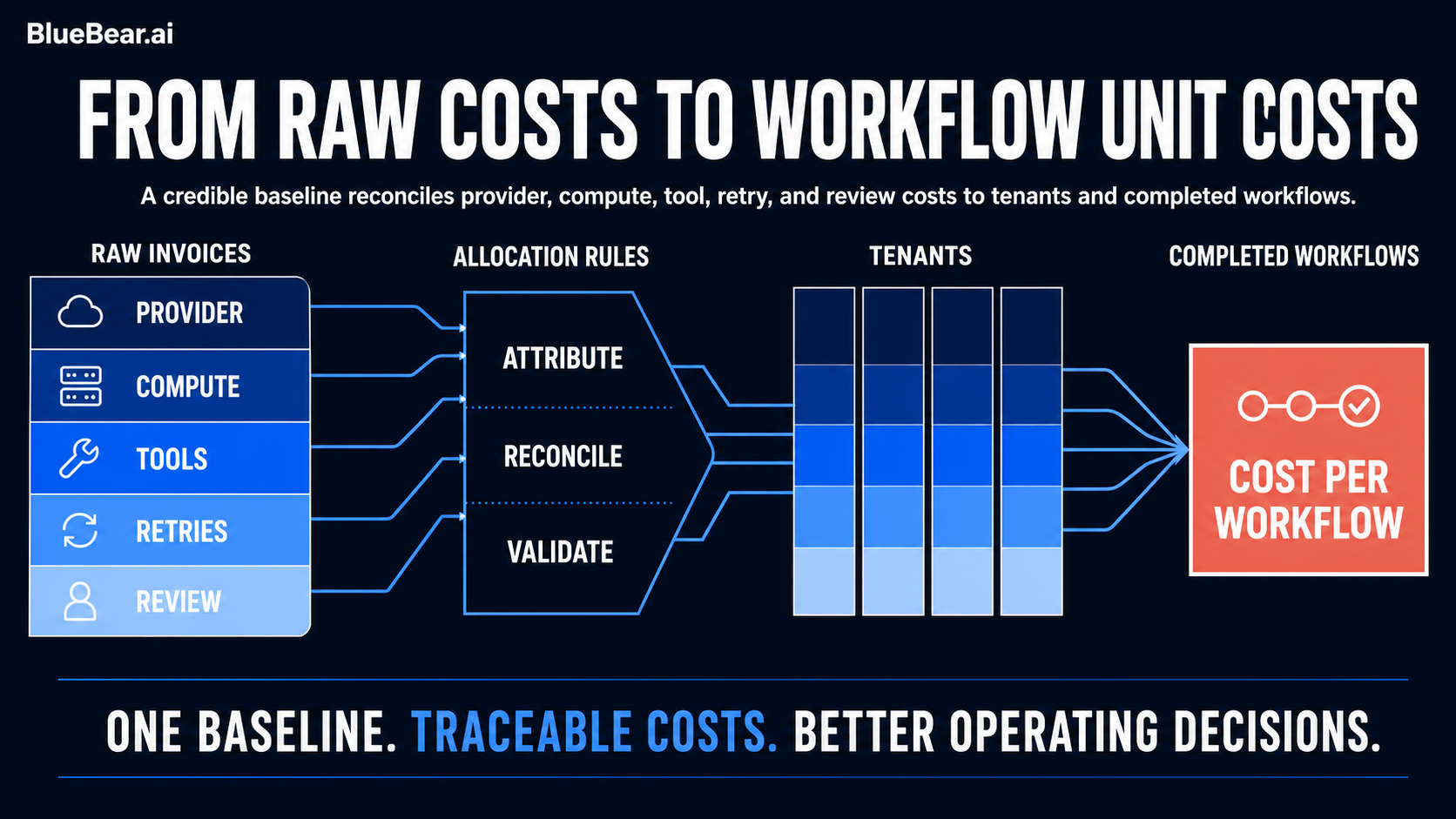
What changed: Updated 18 August 2026: added the record-level fields a baseline depends on, and which of them cannot be reconstructed once the window has passed.
AI initiatives often hide their true operational costs until it's too late.
For Heads of AI, AI Product Directors, FinOps Leads, and Operations Directors, managing AI agent deployments means more than just negotiating provider discounts. It involves a deeper challenge: accurately attributing usage, retries, review labor, and even idle capacity to specific workflows or tenants. Without this clarity, decisions about scaling, optimizing, or even continuing an AI agent project are made in the dark. This article provides a practical framework to define an AI agent cost baseline, ensuring your investments deliver measurable value.
Why AI Agent Costs Remain Opaque
Many organizations launch AI agent projects with high hopes, only to find that the financial landscape becomes murky post-deployment. Provider invoices often lack the granular detail needed for workflow attribution. What looked like a successful demo can quickly become a production readiness headache when the actual costs of operation are exposed. Moreover, the hidden expenses of retries and human review labor can obscure the true unit cost of an agent's output, making it impossible to distinguish between efficient and inefficient operations.
The FinOps Foundation highlights this complexity, describing AI costs as both granular and unpredictable. They advocate for robust allocation, forecasting, optimization, policy, and governance strategies to manage these evolving expenditures. This is critical for any enterprise software, AI platforms, or managed services company looking to maintain control over its AI spending. FinOps for AI underscores the need to align consumption, investment, and business value.
Elements of a Credible AI Agent Cost Baseline
To gain control, you need to define a "baseline packet" for AI agent costs. This packet includes a set of quantifiable elements that together form a comprehensive view of your expenditure. These elements are:
- Sessions: Each interaction or continuous period of activity with an AI agent.
- Models: The specific large language models (LLMs) or other AI models invoked by the agent.
- Tools: External APIs, databases, or specialized functions an agent uses to complete tasks.
- Compute: The underlying processing power and infrastructure consumed by the agent runtime.
- Retries: Instances where an agent failed to produce an acceptable output on the first attempt, requiring additional processing.
- Approved Outputs: The final, validated results from an agent's session, often requiring human review.
- Ownership: The specific team, project, or tenant responsible for a given agent's operation and consumption.
Iterative reasoning loops and multi-agent handoffs introduce unique cost dynamics. Unlike traditional, more predictable compute patterns, agentic systems can accrue significant costs through extended or inefficient reasoning. AWS guidance emphasizes that designing cost-aware reasoning patterns from the outset, with explicit termination conditions and token budgets, is essential. This prevents cost overruns that often emerge as agentic projects scale. AWS Well-Architected Framework highlights the importance of measuring orchestration versus execution costs separately.
Connecting Technical Consumption to Business Value: The BlueBear Approach
Establishing an AI agent cost baseline requires tools that bridge the gap between technical consumption and business context. This is where BlueBear's operating story comes into play. BlueBear’s sessions and usage controls connect technical consumption to workspace and workflow context. This capability is central to transforming opaque invoices into actionable insights.
The BlueBear AI agent platform provides a governed agent runtime and an MCP gateway. These components work together to track and attribute every element of the baseline packet. Instead of seeing a monolithic provider bill, you gain visibility into how specific models are used within particular sessions, which tools are invoked, and the compute resources consumed. Critically, BlueBear helps to track costs by project or tenant, directly addressing the pain point of provider invoices lacking workflow attribution.
BlueBear Cost-per-Outcome Baseline Worksheet
BlueBear's Sessions and Budget Manager surfaces make technical consumption inspectable, but a defensible baseline must also include retries, exceptions, and human review. Use actual approved rate inputs; the example formula contains no claimed customer measurements.

workflow cost =
  model cost
  + tool/API cost
  + allocated runtime cost
  + retry cost
  + human review cost
  + exception-resolution cost

cost per accepted outcome = workflow cost / accepted outcomes| Measure | Collection rule | Common distortion |
|---|---|---|
| Attempts | Count every initiated session for the workflow version and period. | Counting only successful model calls. |
| Retries and fallbacks | Attach each retry and fallback to its originating session and reason. | Blending recovery spend into an aggregate invoice. |
| Review and exceptions | Record approval or queue elapsed time and multiply only active labor by an approved rate. | Treating all elapsed queue time as labor, or ignoring labor entirely. |
| Accepted outcomes | Reconcile terminal BlueBear state with the business system of record. | Using agent completion as a proxy for business acceptance. |
| Allocation | Apply the same documented runtime-allocation rule across comparison periods. | Changing the allocation method after an optimization. |
Publish the measurement window, workflow version, sample size, rate source, exclusions, and confidence range beside every baseline so another reviewer can reproduce the result.
Practical Diagnostic Checklist: Steps to Audit Your AI Agent Spending
Before investing in more capacity or new AI tools, conduct a thorough diagnostic of your current AI agent spending. This checklist helps you evaluate existing workflows and identify areas for cost optimization:
- Do your current provider invoices clearly break down usage by individual AI agent, project, or tenant?
- Can you easily identify the costs associated with agent retries and human review cycles for each workflow?
- Are you accurately distinguishing between the costs of a successful proof-of-concept and the operational costs of production readiness?
- Do you have mechanisms to set and enforce token budgets and termination conditions for agent reasoning loops?
- Can you track the invocation of external tools and APIs by your agents and attribute those costs?
- Is there a clear ownership model for each AI agent, with corresponding cost accountability?
- Can you identify and measure idle capacity or unused agent resources within your current infrastructure?
Representative Operating Scenario: Tracing Costs in a Multi-Agent Workflow
Consider a representative operating scenario in an enterprise software company. A "Customer Support Agent" workflow utilizes several specialized AI agents: one for natural language understanding (NLU), another for knowledge base retrieval, and a third for drafting responses. Initially, the team celebrates a successful demo, where the agents efficiently handled common queries. However, a few months into production, the FinOps Lead notices a significant increase in the overall Large Language Model (LLM) bill with no clear understanding of the drivers.
Without a cost baseline, it's difficult to pinpoint the issue. Is the NLU agent making too many unnecessary calls to an expensive model? Is the knowledge base retrieval agent failing frequently, leading to costly retries? Are human reviewers spending excessive time correcting poorly drafted responses, indicating a higher true unit cost for approved outputs? This scenario perfectly illustrates how "demo success is confused with production readiness" and how "retries and review labor hide true unit cost."
With BlueBear's capabilities, this FinOps Lead could trace the usage of each model, tool, and compute resource for every session within the Customer Support Agent workflow. They would see detailed logs of retries, allowing them to optimize agent design or prompt engineering. Human review time could be linked directly to specific agent outputs, revealing the true cost per approved response. This granular visibility helps teams move beyond simple provider invoices to understand the actual economic performance of their AI agents.
Take Control of Your AI Agent Spending
The proliferation of AI agents promises immense productivity, but unmanaged costs can quickly erode those gains. Establishing a clear, comprehensive cost baseline is not merely an accounting exercise; it's a strategic imperative for any organization leveraging AI at scale. By understanding the true cost of sessions, models, tools, compute, retries, approved outputs, and ownership, you can make informed decisions, optimize performance, and ensure your AI investments contribute meaningfully to your business objectives.
Don't let hidden costs derail your AI strategy. Take the crucial first step toward financial clarity:
Bring one month of usage into a cost-baseline working session.
The fields that make a cost-per-outcome number defensible
A cost-per-outcome figure is only as good as the record behind it. These are the fields BlueBear's gateway attaches to a routed request; the point is not the platform but that each one is unrecoverable after the fact. None of them can be reconstructed from a provider invoice, which knows an API key and nothing else.
| Field | What it prevents | Recoverable later? |
|---|---|---|
| Tenant or customer identifier, resolved from the authenticated caller | Blended margins that hide which accounts are unprofitable. Deriving it from the credential rather than trusting the application to supply it means a background job cannot forget it. | No |
executionSucceeded | Counting failed work as delivered work. Failed runs cost full price. | No |
userRegenerated | Declaring a saving that was actually a quality regression. A change that cuts model cost by 20% and raises regenerations by 30% reads as a win on any cost dashboard. | No |
toolCallFailed | Missing the failure mode that separates models most sharply, and moves first after a model change. | No |
| Input and output tokens, held separately | Applying an input-side fix to an output-heavy problem. Output tokens are priced above input tokens by every major provider. | Sometimes |
| Cost projection with its derivation source | Presenting a heuristic estimate with the same confidence as an observed one. Ours records whether a projection came from an explicit token demand or a message-size heuristic, and any calibration carries its sample count. | No |
Prices themselves are held per million tokens with the unit as an explicit field rather than a convention — a factor-of-1000 error between per-1K and per-1M pricing is easy, embarrassing, and entirely avoidable.
One consequence worth drawing out. Once failed and retried work is visible as its own line, a reliability fix starts competing directly with a model-substitution project for the same budget — and it frequently wins, because it carries no quality risk. Teams that only measure spend by model never see that trade-off exists. Finding your most expensive LLM calls covers the six cuts that surface it.
Where to go deeper
- Find your most expensive LLM calls — six cuts of the same usage data, and the one field each requires.
- Why AI agent costs spike — the seven causes to work through when a baseline moves.
- One request, many model calls — why per-call intuitions understate agent cost by a multiple.
- The cost-per-outcome calculator — the arithmetic, with review and exception time included.
Questions people actually search for
- how do I baseline ai agent costs
Fix a measurement window, a rate source and a workflow version before collecting anything, then record spend per run alongside whether the run succeeded. A baseline without a stated window and rate source cannot be compared to anything later, which defeats the purpose of having one. Write those three facts down first; they take five minutes and they are what makes the number defensible in six months.
- what should be included in an ai cost baseline
Model and tool spend, allocated runtime, retries and failed attempts, human review time at a loaded rate, and exception handling. The last three are what separate a baseline from a provider invoice, and they are the ones that move most when a workflow changes.
- how long should a cost baseline run
Long enough to contain your traffic's real variety rather than a fixed number of days. The failure is baselining over a quiet fortnight and missing the month-end batch or the one customer whose work is shaped differently. A useful check is whether the task mix in the baseline resembles the mix in your last full billing period.
- why is my ai spend different from my baseline
Usually because the cost per request moved rather than the request count. Compare tokens per request, split into input and output, between the two periods — that single comparison eliminates most causes immediately, and step count is the one it most often points at.