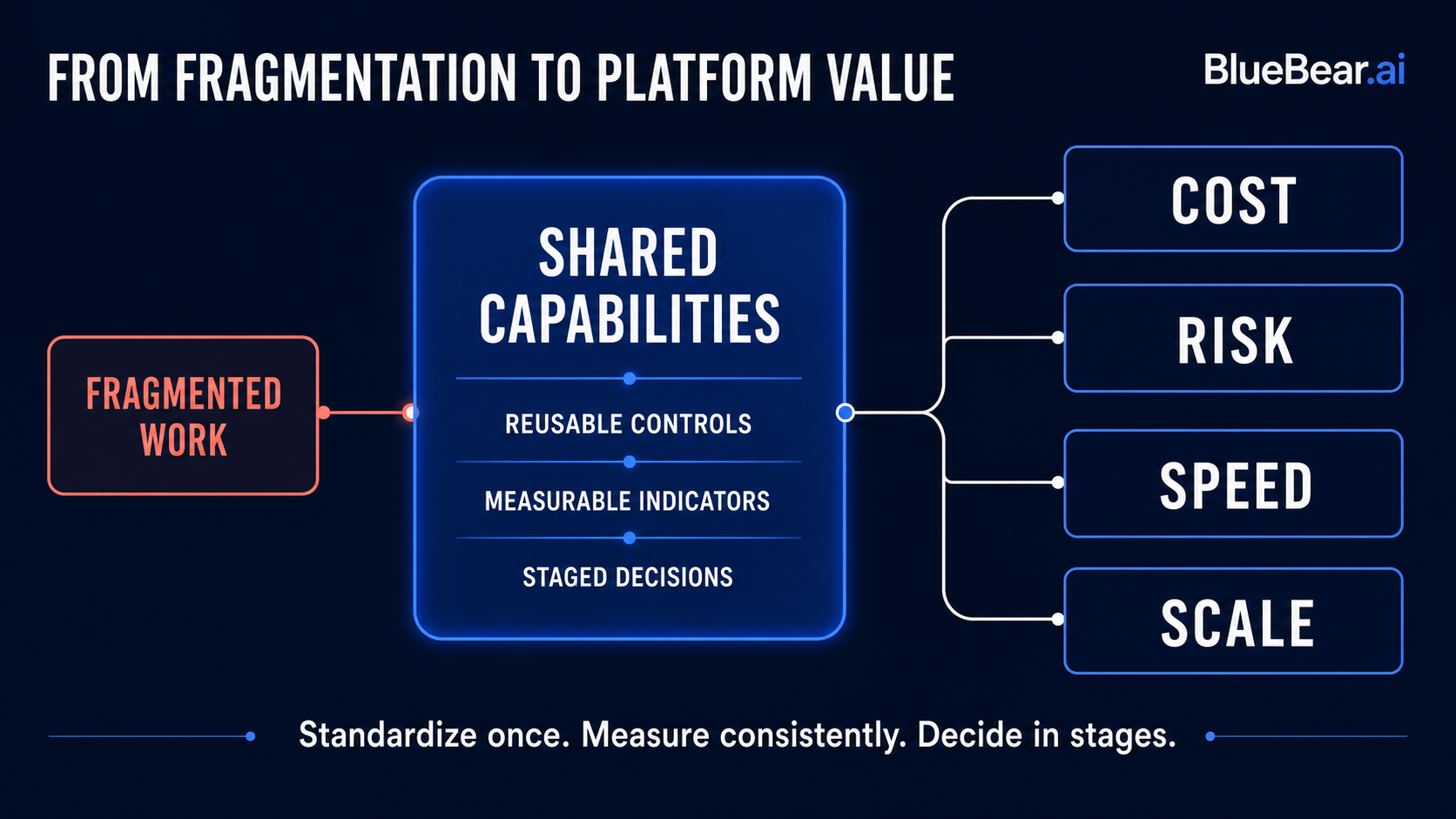
Generic AI agent platform proposals often fail to secure executive buy-in. They struggle to connect fragmented agent work to core business metrics like risk, cost, speed, and reuse.
For Heads of AI, AI Product Directors, FinOps Leads, and Operations Directors, the path to AI agent adoption is paved with more than just innovation. It demands a clear, commercially literate business case. Your challenge is not merely demonstrating what AI agents can do, but proving how a platform investment directly addresses operating friction and delivers measurable value. This article provides a framework to do just that.
The Hidden Costs of Fragmented AI Agent Work
The promise of AI agents is compelling. Yet, realizing this promise within an enterprise often exposes significant operational and financial challenges. These challenges undermine the value proposition of standalone solutions and complicate platform investment decisions.
Provider Invoices Lack Workflow Attribution
One of the most immediate pain points is the opaque nature of AI-related costs. Provider invoices often present a lump sum, making it nearly impossible to attribute spend to specific AI agent workflows, projects, or even individual agents. This lack of granularity makes cost optimization and budget forecasting difficult. It leaves FinOps Leads and Operations Directors without the data needed for informed decisions.
Demo Success is Confused with Production Readiness
Many AI agent initiatives move from impressive demos to stalled production deployments. A successful proof-of-concept might showcase an agent's capability, but it rarely accounts for the real-world complexities of enterprise integration, governance, security, and scalability. This gap between demo and deployment readiness is a critical hurdle for AI Product Directors, leading to wasted resources and delayed time-to-value.
Retries and Review Labor Hide True Unit Cost
Beyond initial deployment, the ongoing operation of AI agents can conceal significant costs. Iterative reasoning loops and multi-agent handoffs, while powerful, can be expensive. AWS guidance confirms that these processes create cost dynamics requiring explicit termination conditions, token budgets, and separate orchestration-versus-execution measurement 1. Without a governed agent runtime, the labor involved in manual reviews, error handling, and frequent retries — often due to unoptimized token usage or integration failures — inflates the true unit cost of an agent's output. This invisible labor directly impacts profitability and operational efficiency.
Building a Value Tree for Your AI Agent Platform
To move past generic productivity claims, you need a structured approach. A value tree links operating friction to shared capabilities, measurable leading indicators, and clear decision checkpoints. This framework helps Head of AI and AI Product Directors articulate the commercial impact of an AI agent platform investment.
Operating Friction: The Root of the Problem
Start by identifying the specific points of friction within your current AI agent development and operational workflows. These are the problems that fragmented approaches exacerbate:
- Inconsistent deployment environments for agents.
- Lack of centralized logging and auditing for agent actions.
- Duplicated efforts in building common integrations.
- Difficulty in tracking and optimizing token consumption across projects.
- Manual security reviews for each new agent deployment.
Shared Capabilities: The Platform Solution
A governed AI agent platform consolidates essential functions, providing reusable controls that address the identified friction points. BlueBear, for example, focuses on consolidation of governed runtime, integrations, evidence, deployment, and cost controls—not automatic ROI. Key platform capabilities include:
- **Governed Agent Runtime:** Standardized, secure environments for agent execution, ensuring compliance and performance.
- **Centralized Integration Layer:** Reusable connectors to internal systems and external services, reducing integration overhead.
- **Evidence and Audit Trails:** Comprehensive logging of agent decisions, inputs, and outputs for transparency and debugging.
- **Streamlined Deployment:** Consistent pathways for moving agents from development to production.
- **Cost Controls and Visibility:** Tools to monitor, allocate, and optimize AI spend, directly addressing invoice attribution issues.
Measurable Leading Indicators: Quantifying Progress
Translate shared capabilities into tangible, measurable indicators that executives can track. These are not direct ROI figures yet, but signals of improved operational health and efficiency:
- Reduction in manual review hours for agent output.
- Decrease in agent deployment cycle time.
- Improved accuracy of AI cost allocation per workflow.
- Lower token consumption rates for similar agent tasks.
- Reduction in security vulnerabilities identified during agent audits.
The FinOps Foundation emphasizes that AI costs are granular and unpredictable, necessitating allocation, forecasting, optimization, policy, and governance 2. These leading indicators align with those governance needs.
Decision Checkpoints: Staged Investment and Evaluation
Define clear stages for platform investment, with specific criteria for moving forward. This mitigates risk and ensures that investment is tied to observed improvements:
- **Pilot Phase:** Focus on a high-friction, high-visibility workflow. Measure initial leading indicators.
- **Expanded Rollout:** Apply the platform to additional workflows. Demonstrate consistent improvement across projects.
- **Full Adoption:** Integrate the platform as a core component of your AI strategy, leveraging its full suite of governance and control features.
BlueBear's Approach: Consolidation, Not Automatic ROI
BlueBear’s AI agent platform is built on the principle of consolidation. It brings together the disparate elements needed to operate AI agents effectively within an enterprise. Our focus is on providing a governed infrastructure that enables reliable integrations, clear evidence trails, controlled deployments, and granular cost management. We believe that true value comes from addressing the operational fragmentation that plagues most AI initiatives, rather than promising unverified, automatic returns.
The BlueBear platform, with its MCP gateway and governed agent runtime, aims to be the single source of truth for your agent operations. It is an implementation path to better manage your existing AI investments, not a magic bullet for unmeasured business results. We help you connect AI spend to business workflows, set rollout gates, and scale successful agents without losing control.
A Representative Operating Scenario
Consider a large financial services firm grappling with fraud detection. Their existing system uses multiple specialized AI agents, developed by different teams, each with its own deployment method, monitoring tools, and cost tracking. Provider invoices bundle all AI service usage, making it impossible for the FinOps Lead to know which agent or even which team is consuming the most resources for specific fraud checks. Demo successes for new agents are celebrated, but integrating them into the production pipeline takes months due to security reviews and custom integration work. Retries on complex cases are handled manually, adding significant, untracked labor costs. This fragmented approach leads to inflated costs, slow deployment, and a high operational burden, hindering the firm's ability to respond quickly to new fraud patterns.
A governed AI agent platform would consolidate these efforts. All agents would deploy through a standardized pipeline, leveraging a shared library of audited integrations. Costs would be tagged per agent and per workflow, providing the FinOps Lead with real-time attribution. The Head of AI would have a clear dashboard showing agent performance, token usage, and audit trails. New agents could move from demo to production in weeks, not months, because the underlying governance and integration frameworks are already in place.
BlueBear Outcome-Cost Decision Worksheet
BlueBear treats the business case as an operational measurement problem. The platform can correlate model and tool activity with sessions, retries, review, and outcomes; the buyer still owns the labor rate, value assumptions, and approval threshold.
cost per accepted outcome =
  (model + tool + runtime + retry + review + exception cost)
  / accepted outcomes

net value per accepted outcome =
verified business value - cost per accepted outcome| Worksheet field | BlueBear evidence | Business-owned input |
|---|---|---|
| Attempt volume and completion | Sessions, workflow status, retries, failures, and accepted outcomes. | What counts as a completed and accepted business result. |
| Technical consumption | Model, token, tool, runtime, and estimated cost records attached to the work. | Approved rate source and accounting period. |
| Human effort | Approval and exception events with elapsed time where available. | Loaded labor rate and which review steps are incremental. |
| Business value | Outcome identifier that can be reconciled with the operating system of record. | Revenue, loss avoidance, cycle-time, or capacity value and confidence range. |
Keep a low, expected, and high case. Do not convert unverified time savings into booked ROI, and do not omit rejected outputs from the denominator.
Diagnostic Checklist for Your AI Agent Workflows
Before investing in any AI agent platform, evaluate your current state. Ask these questions:
- Can you attribute specific AI provider costs to individual agents or business workflows?
- How long does it typically take to move a successful AI agent demo into a production environment?
- What is the estimated labor cost associated with manual retries, error handling, or quality assurance for your AI agents?
- Do you have a centralized, auditable log of all agent decisions and actions?
- Are your AI agent deployments consistent, secure, and easily scalable?
- Do you have clear policies and controls in place for token usage and budget management across all agents?
Quantify Fragmentation. Define Evidence. Decide.
Building a compelling business case for a governed AI agent platform requires more than just enthusiasm for AI. It demands a clear understanding of your current operational challenges and a practical framework to demonstrate how an investment will solve them. Focus on verifiable improvements, not speculative ROI.
Evaluate your current workflow before adding another tool. Use the value-tree template to quantify fragmentation and define evidence for an investment decision.