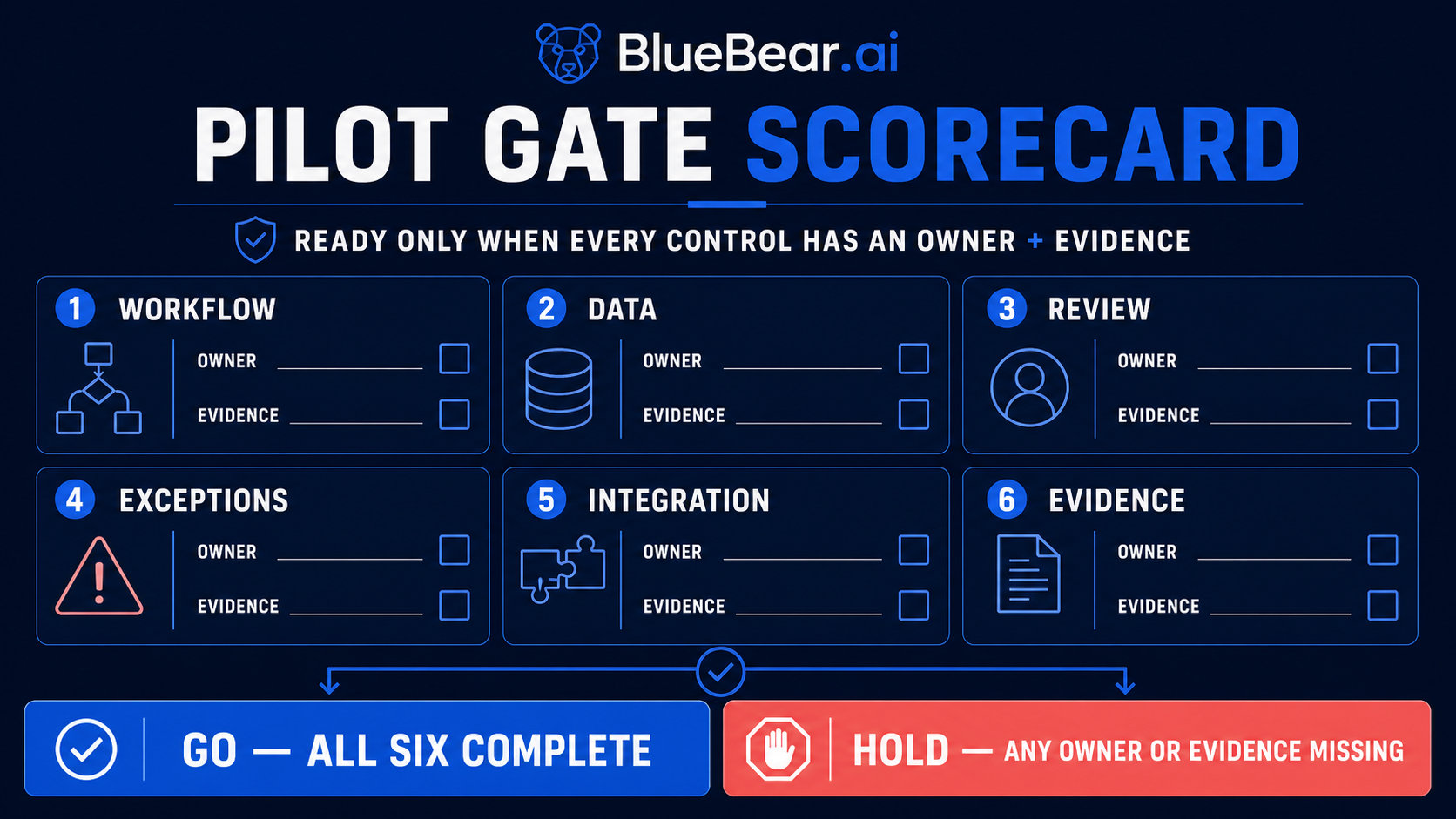
A Readiness Gate for Healthcare Administrative AI Agent Pilots
Healthcare AI pilots can seem successful, but hidden control gaps create significant operational risk.
In the rapidly evolving landscape of artificial intelligence, healthcare organizations are eager to leverage AI agents for administrative efficiencies. An AI agent is a software program that can perceive its environment, make decisions, and take actions to achieve specific goals. This often involves interacting with other systems and sensitive data. While the promise of increased speed and reduced costs is appealing, the rush to deploy can overlook critical operational and compliance safeguards. For CISOs, AI Governance Leads, Security Architects, and Risk and Compliance Leads in regulated operations, enterprise software, and managed services, this oversight is a major concern. Without a robust readiness framework, administrative AI agent pilots risk becoming liabilities rather than assets.
The Hidden Risks of Untested AI Agent Pilots
A pilot might appear to succeed in boosting throughput or automating routine tasks. Yet, underlying risks often remain unaddressed. Healthcare pilots can appear successful while exception ownership, sensitive-data handling, integration repair, review, and audit evidence remain undefined. This creates a false sense of security, exposing the organization to potential data breaches, compliance failures, and operational disruptions.
Key Pain Points in Ungoverned Deployments:
- Credentials and permissions are scattered: AI agents often inherit broad access, or are granted permissions without granular controls. This makes it difficult to manage exactly what an agent can do and where. Without centralized, auditable access management, agents can access systems or data beyond their defined scope.
- Logs do not preserve authorization context: When an AI agent takes an action, audit logs might record the action itself, but not the specific policy, permission, or decision framework that authorized it. This absence of authorization context makes it nearly impossible to reconstruct the "why" behind an agent's actions during an audit or incident response.
- Tool autonomy expands faster than policy coverage: As AI agents evolve and their capabilities expand, the policies governing their use often lag. This gap between agent autonomy and policy coverage means that agents might operate in areas not explicitly covered by governance, increasing the risk of unintended or unauthorized actions.
This situation is directly at odds with regulatory expectations. CMS guidance connects responsible AI use to secure operations, ethical handling, and safeguards for sensitive PII and PHI. Simply automating a task without defining these controls is insufficient.
Beyond Initial Success: A Deeper Look at Operational Readiness
Early pilot metrics, such as speed or basic accuracy, can be misleading. True operational readiness requires more than just functional performance. It demands a comprehensive framework that anticipates and mitigates risks across the entire lifecycle of an AI agent. This means establishing clear lines of accountability, defining strict data handling protocols, ensuring integration stability, implementing rigorous review cycles, and generating irrefutable audit evidence.
Introducing the Administrative AI Agent Pilot Readiness Gate
To address these challenges, we propose an Administrative AI Agent Pilot Readiness Gate. This framework provides a structured go/no-go decision point, ensuring all necessary controls are in place before an administrative AI agent pilot proceeds. This gate specifically targets administrative workflows, making no unsupported clinical or compliance claims. It focuses on the practicalities of secure and compliant operation.
Key Domains of the Readiness Gate: A Practical Diagnostic Checklist
Evaluating your pilot's readiness requires examining several critical domains. This diagnostic checklist helps identify gaps that could derail an otherwise promising AI agent initiative:
Workflow Control
- Is there clear ownership for every step of the agent's workflow, including its initiation, execution, and completion?
- How are exceptions identified, escalated, and handled by human operators? Is there a defined process for out-of-bounds scenarios?
- Is a human-in-the-loop required for high-risk or sensitive actions? How is this approval process enforced?
Data Handling & Privacy
- How is sensitive data handling defined, enforced, and audited for the AI agent? This includes Protected Health Information (PHI) and Personally Identifiable Information (PII).
- Are agent access controls granular? Can you limit access to specific data sets or fields rather than entire systems?
- CMS guidance connects responsible AI use to secure operations, ethical handling, and safeguards for sensitive PII and PHI. Is your pilot aligned with this?
Integration Resilience
- What is the plan for integration repair when external systems or APIs change? How quickly can the agent adapt or be updated?
- How does the agent manage API failures, unexpected responses, or system downtime? Does it have robust error handling?
- Are integration points clearly mapped and secured to prevent unauthorized access or data leakage?
Review and Approval Processes
- Who reviews the AI agent's decisions or proposed actions before they are executed? What is the chain of command for approval?
- Is there a formal approval process for deploying agent updates or changes to its operational scope?
- CMS AI guidance treats monitoring, versioning, and observability as production requirements while tying controls to the impact of each use case. Are these elements part of your review process?
Audit Evidence & Observability
- How is comprehensive audit evidence captured and preserved for every agent action and decision? This includes timestamps, context, and outcomes.
- Do logs preserve the authorization context for each agent action? Can you trace exactly which policy or permission permitted a specific action?
- What mechanisms are in place for continuous monitoring, versioning, and observability of the agent's performance and adherence to policy?
Policy and Governance
- How is policy coverage extended to match the AI agent's autonomy? Are there clear boundaries for agent behavior?
- Are credentials and permissions for the AI agent managed centrally and dynamically, rather than being scattered across disparate systems?
- What are the mechanisms for updating policies and governance frameworks as the AI agent evolves or new risks emerge?
Representative Operating Scenario: Claims Status Inquiry Automation
Consider an administrative AI agent designed to automate claims status inquiries for a large healthcare provider. Without a readiness gate, a quick pilot might show the agent successfully retrieving information from payer portals. However, hidden risks emerge:
- The agent's credentials might grant it broad access to patient data, even if it only needs claims status, violating the principle of least privilege.
- If the payer's API changes, the integration could break, leading to silent failures or incorrect information being retrieved, without a clear owner for repair.
- Logs might show "agent retrieved claim status," but not which specific authorization allowed access to a particular patient's PHI. This obscures accountability.
- As the agent "learns" to handle more complex inquiries, its autonomy expands beyond the initial policy, operating in undefined territory.
Applying the readiness gate to this scenario would immediately flag these issues. It would demand explicit answers for data access scope, integration repair ownership, authorization context in logs, and a clear policy boundary for expanded capabilities. This proactive approach prevents operational surprises and ensures compliance.
The BlueBear Approach: Governed Agent Workflows
BlueBear emphasizes controlled workflows, exception queues, and a tamper-evident audit log for administrative use cases. The BlueBear AI agent platform is purpose-built to address the challenges outlined by the readiness gate. Our MCP gateway and governed agent runtime provide the infrastructure to operate AI agents securely and compliantly, particularly in regulated environments.
- Centralized Credential & Permission Management: BlueBear ensures that credentials and permissions are not scattered. Instead, access is managed centrally with granular controls, enforcing the principle of least privilege for every agent action.
- Tamper-Evident Audit Log: Prescriber signatures and user logins are written to a tamper-evident audit log, so a reviewer can see who signed or signed in, and when. Recording fuller authorization context for agent actions is being built with pilot partners.
- Controlled Autonomy & Policy Enforcement: BlueBear's governed agent runtime extends policy coverage as agent autonomy expands. It provides mechanisms to define and enforce policy boundaries, preventing tool autonomy from expanding faster than policy coverage. This ensures agents operate within defined guidelines.
- Structured Exception Handling: The platform incorporates structured exception queues, ensuring that any deviation or uncertain agent action is flagged for human review and approval, preventing unauthorized operations.
- Approval Rules and Audit Export (with pilot partners): Per-client approval rules and audit export are being built with pilot partners, so the evidence a reviewer needs for administrative processes can come from the platform rather than being assembled by hand.
How BlueBear Differs
Many AI agent solutions focus on raw automation speed. BlueBear, however, leads with workflow evidence before feature claims. We recognize that in healthcare, mere speed without control is a liability. Our platform differentiates by prioritizing governance, audibility, and human oversight within administrative workflows. We provide a path for organizations to implement AI agents not just efficiently, but responsibly, ensuring that every automated action is accountable and compliant. This distinct focus on controlled execution and verifiable proof makes BlueBear a critical partner for healthcare organizations navigating AI adoption.
Conclusion
Launching administrative AI agent pilots in healthcare demands more than just technical readiness. It requires a strategic commitment to operational governance, data security, and compliance. The Administrative AI Agent Pilot Readiness Gate offers a practical framework to ensure that your AI initiatives are built on a foundation of control and accountability. By systematically evaluating workflow, data, review, integration, and evidence controls, organizations can confidently move forward with their AI adoption. This proactive approach minimizes risks and maximizes the long-term value of AI in healthcare administration.
Next Step: Select one administrative workflow and complete the gate with operations, security, and compliance owners.