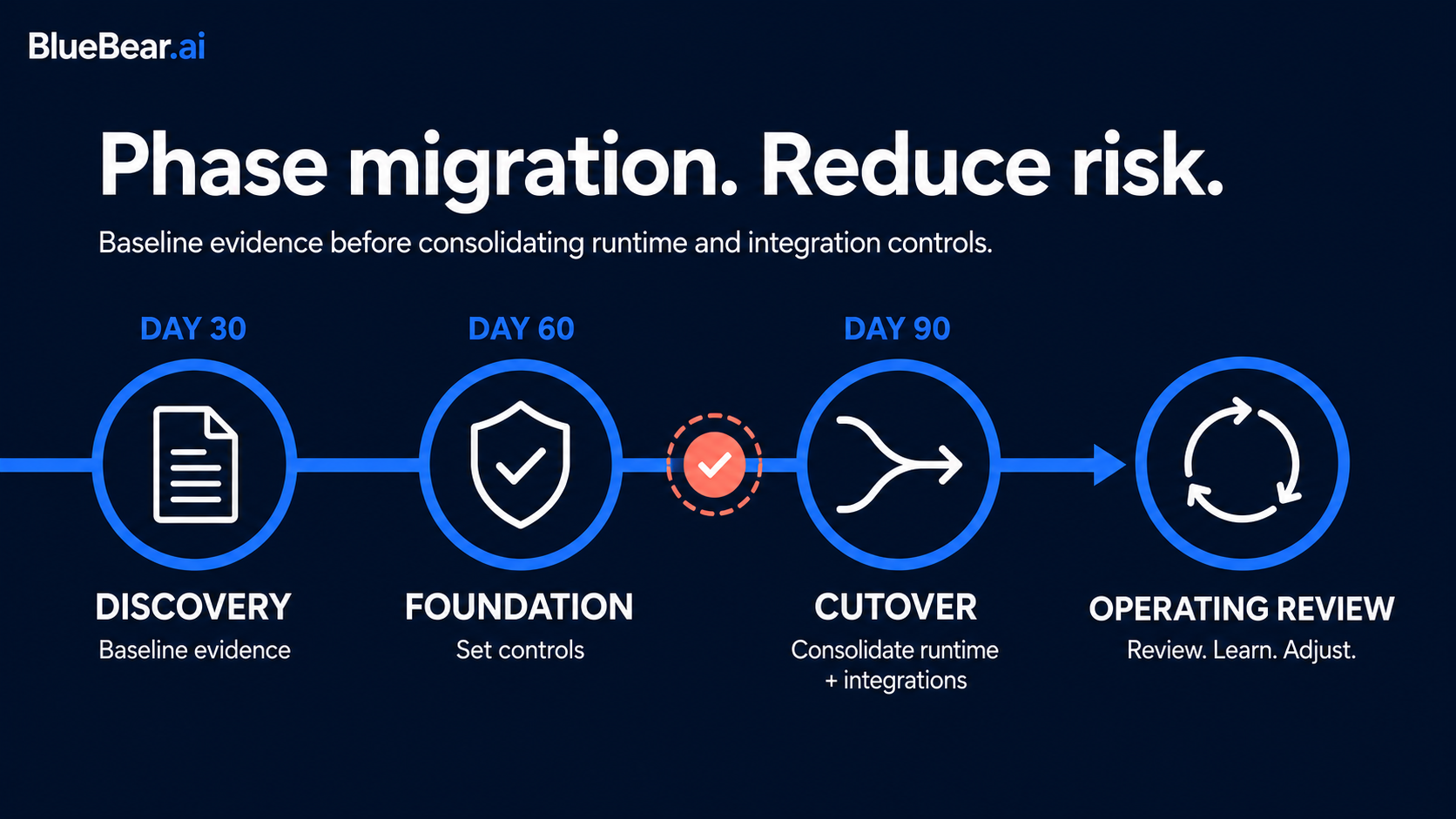
A 90-Day Plan to Move AI Agent Pilots onto Shared Infrastructure
Many AI agent pilots succeed in isolation but struggle to scale across fragmented infrastructure. Technical leaders often hesitate to standardize these successful, but siloed, agent pilots. The fear is clear: migration could mean rewriting working agents or halting valuable experimentation.
However, delaying standardization brings its own set of challenges. Agent infrastructure becomes fragmented across teams, making failures difficult to reconstruct end-to-end. Critical features like tenant isolation and capacity controls arrive late, if at all. This article outlines a practical 90-day plan for platform engineering leaders, AI infrastructure architects, and VP Engineering teams to address these issues directly. It provides a phased approach to bring AI agent pilots onto a shared, governed platform without disrupting innovation.
Day 1-30: Discovery and Evidence Baselining
The first month focuses on understanding your current agent ecosystem and gathering essential data. This phase avoids disruptive changes, instead building a clear picture of existing operations.
Identify and Map Existing Agent Pilots
Begin by cataloging all active AI agent pilots. For each pilot, document:
- Its core function and business objective.
- The frameworks and models it uses.
- Its current deployment environment and infrastructure.
- Any external integrations or APIs.
- Team ownership and key stakeholders.
This mapping reveals the true extent of fragmented infrastructure across teams.
Baseline Current Operational Evidence
Before any migration, you need clear performance benchmarks. Gather evidence on:
- Agent reliability and uptime.
- Latency and throughput metrics.
- Resource consumption (CPU, memory, GPU, API calls).
- Observed failure rates and common error patterns.
- Current traceability for reconstructing failures.
This data becomes your baseline. It proves the value of existing pilots and provides objective targets for a shared platform. Without this, evaluating the success of a migration is guesswork.
Industry guidance supports this evidence-led approach. Microsoft's agent architecture framework emphasizes evaluating fit, operability, governance, lifecycle management, observability, traceability, and long-term return, not just capability. Similarly, the AWS Agentic AI Lens focuses on reviewing reliability, security, cost, and operational readiness as agent systems move from prototypes into production.
Assess Pain Points in Existing Operations
Engage with pilot teams to understand their current challenges. Common pain points include:
- Difficulty reconstructing end-to-end failures across disparate tools.
- Lack of standardized observability and logging.
- Inconsistent security or compliance postures.
- Manual processes for scaling or managing resources.
These conversations help prioritize migration efforts toward pilots that will benefit most from a shared platform's governance and controls.
Day 31-60: Integration Consolidation and Runtime Onboarding
The second month focuses on building the foundational shared infrastructure and beginning the onboarding process. This phase introduces the concept of a governed agent runtime.
Establish a Shared Operating Layer
Introduce a shared operating layer designed to host diverse AI agents. This layer should provide:
- Centralized policy enforcement for security and compliance.
- Standardized observability and monitoring tools.
- Mechanisms for tenant isolation and capacity controls.
- An MCP gateway (Multi-Cloud Proxy) for consistent access to models and external services.
This is where BlueBear's approach becomes particularly effective. BlueBear can onboard existing agents into a shared operating layer. It preserves their original frameworks and clarifies runtime boundaries, avoiding a costly rewrite.
BlueBear's Distinctive Approach
The BlueBear AI agent platform differs from typical migration strategies that demand agent refactoring. Instead of forcing agents into a new framework, BlueBear acts as a governed agent runtime. It abstracts away the underlying infrastructure complexities, allowing agents built with various frameworks (e.g., LangChain, LlamaIndex, custom Python scripts) to operate side-by-side. This preserves initial experimentation while introducing enterprise-grade controls for reliability and security.
This method directly addresses the core problem: teams hesitate to standardize because migration appears to require rewriting successful pilots or freezing experimentation. BlueBear’s strategy makes standardization an additive process, not a destructive one. It clarifies runtime boundaries and provides essential guardrails without stifling developer choice.
Initial Agent Onboarding and Testing
Select two to three representative pilot agents for initial onboarding to the shared platform. Focus on diversity in frameworks or complexity. During this period:
- Configure agents to run within the shared operating layer.
- Verify existing functionality against the baselined evidence.
- Test tenant isolation and capacity control mechanisms.
- Ensure end-to-end traceability for troubleshooting.
This early integration helps identify and resolve environmental differences or compatibility issues within a controlled scope.
Day 61-90: Policy Gates and Progressive Cutover
The final month moves from initial onboarding to broader adoption, guided by clear policy gates and a progressive cutover strategy.
Implement Policy Gates and Governance
With agents operating on the shared platform, establish automated policy gates. These gates enforce:
- Resource limits and quotas.
- Access controls and authentication policies.
- Data handling and privacy standards.
- Observability requirements (logging, metrics, traces).
These policies ensure that as more agents onboard, the platform maintains its stability, security, and cost-effectiveness. They directly address the pain point of tenant isolation and capacity controls arriving late.
Practical Diagnostic Checklist for Migration Readiness
Before migrating additional agents, use this checklist:
- Have we accurately baselined the current operational metrics for the pilot agent?
- Can we reconstruct failures end-to-end within the new shared platform?
- Are tenant isolation and capacity controls demonstrably working for onboarded agents?
- Is the agent's framework compatible with the BlueBear AI agent platform's governed runtime?
- Are all external integrations correctly configured via the MCP gateway?
- Are policy gates consistently applied and enforced?
- Have stakeholders reviewed and approved the migration plan for upcoming agents?
Progressive Cutover of Remaining Pilots
Roll out the shared platform to the remaining agent pilots in a phased manner. Prioritize based on:
- Business criticality.
- Complexity and dependencies.
- The urgency of addressing specific pain points (e.g., a highly fragmented agent infrastructure).
Maintain continuous monitoring and feedback loops throughout this cutover. This ensures any issues are quickly identified and resolved, building confidence in the shared infrastructure.
Conclusion: Standardize for Scale, Not Stagnation
Moving AI agent pilots to shared infrastructure doesn't have to mean sacrificing innovation. By following a structured 90-day plan—from discovery and baselining to integration and progressive cutover—organizations can gain control over fragmented agent infrastructure, improve traceability for failures, and implement critical tenant isolation and capacity controls. A platform like BlueBear facilitates this by providing a governed agent runtime that respects existing frameworks and operational boundaries. The goal is to standardize for scale, not to halt experimentation.
To take the next step in bringing order to your AI agent ecosystem, we invite you to:
Select two representative pilots for a scoped platform migration workshop.
BlueBear Pilot-to-Platform Dependency Map
| Dependency | Pilot discovery | Shared-platform target | Cutover proof |
|---|---|---|---|
| Identity and ownership | Users, service accounts, hidden owners, and manual approvals. | Named tenant/workspace roles and accountable workflow owner. | Allowed and denied identity tests. |
| Models and prompts | Providers, versions, keys, limits, fallback, and embedded policy. | Versioned model eligibility and routing policy. | Shadow comparison and accepted outcome checks. |
| Tools and data | Direct APIs, MCP servers, credentials, scopes, and data movement. | Assigned connections, execution-time credentials, action policy, and approvals. | Tool receipts, denial tests, and downstream reconciliation. |
| Runtime and reliability | Hosting, queues, retries, state, schedules, and manual repair. | Declared deployment, idempotency, exception states, and incident ownership. | Failure rehearsal and rollback test. |
| Cost and value | Provider spend and unmeasured review/rework. | Tenant/workflow allocation and cost per accepted outcome. | Comparable baseline and post-cutover window. |
Migrate one bounded workflow first. Inventory and shadow measurement can run in parallel, but production control should move only when the dependency row has an owner and cutover evidence.