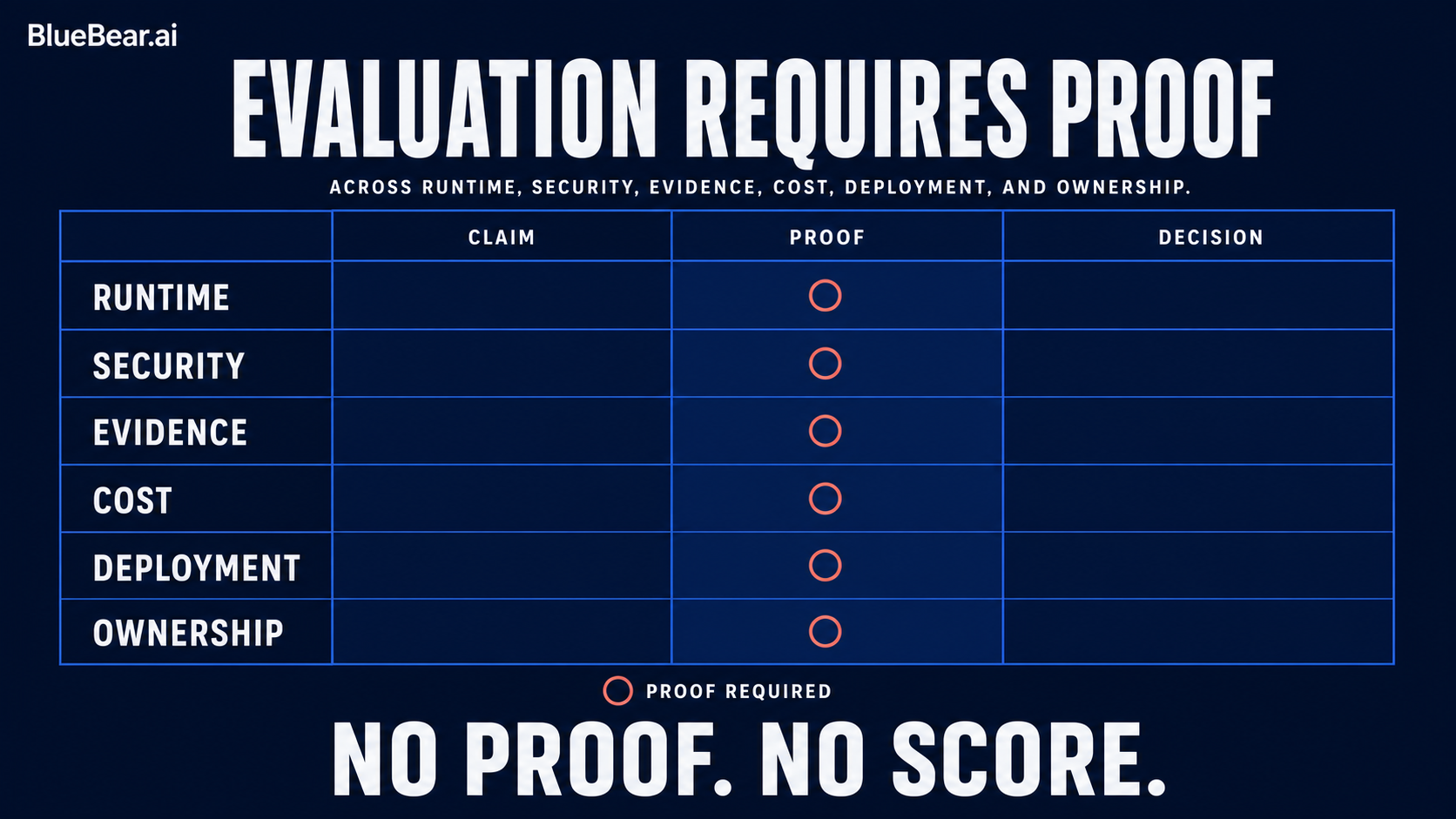
BlueBear Enterprise Platform Evidence Scorecard
Use this weighted scorecard against one real workflow. A vendor earns points only when the review team can inspect the named evidence; a slide or unchecked product claim earns zero. The weights are a starting template, not a universal procurement standard.
| Evaluation area | Weight | Evidence to inspect in BlueBear | Fail condition |
|---|---|---|---|
| Identity and isolation | 20% | Tenant, organization, workspace, user or service identity, and effective access rights for the run. | The acting identity or workspace boundary cannot be reconstructed. |
| MCP and integration control | 20% | Assigned connection, permitted tool/action, credential boundary, policy result, and approval state. | A model receives reusable credentials or can invoke an unassigned tool. |
| Runtime and deployment | 15% | Selected deployment boundary, workload status, quota state, and retained execution result. | The production runtime or customer-cloud responsibility is ambiguous. |
| Observability and replay | 15% | Correlated session, model, tool call, retry, approval, failure, and outcome identifiers. | Operators must manually join unrelated logs to explain a run. |
| Cost and routing | 15% | Effective model policy, token and tool usage, estimated cost, retry cost, and cost per accepted outcome. | Only a provider invoice or aggregate token total is available. |
| Operations and ownership | 15% | Named workflow owner, exception queue, incident path, approval authority, and retirement procedure. | No accountable owner can stop or change the workflow. |
How to run the evaluation
- Select one workflow with an owner, input, tool action, acceptance rule, and measurable outcome.
- Run a normal case, a denied action, a tool failure, a retry, and a human-approval case.
- Score only the evidence the review team can inspect from those runs.
- Record missing evidence as a deployment risk, not as a feature-roadmap promise.
An Enterprise AI Agent Platform Evaluation Scorecard
Ignoring operational evidence during AI agent platform selection creates hidden costs and risks.
Enterprise adoption of AI agents promises transformative efficiency. Yet, many organizations evaluating AI agent platforms find themselves caught in a cycle of impressive demos and extensive model lists. This focus often overlooks critical operational realities, leading to significant challenges down the line. Vendor evaluations frequently overweight initial demonstrations and available models, while underweighting isolation, verifiable evidence, recovery mechanisms, granular cost allocation, and clear ownership.
For a Head of AI, an AI Product Director, a FinOps Lead, or an Operations Director in enterprise software, AI platforms, or managed services, this imbalance creates acute pain. Provider invoices often lack workflow attribution, making it nearly impossible to connect AI spend to specific business value. Demo success is frequently confused with production readiness, leading to unexpected hurdles once an agent system moves to live environments. Moreover, the hidden labor of retries and manual review can obscure the true unit cost of agent operations.
Beyond Demos: The Operational Reality of AI Agents
A flashy demonstration showcases potential, but it rarely reveals the underlying operational rigor required for enterprise deployment. An AI agent platform is a governed infrastructure designed for developing, deploying, and managing AI agents. Its true value emerges not in a controlled demo, but in its ability to operate reliably, securely, and cost-effectively in production at scale.
Microsoft's agent architecture framework emphasizes this shift, urging buyers to evaluate "fit, operability, governance, lifecycle management, observability, traceability, and long-term return rather than capability alone." [source] This holistic view moves beyond mere functionality to assess the practicalities of running agents in a complex business environment. A governed agent runtime ensures agents operate within defined parameters, crucial for predictability and compliance.
Why Traditional Evaluation Falls Short
The gap between proof-of-concept and production often stems from overlooked operational details:
- Provider invoices lack workflow attribution: Without detailed insights into which workflows consume which AI resources, FinOps Leads struggle to connect spend to specific business outcomes. This makes cost optimization efforts difficult and strategic investment decisions opaque. The true unit cost of an agent operation remains elusive when costs are aggregated, preventing accurate ROI calculations.
- Demo success is confused with production readiness: A successful demo validates a technical possibility. However, it rarely accounts for the complexities of enterprise integration, scalability, security, and error handling. Operations Directors often find that what worked flawlessly in a controlled environment falters under real-world load or unexpected inputs.
- Retries and review labor hide true unit cost: AI agents, especially in early stages, can require frequent human intervention for error correction, review, and retry orchestration. This labor-intensive overhead is often a hidden cost, inflating the true expense of running agents and masking inefficiencies. It directly impacts the Head of AI's ability to demonstrate clear value and scale solutions responsibly.
These pain points underscore a critical need: an evaluation framework that prioritizes operational evidence over aspirational claims.
The BlueBear Approach: Evidence-Led Operations
BlueBear addresses these challenges by focusing on operational evidence across the entire AI agent lifecycle. BlueBear should be evaluated on operational evidence across runtime, integrations, sessions, deployment, and usage controls. Our platform provides the infrastructure needed to move beyond prototypes into reliable, attributable, and governed agent operations.
The BlueBear platform implements several core components to achieve this:
- Governed Agent Runtime: Ensures agents operate within predefined limits, providing stability and predictability.
- MCP Gateway (Managed Control Plane Gateway): Acts as a central point for enforcing policies, monitoring agent interactions, and providing granular visibility into performance and usage.
- Session Manager: Manages the complete lifecycle of agent interactions, from initiation to completion, including robust error handling and recovery mechanisms. This allows for detailed tracking and auditing of every agent activity.
- Inference Routing: Optimizes AI model requests by directing them to the most appropriate or cost-effective endpoints, ensuring efficient resource utilization and cost control.
- Usage Controls: Provides fine-grained mechanisms to manage and limit agent resource consumption, access, and permissions, crucial for security and budget adherence.
This approach aligns with industry best practices. The AWS Agentic AI Lens, for instance, is designed for reviewing "reliability, security, cost, and operational readiness as agent systems move from prototypes into production." [source] This framework emphasizes the same operational rigor that BlueBear delivers, ensuring that AI agent initiatives are not just technically feasible, but truly production-ready and financially accountable.
A Practical Diagnostic Checklist for AI Agent Platforms
To move beyond surface-level demonstrations, consider these proof-oriented questions organized around your buyer’s risk and workload profile:
Runtime and Resilience
- Can the platform demonstrate automated recovery from common agent failures, not just ideal paths?
- What real-world evidence exists for agent uptime and error rates in a production-like environment?
- How does the platform handle concurrency and scaling under varying load conditions, with verifiable data?
- Can you inspect the live state of an agent and its interactions in real-time?
Security and Isolation
- What mechanisms ensure agent isolation, preventing unauthorized access or data leakage between different agents or tenants?
- How are sensitive data and credentials managed and protected within the agent runtime?
- Can the platform provide an audit trail of all agent actions and data access, crucial for compliance?
- Does the platform integrate with your existing enterprise identity and access management (IAM) systems?
Cost Allocation and Efficiency
- Can the platform attribute granular costs (e.g., model calls, compute, data transfer) to specific agents, workflows, or business units?
- What controls are in place to set budget limits and prevent runaway agent spending?
- How does the platform optimize inference routing to manage and reduce operational costs?
- Is there transparent reporting on retry frequency and the associated costs?
Deployment and Lifecycle Management
- What is the verifiable process for deploying, updating, and rolling back agent versions?
- How does the platform manage dependencies and versioning for different agent components?
- Can the platform demonstrate seamless integration into existing CI/CD pipelines?
- What tools are available for monitoring agent performance and health in production?
Ownership and Governance
- How does the platform define and enforce ownership for agent development, deployment, and operation?
- What governance features prevent unauthorized agent modifications or deployments?
- Can the platform support different levels of access and control for various roles (e.g., developers, operations, finance)?
- How does the platform ensure compliance with internal policies and external regulations?
BlueBear in Action: A Representative Operating Scenario
Consider a Head of AI tasked with deploying intelligent agents to automate customer service inquiries within a large enterprise. The FinOps Lead is concerned about spiraling cloud costs without clear attribution, while the Operations Director demands robust control and visibility over every deployed agent. In this scenario, BlueBear’s governed agent runtime provides the necessary control. The MCP gateway ensures that all agent interactions adhere to company policies, automatically routing customer queries through approved large language models via intelligent inference routing. The session manager logs every customer interaction and agent response, providing an immutable audit trail. This transparency allows the FinOps Lead to attribute model usage and compute costs directly to the customer service workflow, addressing the "Provider invoices lack workflow attribution" pain point. Should an agent encounter an unexpected error, the platform’s recovery mechanisms, managed by the session manager, attempt to resolve the issue or flag it for human review, minimizing the impact of "Retries and review labor hide true unit cost" by streamlining intervention. This operational clarity ensures that "Demo success is not confused with production readiness," as the platform is built for rigorous, observable enterprise use from day one.
Conclusion
Selecting an AI agent platform requires moving beyond superficial capabilities to a deep understanding of operational evidence. The true value lies in a platform's ability to provide governed infrastructure, transparent cost attribution, and verifiable operational controls. This ensures that your investment in AI agents translates into predictable, scalable, and accountable business outcomes.
Use the scorecard with platform, security, finance, and workflow owners to evaluate your current workflow before adding another tool.