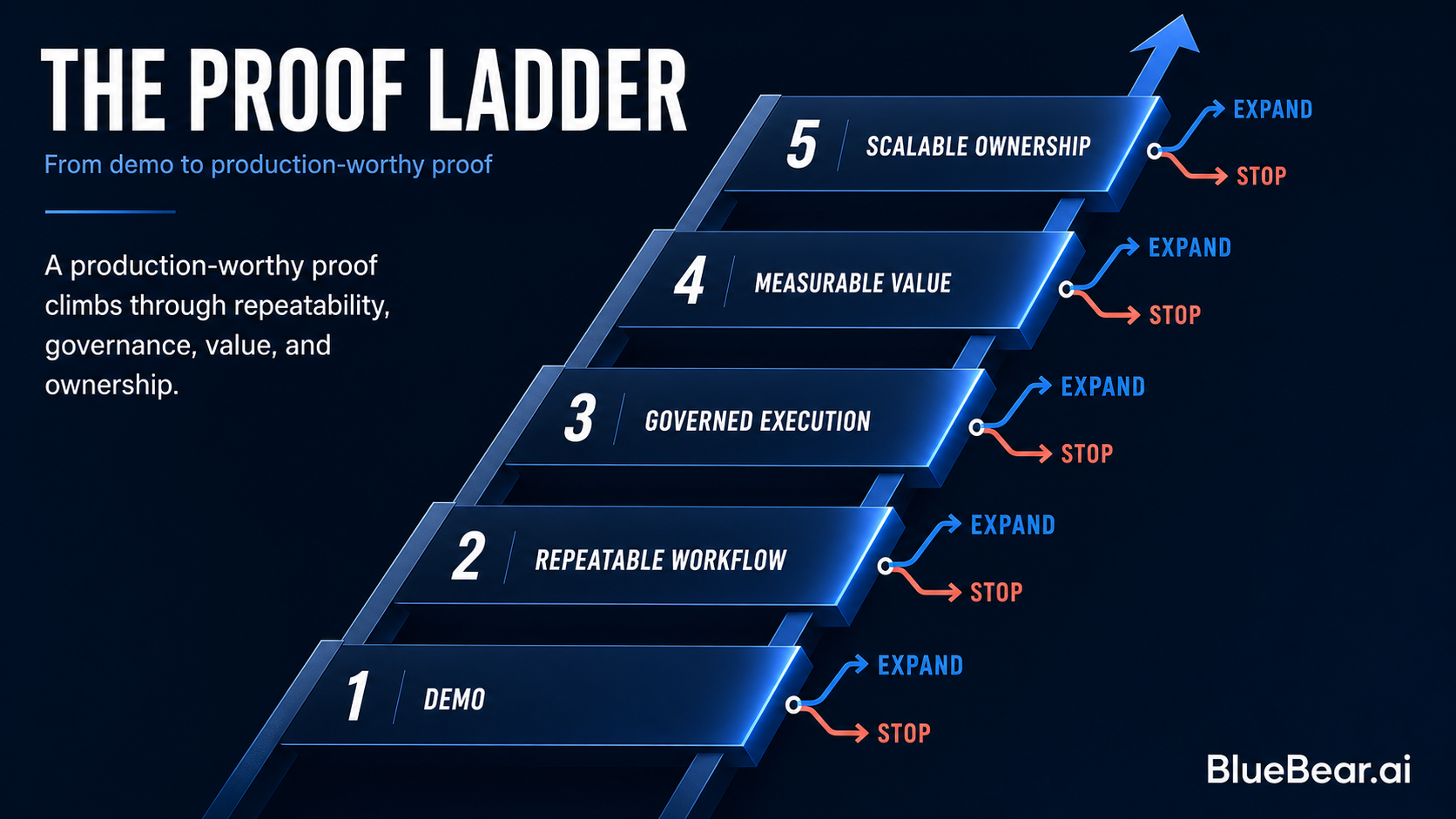
Many AI agent proofs show capability, but struggle to prove real operating value, risk, and cost.
AI agents promise efficiency and automation. However, many proofs of concept (PoCs) focus on showcasing technical feasibility. They often miss the critical elements needed for a clear production decision. This includes understanding the operating value, associated risks, true costs, and scalability. This oversight means many promising AI initiatives stall after a successful demo.
The Gap Between Demo Success and Production Reality
The journey from a successful demonstration to a production-ready AI agent is complex. A demo confirms that a system can work. It rarely shows if it should work at scale, within budget, or under real-world conditions. This is where "demo success is confused with production readiness," a critical pain point for AI product directors and operations leaders.
Industry guidance supports a broader evaluation. Microsoft’s agent architecture framework urges buyers to look beyond mere capability. It asks for evaluation of fit, operability, governance, lifecycle management, observability, traceability, and long-term return [1]. These factors are essential for any AI agent that will operate within an enterprise environment. Ignoring them can lead to unforeseen costs and operational challenges.
Defining Success for a Production-Ready AI Agent Proof
A production-worthy proof of value (PoV) defines success clearly. It centers on accepted outcomes, anticipated exceptions, necessary review effort, and evidence completeness. It also includes the total cost and owner confidence. This holistic view provides a robust foundation for decision-making.
Beyond Simple Functionality: Key Metrics for Value
Measuring accepted outcomes moves beyond basic functionality. It means quantifying the business impact. For example, how much time does the agent save? How accurate are its decisions? These are tangible gains that leadership can recognize.
Exceptions are unavoidable in any system. A production-ready PoV anticipates them. It outlines how they are handled, measured, and mitigated. Overlooking exceptions means "retries and review labor hide true unit cost." This directly impacts FinOps Leads. Understanding this cost component is vital for an accurate return on investment (ROI) calculation.
Evidencing Operational Viability
Review effort involves the human hours spent overseeing and correcting agent actions. Minimizing this effort boosts efficiency. Evidence completeness ensures that all claims are backed by verifiable data. This provides confidence to stakeholders.
The total cost includes infrastructure, licensing, and human oversight. A clear cost analysis is paramount. Owner confidence means stakeholders trust the agent's performance and its contribution to business goals. The AWS Agentic AI Lens is designed for reviewing reliability, security, cost, and operational readiness as agent systems move from prototypes into production [2]. This framework helps validate operational viability.
Another common pain point is that "provider invoices lack workflow attribution." Without clear attribution, it is hard to connect AI spend to actual business value. This makes budget justification difficult for operations and AI product directors.
BlueBear's Approach to Production-Worthy Proofs
BlueBear offers a different path for AI agent proofs of value. Our platform focuses on operationalizing AI agents. "BlueBear’s governed sessions and usage evidence let a proof test both workflow and operating model." This means you can evaluate an agent not just for what it does, but how it operates within your existing systems and processes.
The BlueBear AI agent platform includes a managed control plane (MCP) gateway and a governed agent runtime. These components ensure that agent executions are observable and attributable. This directly addresses the pain point of provider invoices lacking workflow attribution. With BlueBear, you gain granular insight into resource consumption per agent task. This provides clear cost data for FinOps Leads.
Our approach enables a clear distinction between a feature demonstration and an operational validation. We focus on workflow evidence before feature claims. We also separate measured proof from mere hypotheses. This ensures that your PoV delivers business outcomes before infrastructure commitments. It provides the necessary evidence for confident expansion or a well-informed decision to stop.
BlueBear Production Review Evidence Pack
A BlueBear proof of value ends with an evidence pack, not a demo recording. The workflow owner should be able to accept or reject production rollout from the artifacts below.
| Gate | Evidence pack item | Decision question |
|---|---|---|
| Outcome | Accepted-output definition, sample size, completion rate, rejection reasons, and downstream reconciliation. | Did the workflow create the result the business agreed to measure? |
| Control | Identity, workspace, MCP tool scope, approval path, credential boundary, and denied-action test. | Can the workflow act only inside its approved boundary? |
| Reliability | Normal, degraded, tool-failure, retry, and recovery runs with correlated session evidence. | Can operators explain and recover the failure modes? |
| Economics | Model, tool, runtime, retry, exception, and review cost per accepted outcome. | Are unit economics viable at expected volume? |
| Operations | Named owner, exception queue, incident runbook, budget decision, and retirement path. | Who operates, changes, stops, and pays for the workflow? |
BlueBear supplies the governed workspace and correlated operational evidence. The customer approves acceptance criteria, risk tier, accountable owners, and the production decision.
A Practical Diagnostic Checklist for Your AI Agent Proof
Use this checklist to ensure your AI agent proof of value is production-ready:
- Is the target workflow clearly defined and measurable? Can we establish specific success metrics?
- Have we established a baseline for current performance or cost? This allows for objective comparison.
- What specific, verifiable evidence confirms the agent’s value, identifies risks, and quantifies true costs?
- Who owns the final decision to expand the agent’s use or discontinue the initiative? Is this clear?
- How are exceptions handled within the workflow? Is their impact on cost and outcomes measured?
- Does your provider invoice attribution clearly link to specific workflow value and agent activity?
- Have you considered the full lifecycle management of the agent? This includes updates and monitoring.
Representative Operating Scenario: Optimizing Expense Report Review
Consider an enterprise seeking to optimize its expense report review process. This process currently involves significant manual effort and time. An AI agent is proposed to automate the initial review, flagging anomalies for human attention. The goal is to reduce manual review time and improve compliance.
A production-worthy proof of value here would not just show the agent correctly identifying anomalies. It would establish a baseline of current review times and error rates. The PoV would then deploy the agent using BlueBear’s governed agent runtime. It would measure the reduction in manual review time and the accuracy of the agent's flags over a defined period. Usage evidence from BlueBear’s MCP gateway would directly attribute processing costs to the expense report workflow. This provides a clear unit cost per processed report. The proof would define accepted outcomes as a 30% reduction in manual review hours, with an error rate below 2%. It would also detail how unflagged anomalies, or exceptions, are escalated and resolved. This process gives a Head of AI or Operations Director the confidence to scale the solution based on verifiable operating data.
Conclusion: Build Your Proof with Confidence
Moving an AI agent from concept to production demands more than just a successful demo. It requires a rigorous proof of value that focuses on operational realities. Leaders need clear evidence of value, cost, and risk before making significant investments. By defining success with accepted outcomes, managed exceptions, clear review effort, comprehensive evidence, transparent costs, and owner confidence, you build a foundation for growth.
Define one workflow, one baseline, one decision date, and the evidence required to expand or stop. Before adding another tool, evaluate your current workflow and determine the true value an AI agent can deliver.