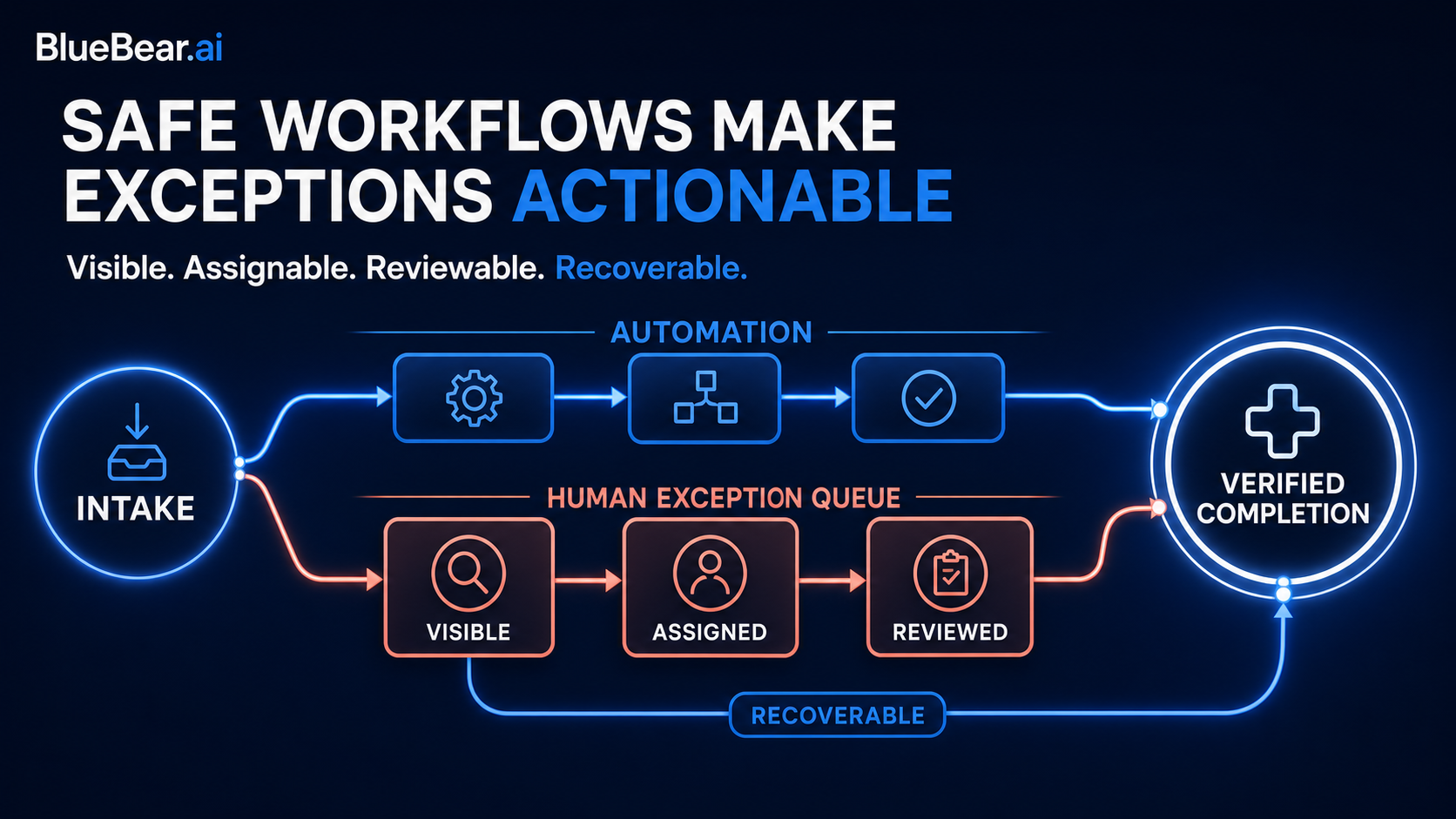
Healthcare AI Agents Need Exception Queues, Not Just Automation Rates
AI automation rates often hide the manual work still needed for complex healthcare operations.
Healthcare operations leaders today face immense pressure to boost efficiency. Artificial intelligence (AI) agents offer a compelling vision of automated workflows, reducing human effort and speeding up processes. However, a singular focus on achieving high "automation rates" can create a misleading picture. It often obscures significant manual work, delays, and compliance risks lurking within complex healthcare administrative tasks.
For many, the success of an AI demo is confused with production readiness. This gap in understanding leads to a critical oversight: the crucial role of exception queues. Without clear management of these exceptions, organizations face hidden costs. Provider invoices, for instance, often lack workflow attribution, making it impossible to track the true cost of human intervention. Also, frequent retries and extensive review labor silently inflate the true unit cost of processing each item.
The core problem remains: automation metrics hide documents, signatures, authorizations, sync failures, and ambiguous cases that still require accountable human work.
The Hidden Costs of Unmanaged AI Exceptions in Healthcare
When Automation Isn't Fully Automatic
AI agents, while powerful, operate within real-world systems. They frequently encounter situations they cannot resolve autonomously. These exceptions can stem from missing data, ambiguous interpretations of rules, system integration failures, or even regulatory requirements demanding human review. Think about a prior authorization request. An AI agent might process most of it. But if a specific document is missing, or a physician's signature needs human verification, the automation stops.
Without a defined process, these unhandled items become "dark work." They often lead to manual workarounds, informal email chains, or spreadsheet tracking. This creates a significant drain on resources. It also blurs the lines of accountability. When provider invoices lack workflow attribution, it becomes impossible to identify exactly where bottlenecks occur or the true labor cost of handling exceptions. This manual effort, including repeated retries and extensive human review, directly hides the true unit cost of processing claims or other administrative tasks.
Consider a representative operating scenario: an AI agent is designed to process incoming patient claims. One claim arrives with a missing prior authorization document, a common occurrence. Without a robust exception queue, this claim might simply fail, requiring an administrator to manually search for it, identify the missing piece, contact the provider, and then re-initiate the process. This adds significant time, cost, and introduces potential for errors.
The Regulatory Imperative for Oversight
Beyond operational efficiency, the responsible use of AI in healthcare is a regulatory and ethical concern. The Centers for Medicare & Medicaid Services (CMS) provides clear guidance on this.
CMS guidance connects responsible AI use to secure operations, ethical handling, and safeguards for sensitive PII and PHI. Source 1
This means AI deployments cannot be "set and forget." Organizations must ensure secure operations and ethical data handling, especially concerning Protected Health Information (PHI) and Personally Identifiable Information (PII). Unmanaged exceptions create vulnerabilities in both areas. They can expose sensitive data or lead to non-compliant processing.
Furthermore, CMS AI guidance treats monitoring, versioning, and observability as production requirements. It ties controls to the impact of each use case. Source 2 This emphasizes the need for systems that provide transparency into AI agent performance. It also requires the ability to audit decisions and intervene when necessary. Exception queues are a fundamental component of achieving this level of oversight and compliance.
Following a Healthcare Operations Queue: From Automation to Audit
A truly effective AI strategy in healthcare integrates automated processing with robust human oversight. This involves a clear journey for every work item.
Automated Handling: The First Pass
The process begins with the AI agent. It ingests a work item, like a patient enrollment form or a complex billing code. The agent applies its logic and data processing capabilities. For straightforward cases that fit predefined rules, the AI agent can complete the task quickly and accurately. This represents the "happy path" of automation, where significant efficiency gains are realized.
The Exception Queue: Where Humans Take Over
When an AI agent encounters an anomaly or a required human checkpoint, the work item doesn't just disappear. Instead, it enters an "exception queue." An exception queue is a structured holding area for tasks that AI agents cannot fully process or that require human review and decision-making. It provides immediate visibility into every item that needs attention. It also ensures clear accountability for its resolution. This structured approach prevents tasks from falling through the cracks. It also ensures critical items are addressed promptly and compliantly.
Returning to our missing prior authorization claim, instead of causing a system error, the AI agent now routes it to a dedicated exception queue. This queue is staffed by human reviewers. They have the specific knowledge to handle complex scenarios.
Review and Retry: Guided Human Intervention
Within the exception queue, human reviewers take over. They examine the specific reason for the exception. This might involve verifying information, gathering missing documents, or applying nuanced judgment. The system should provide all necessary context and tools for the reviewer to make an informed decision. For instance, the reviewer might retrieve the missing prior authorization document from a different system or contact the provider directly. Once the issue is resolved, the item can either be re-submitted to the AI agent for reprocessing or routed to another system for finalization. Every action taken by the human reviewer is meticulously recorded. This creates a transparent audit trail.
The Audit Packet: Evidence and Accountability
The ultimate goal is to generate a comprehensive "audit packet" for every work item, especially those involving exceptions. An audit packet is a complete record of a work item's entire journey. It includes automated actions taken by AI agents, all human reviews, decisions made, and any supporting documentation. This packet is vital for several reasons. It ensures compliance with regulatory standards. It supports quality assurance and allows for continuous improvement of both AI models and human workflows. Furthermore, it provides irrefutable evidence for any audit, demonstrating due diligence and responsible AI operation.
The BlueBear Difference: Governed Workflow and a Tamper-Evident Audit Log
Many AI agent platforms focus solely on raw automation percentages. BlueBear offers a different approach. BlueBear's healthcare approach centers governed workflow states and reviewable exceptions rather than autonomous claims. Prescriber signatures and user logins go to a tamper-evident audit log today. Per-client approval rules and audit export are being built with pilot partners.
We believe that true operational readiness comes from making exceptions visible, assignable, reviewable, and recoverable. Our MCP gateway and governed agent runtime ensure that AI agents operate within defined boundaries. Any deviation or anomaly is immediately flagged and routed to a human for review. This prevents "black box" scenarios where decisions are opaque. It also ensures that healthcare operations remain compliant and accountable.
BlueBear Healthcare Exception State Contract
BlueBear models exception handling as an explicit workflow with ownership and evidence. The exact clinical or operational decision remains with the customer; the platform provides the queue, policy, approval, integration, and audit boundaries around that decision.
| State | Entry condition | Required owner/evidence | Allowed exit |
|---|---|---|---|
| Received | A request or document enters the governed workspace. | Tenant, workspace, source, timestamp, and correlation ID. | Validated or quarantined. |
| Needs review | Required data is missing, confidence is below policy, or a rule requires human judgment. | Reason code, extracted fields, source reference, and named queue. | Approved, corrected, rejected, or escalated. |
| Waiting on dependency | A signature, authorization, external system, or customer response is outstanding. | Dependency, due time, retry policy, and current owner. | Needs review, ready to sync, or expired. |
| Ready to sync | Required checks and approvals are complete. | Effective approval, destination, permitted action, and credential boundary. | Completed or sync repair. |
| Sync repair | The downstream write failed or produced an ambiguous result. | Tool receipt, failure class, retry count, and reconciliation owner. | Completed, needs review, or escalated. |
| Completed | The downstream system confirms the accepted outcome. | Outcome ID, completion time, and retained evidence packet. | Reopened only through a recorded action. |
For healthcare deployments, customers must confirm role design, disclosure rules, retention, and regulatory requirements for their environment. BlueBear should not be treated as making a clinical decision merely because it coordinates the workflow.
A Diagnostic Checklist for Your AI Agent Workflow
For Heads of AI, AI Product Directors, FinOps Leads, and Operations Directors, evaluating your current or planned AI agent deployments requires asking critical questions:
- How do you identify and track work items that AI agents cannot complete?
- Do you have a clear, documented process for escalating and resolving these "exceptions"?
- Who owns the resolution of these exceptions, and are they adequately resourced?
- What is your system for gathering and storing evidence for human-reviewed items?
- Can you accurately attribute the full cost—including both automated processing and human review labor—of each processed item?
- How do you ensure your AI agent workflows comply with regulatory guidelines for AI use in healthcare?
- Is there a mechanism to learn from exceptions and continuously improve both AI agent performance and human workflows?
Unanswered questions in these areas point to potential hidden costs, compliance risks, and operational inefficiencies that can undermine the perceived benefits of AI automation.
True efficiency and compliance in healthcare AI depend on managing exceptions, not just automating the easy cases. A robust exception management framework transforms potential weaknesses into strengths. It provides clarity, accountability, and a pathway for continuous improvement. Evaluate your current workflow before adding another tool. Map exception states and escalation owners in one healthcare administrative workflow.