What changed: Updated 18 August 2026: added the fallback reason taxonomy, the distinction between a delivery retry and a re-inference, and how to tell an expected route divergence from an unexplained one.
Relying on a single AI model for critical workloads is a growing business risk that demands proactive management.
The Hidden Costs of Multi-Model Adoption
Many engineering teams initially explore multiple AI models with a primary focus on cost arbitrage. They aim to route inference traffic to the cheapest available provider or leverage specialized models for specific tasks. This financial incentive is strong, but it frequently overshadows the equally critical operational aspects. Key factors like unexpected service outages from a primary provider, sudden API rate limits on a heavily used endpoint, variations in regional availability, the unique capability fit of each model, and internal policy constraints are often overlooked. Ignoring these crucial elements can quickly transform a perceived cost optimization into a significant resilience nightmare for enterprise AI. When these operational realities are not accounted for, the system becomes brittle. Unexpected failures become common, quality degrades unpredictably, and the initial perceived savings can quickly erode when business operations face costly interruptions or complete halts.
Fragmented Infrastructure Hinders Operations
Agent Infrastructure is Fragmented Across Teams
For leaders in VP Engineering, Platform Engineering, and AI Infrastructure, the operational landscape of multi-model AI agents presents significant challenges. A pervasive issue is the inherent fragmentation of agent infrastructure across an enterprise. Different development teams, often working autonomously, adopt their preferred models and orchestration tools. This leads to a complex, disparate landscape of systems. Such a patchwork environment makes central management exceptionally difficult. Each team optimizes for its immediate project needs, inadvertently creating silos. The consequence is a lack of standardized practices, shared visibility into performance, and consistent application of operational policies across the organization. This fragmentation directly impacts overall efficiency, complicates security audits, and hinders efforts to maintain regulatory compliance.
Failures Are Difficult to Reconstruct End to End
When an AI agent malfunctions in a multi-model setup, identifying the root cause is exceptionally complex. Failures are difficult to reconstruct end to end. The question immediately arises: Was it a transient provider outage impacting a specific region? Did we hit a hard API rate limit from a particular service? Was there an issue with the agent’s prompt design, or a problem with a downstream dependency? Without a unified control plane that offers comprehensive, granular telemetry across all models and services, pinpointing the exact point of failure becomes an exhaustive, time-consuming, and often manual process. This prolonged diagnostic effort leads to extended downtime, significant increases in operational costs, and frustration among engineering teams. AWS guidance strongly recommends a proactive approach to cost optimization through cost-aware model selection. They emphasize efficient context handling and explicit cost-quality telemetry, advocating against choosing models in isolation from the overall workload design (Source 1). This means understanding how every decision, from model choice to prompt engineering, impacts both performance and cost at a detailed, observable level.
Late Arrival of Tenant Isolation and Capacity Controls
AI Infrastructure Architects face the critical task of ensuring robust tenant isolation and effective capacity controls. These capabilities are fundamental for stable, secure multi-tenant AI environments. However, in many emergent multi-model deployments, these essential features often arrive late in the development cycle, if at all. Without proper isolation, a sudden surge in usage by one internal team or customer tenant can inadvertently degrade the performance of others. This leads to unpredictable service quality and introduces significant security and fairness risks within shared infrastructure. Proactive implementation, rather than reactive patching, is essential for managing growth. Microsoft guidance for designing scalable AI agent solutions clearly connects strategic model and orchestration choices to business demand, cost visibility, governance, and long-term operating efficiency (Source 2). This highlights the absolute necessity of integrating intentional architectural decisions for isolation and capacity management from the very beginning of any multi-model AI initiative.
An Operations Story: Routing for Resilience
Consider a large, geographically dispersed enterprise. This organization relies heavily on a fleet of AI agents for mission-critical functions, ranging from sophisticated customer service automation to real-time internal knowledge retrieval for technical support. Their primary large language model (LLM) provider experiences an unexpected, localized outage in a key region. In a traditional, single-model architecture, or even a basic multi-model setup without intelligent routing, customer support queues would immediately back up. Internal operations would grind to a halt, leading to significant financial losses and reputational damage. This is not merely a hypothetical scenario; such disruptions are a constant, evolving threat within today's dynamic AI ecosystem. A truly resilient strategy demands sophisticated routing decisions. These decisions must protect continuity and maintain quality across continuously changing provider conditions. This involves more than just having a backup model. It means automatically and seamlessly switching to a pre-approved fallback model when the primary one fails. It also requires the ability to dynamically manage and distribute traffic based on real-time performance metrics, current capacity, and even cost efficiency across all available models.
The BlueBear Difference: Governed Agent Runtime
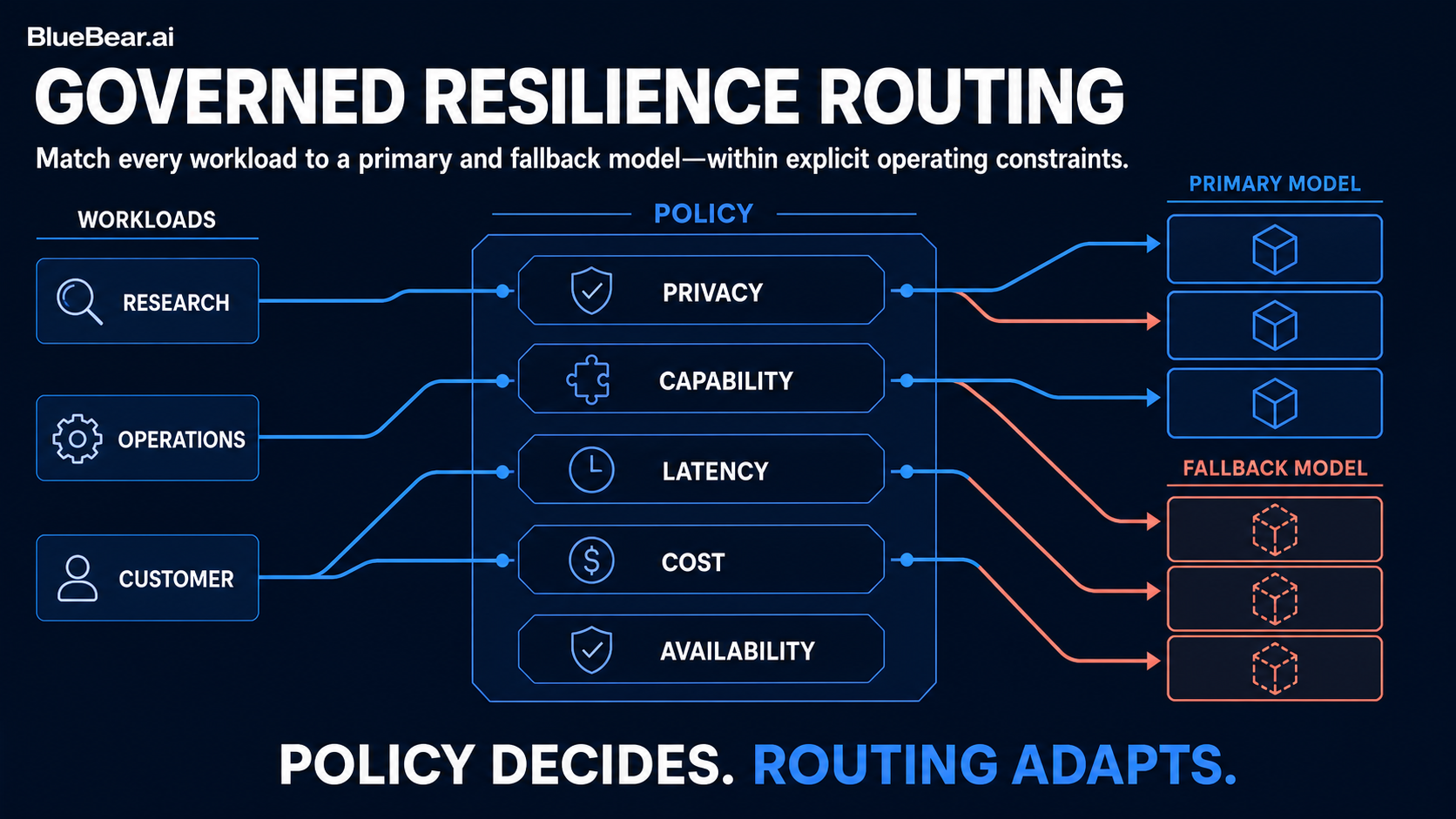
BlueBear offers a specialized AI agent platform meticulously engineered to directly address these complex operational challenges. At its core, our MCP gateway provides a sophisticated governed agent runtime. This fundamentally transforms how organizations approach the strategic adoption and management of multi-model AI. With BlueBear, model choice is elevated from a static configuration to a dynamic, governed runtime policy. This policy is intricately tied to explicit workload requirements, current budget constraints, user access permissions, and predefined fallback options. Crucially, it is not a hard-coded SDK decision made once during development and forgotten. Instead, it operates as a dynamic, observable, and fully auditable process that adapts to real-time conditions. This approach differs significantly from simply abstracting API calls or using a basic load balancer. The BlueBear platform injects deep operational intelligence directly into the routing layer. This empowers AI Infrastructure Architects and Platform Engineering Leads to define granular, sophisticated policies. These policies precisely dictate which models handle which specific requests under a wide array of varying conditions. Criteria can include latency tolerances, acceptable cost per inference, data security classifications, compliance mandates, and the unique capabilities or limitations of each individual model. This level of granular control ensures that every inference request is routed optimally.
BlueBear Operating Scenario: Dynamic Workload Routing
Consider a representative operating scenario within a large financial services institution. This firm utilizes AI agents for two distinct, mission-critical purposes: high-priority, low-latency fraud detection and routine, high-volume customer inquiry chatbots. For the fraud detection system, the defined policy prioritizes maximum security and ultra-low latency. These critical requests are routed to a specialized, enterprise-grade model from Provider A, which comes with a stringent service level agreement (SLA) and robust security certifications. If Provider A experiences elevated latency, a temporary outage, or a specific region becomes unavailable, the BlueBear platform's policy automatically triggers a failover. Requests are seamlessly rerouted to a pre-approved, equally secure, but perhaps slightly higher-latency model from Provider B. The transition is transparent to the fraud detection agent. For the customer chatbot system, the policy balances cost efficiency with acceptable responsiveness. These requests are primarily routed to a general-purpose model from Provider C, which offers highly competitive pricing and good conversational quality. Should Provider C approach its predefined rate limits for this specific workload, or experience a minor performance degradation, the BlueBear MCP gateway dynamically reroutes new chatbot requests to an alternative general-purpose model from Provider D. This ensures continuous service availability and maintains a consistent user experience, all without requiring any manual intervention from operations staff. This intelligent, dynamic routing ensures that all critical workloads consistently meet their stringent operational requirements for quality and availability. Simultaneously, less critical, high-volume workloads remain cost-efficient. The entire process is observable through the BlueBear platform, providing end-to-end visibility. This eliminates the guesswork in failure reconstruction and enables proactive operational management, rather than reactive firefighting.
Practical Diagnostic Checklist for Multi-Model Resilience
Before your organization further expands its multi-model AI footprint, a thorough operational assessment is crucial. Consider these practical diagnostic questions to evaluate your current resilience posture and identify potential gaps:
- **Policy Definition:** Can you precisely define, enforce, and audit routing policies based on granular criteria such as workload type, acceptable cost per inference, required latency, and data security classification?
- **Failover Strategy:** Do you have clearly documented and regularly tested failover strategies for every critical AI agent workflow, outlining primary and secondary model assignments?
- **Infrastructure Unification:** Is your AI agent infrastructure unified under a single control plane, or is it fragmented across disparate teams, independent projects, and a variety of incompatible tools?
- **Failure Reconstruction:** Can your engineering teams swiftly and accurately reconstruct an end-to-end failure path across multiple models, external services, and internal components when an issue arises?
- **Isolation & Capacity:** Are tenant isolation and capacity controls implemented proactively at an architectural level, or are they reactive measures applied after performance issues or security concerns emerge?
- **Visibility & Telemetry:** Do you possess real-time visibility into the performance, operational costs, utilization, and health of all your deployed models and agents?
Conclusion
Multi-model AI is more than a strategy for cost reduction. It is a fundamental component of a resilient AI agent infrastructure. Overlooking the operational complexities of outages, rate limits, and policy enforcement leads to unpredictable performance and increased risk.
By treating model choice as a governed runtime policy, platforms like BlueBear allow organizations to build agent systems that are robust, observable, and aligned with business objectives. This shift moves beyond simple model abstraction to true operational control.
Classify workloads by quality, latency, cost, and failover requirements before adding a provider.
Fallback is only useful if it is legible
Every multi-model design has a fallback path, and the fallback path is by definition the one nobody is watching. Two disciplines make it legible rather than merely present.
Give every fallback a distinct reason
"We fell back" is not an operational fact. In BlueBear's gateway a planner timeout records route_plan_timeout, a non-2xx records route_plan_http_<status>, a missing planner URL records inference_os_base_url_missing, and a recommendation whose credential is unavailable records route_plan_selected_model_key_unavailable. Those demand completely different responses — one is capacity, one is an upstream fault, one is configuration, one is credentials — and a single boolean cannot tell you which you have. A rising fallback rate is simultaneously a cost event and a reliability signal, and only the reason string separates them.
| Recorded reason | What actually happened | The response it calls for |
|---|---|---|
route_plan_timeout | The planner did not answer inside its abort window. | Capacity or latency work on the planner. Harmless in itself — the request fell back to the model the caller already wanted. |
route_plan_http_<status> | The planner answered with an error. | An upstream fault. The status code distinguishes an outage from a rejected request. |
inference_os_base_url_missing | No planner was configured. | Configuration. Every request is silently unrouted until it is fixed, which is invisible without this string. |
route_plan_selected_model_unavailable | The recommendation named a model the live catalog no longer permits. | Catalog drift between the planner's snapshot and the gateway's. |
route_plan_selected_model_key_unavailable | No usable credential for the recommended model. | Credentials. Distinct from availability, and confusing the two sends you to the wrong team. |
route_plan_confidence_below_minimum | The planner answered, but not confidently enough to act on. | Nothing urgent. This is the confidence gate doing its job, and a rising rate is a signal about your traffic, not your infrastructure. |
Distinguish an expected divergence from an unexplained one
A planned model and an executed model differing is normal in several modes and alarming in exactly one. Our gateway classifies every comparison into exact_match, expected_shadow_mismatch, expected_evaluation_mismatch, expected_fallback_mismatch, or unexpected_mismatch — and on the last one it refuses to forward the outcome at all, recording route_outcome_unclassified_model_mismatch.
That is a deliberate choice to lose data rather than record data nobody can interpret, and it is the right default for anything feeding an automated decision. An outcome you cannot explain, admitted into an activation dataset, is worse than a gap you can see. If you would rather keep such records, quarantine them; do not blend them.
A retry is not always a retry
Worth separating in your own design, because the word covers two unrelated things. Re-running an inference because the first attempt failed costs tokens and may change the answer. Re-delivering a record because the receiving system was unreachable costs nothing and changes nothing. Our feedback-outcome retry is the second kind — exponential backoff from five seconds to a five-minute ceiling over a bounded number of attempts, with unknown transport failures treated as retryable because the receiver upserts by stable identity. Conflating the two in a dashboard makes a delivery outage look like a model quality incident.
Where to go deeper
- Did your router honour the plan? — the record that separates a declined route from an executed one.
- Tool calling on a budget — tool-call failure as the signal that moves first after a model change.
- Canary rollout for routing — introducing a second model without betting the product on it.
- The routing policy guide — the policy fields a fallback decision is evaluated against.
Questions people actually search for
- why use more than one llm provider
Availability, deprecation, and capability coverage — in that order of how often they bite. Providers have incidents, retire model versions on their own schedule, and differ on specific capabilities such as structured output or long context. Price is a reason to route between models; continuity is the reason to be able to at all.
- how do I fail over between llm providers safely
Decide in advance which failures are eligible for failover and record which one fired. A timeout, a rate limit, a malformed response and a content refusal are four different events, and treating them identically means an upstream policy decision gets silently retried against a second provider. Fail over on transport and capacity; do not fail over on a refusal.
- does model fallback hurt quality
It can, and the risk is that nobody notices, because a fallback produces an answer rather than an error. The mitigation is to record the fallback on the outcome alongside the quality signals you already have — whether the user regenerated, whether a tool call failed — so a degraded fallback path shows up as a quality number rather than only as a slightly higher bill.
- what should I log when a model fallback happens
The reason the primary route was not used, the model that was planned, the model that actually ran, and whether the divergence was expected. Those four fields turn "we fell back a lot" into something you can act on.