BlueBear Insights · Selling on BlueBear · 7 min read

Your AI project worked for one client. How to sell it to the next ten

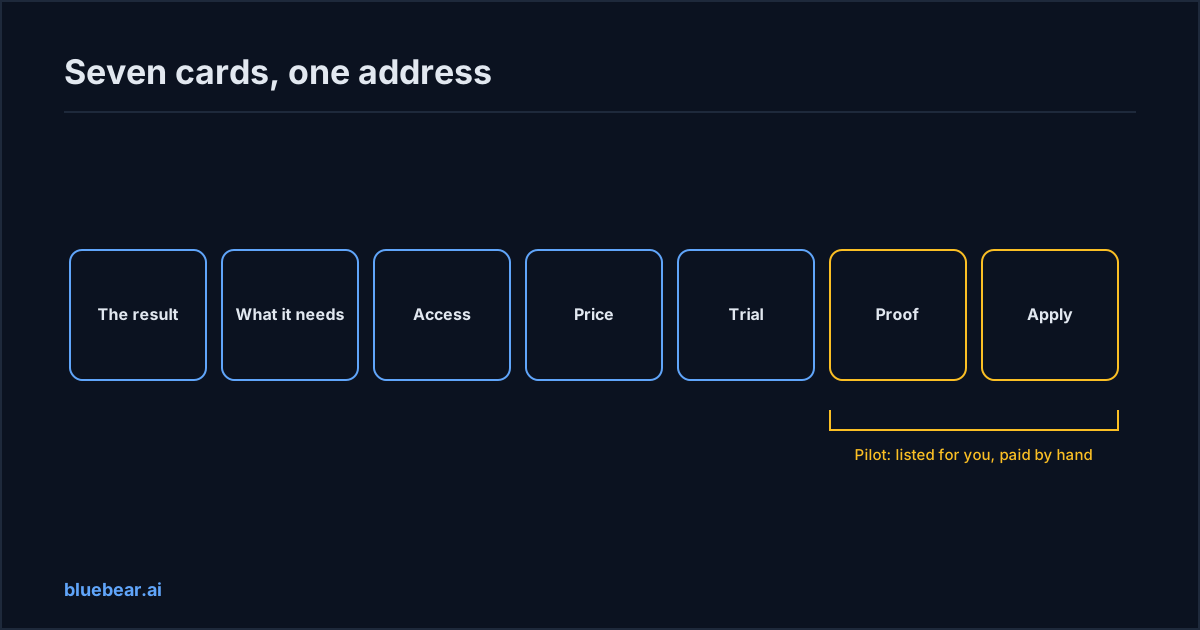
Seven numbered cards in a row, from the result in one sentence to apply, with a bracket under the last two marked as done by the marketplace for you during the pilot.
Most of the work is writing down what you already did for one client so a stranger can buy it.

The problem

You run a small agency. Last year you built a bid-monitoring service for one client. Every morning it reads new government tenders, matches them to what the client sells, and sends a short list. They love it. They have told two friends.

Both friends want it. And you have realised the awkward truth: you cannot just hand it over. It was built around one client. Their logins are wired in. Their odd preferences live in the code. Nobody wrote down what it needs to run or what it costs each morning. Selling it to the next client means rebuilding it. Selling it to ten means rebuilding it ten times.

People searching "how to monetize AI agents 2026" usually get a list of channels. Some call it the AI agent creator economy. That is not your problem. You have a buyer. Your problem is that the thing you built is not yet a thing you can sell twice.

Why this keeps happening

A project is built to work. A product is built to be bought. Those are different jobs, and the second one is mostly writing. When you built the service, you never had to explain it to a stranger. You never had to say what it needs, because you set it all up. You never had to quote one price, because you billed hours. You never had to prove a morning's work, because the client trusted you.

Every one of those gaps stops a second sale. A stranger needs the explanation. A stranger needs to give access without handing you passwords. A stranger needs a price before a call. And a stranger needs proof each morning that the job ran, because they do not know you yet.

What the first client never asked forWhat the next ten will ask
A plain descriptionWhat exactly do I get, and when?
A list of what it needsWhat data, what rules, what of mine does it touch?
A priceWhat does it cost, and can that change?
A trialCan I see one before I pay?
Proof it ranHow do I know it worked this week?
TermsWho do I call, and how do I stop?

The cost of not writing these down is slow. Each new client becomes a small project. The margin never improves. And your calendar fills with setup calls for the same thing.

How to fix it

Write seven things down. Each one is something you already did for the first client, said plainly enough for a stranger to read. You can do this in a week, with or without a marketplace.

  1. The result, in one sentence. "Every weekday by 8am, a short list of new government tenders that match what you sell, ranked, with deadlines." If you cannot say it in one sentence, it is not ready.
  2. What it needs that you do not own. Paid data sources and checks, with the version you tested. Data the AI must not make up. Rules with a named keeper. Any person who reviews or signs off. Write the list; it becomes your disclosure and your bill of materials.
  3. What it must reach in the buyer's systems, and what it may do there. Read their product list? Write to their CRM? Say which, and say whether they bring their own account or you bundle access. Never plan on holding their passwords.
  4. The price and the range. One price per result, per month, or a setup fee plus per result. State the per-use costs that can move. Check that one small job still makes money; why your AI service loses money on small jobs is the worksheet.
  5. The trial. The safe trial runs on sample data you supply and produces a real-looking result without touching the buyer's systems. Say how many runs are included. A trial that needs their live systems is a setup, not a trial.
  6. What the receipt will prove. What ran, which version, what it cost, who signed off if a person did, and what counts as a rejected job. This is the promise a stranger can check. An AI agent proof-of-value plan is the buyer-side version of the same page.
  7. Your terms. Who they call, how fast you answer, how they cancel, how they switch off your access, and how they get their results out. Pin the version they are on and say how you announce changes; change management and versioning covers the habit.

Item six is where disputes come from. Zendesk, which charges per resolved support ticket, tells sellers their contract must say how a disagreement is settled, and adds:

"It should also cover edge cases, such as partial outcomes, delayed verification, overlapping systems, or external factors that affect performance."

Candace Marshall, Vice President, Product Marketing, AI and Automation, Zendesk, "Understanding outcome-based pricing" (April 2026)

Name those four cases in your reject rules. A half-finished list. A tender that appears late. A job that overlaps another tool the buyer runs. A data source that went down. Each one gets a stated answer before anyone pays.

Where the buyer's data cannot leave their building, say so in item three and plan to run part of the job inside their setup. BYOC vs managed hosting explains the trade-off in plain terms.

Once these are written, the "5 ways to make money with your AI agent" question answers itself. Charge per result. Charge a monthly fee for a bounded job. Charge a setup fee for the access and rule work. Sell the human checking step as a service. Or run it under your own brand for your own clients. They are all just different lines on the same seven pages.

One caution. Some investors argue that the real value is deep, hands-on fitting into each buyer's data and habits, and that packaging alone does not deliver it. They are right. Packaging is necessary, not sufficient. Items two and three are where that fit gets written down, and the tenth client will test them harder than the first.

What BlueBear's marketplace does about it

BlueBear's marketplace turns those seven pages into one offer at one web address. Here is what it does for you today, and what it does not.

You apply with a few things. A short name for the offer. A version. A price. The result you promise. An honest list of what it needs and what it touches. And where it runs: on BlueBear, or on your own servers behind BlueBear's payment and counting.

BlueBear checks who you are, your rights to any data you bundle, and that the job can be delivered safely. Then it publishes a public offer page for you. A computer can read the same page, so a buyer's own AI helper can check it.

A buyer pays one price in credits, one credit being one dollar. They decide which of their systems your offer may reach and can switch that off at any time. They can cap what one job may spend and what a month may spend. Every job produces a receipt showing what ran, what it cost and who signed off. A rejected job is refunded. Your earnings are recorded per job.

A named person can review results before they go out, recording corrections and signing or declining. That makes your checking step part of the product rather than a favour.

Works todayNot yet
Public offer page at a fixed address, readable by people and computersSelf-serve publishing; BlueBear lists it for you, by invitation
Payment in credits, one credit equals one dollarAutomatic payouts; you are paid by hand
A receipt for every jobRankings or "top seller" lists
Spending caps per job and per month, set by the buyerAutomatic switching between rival data suppliers
A named reviewer who signs or declines before releaseTax handling
Earnings recorded per job; refunds on rejectA large catalog; the pilot has a small set of offers

For comparison, as of September 2026, OpenAI's app store approves paid transactions only for physical goods, through the seller's own checkout. Anthropic's connector programme has no revenue share. Apify pays makers 80 percent of each paid event minus platform costs. None of those pays a person for a checking step inside a bigger result. On BlueBear the receipt does, though the payout itself is manual today.

What to do next

Write the seven pages for your bid-monitoring service, or whatever your version of it is. Send the one-sentence result to the two friends and see if they say yes without a call. Then apply at /marketplace/sell. Publishing is by invitation during the pilot, and the application is how you ask for one.

Do you also want to serve your existing clients under your own brand? Your own brand or a public listing helps you decide whether to do one, the other, or both.

Questions people actually search for

how do i list an ai solution on bluebear

Write down seven things: the result in one sentence, everything the job needs that you do not own, what it must reach in the buyer's systems, the price in credits, the trial, what the receipt will prove, and your support terms. Then apply at /marketplace/sell. In the pilot there is no self-serve form. Publishing is by invitation, and BlueBear checks your details and lists the offer page for you at a fixed web address. You keep the client relationship and set the price.

what is an evidence contract for an ai offer

The part of your offer that says what the buyer can prove after each job. It names the result, what the receipt will show (what ran, which version, what it cost, who signed off), what counts as a rejected job, and the refund that follows a reject. Writing it forces you to say exactly what a finished job is. That is also what makes charging per result safe, because both sides can point at the same record.

can i publish an ai agent myself on bluebear

Not through a self-serve form, and not as a bare agent in the pilot. Publishing is by invitation and BlueBear lists the offer on your behalf. There is no separate shelf for agents on their own. An agent is sold as part of a finished result, alongside the data, rules, access and checking step that make it something a buyer can use. If the agent is ready but those parts are not, package them first, then apply.

what does a dependency list for an ai solution include

Everything the job needs that you do not fully own. Paid data sources and automatic checks, with the version you tested. Data the AI must not make up. Rules with a named keeper. Any person who reviews or signs off. The systems of the buyer's it must reach, and what it may do there. And a spending limit per job and per month. Anything on the list that cannot be sorted out blocks the job from starting, before the buyer is charged.

Primary sources