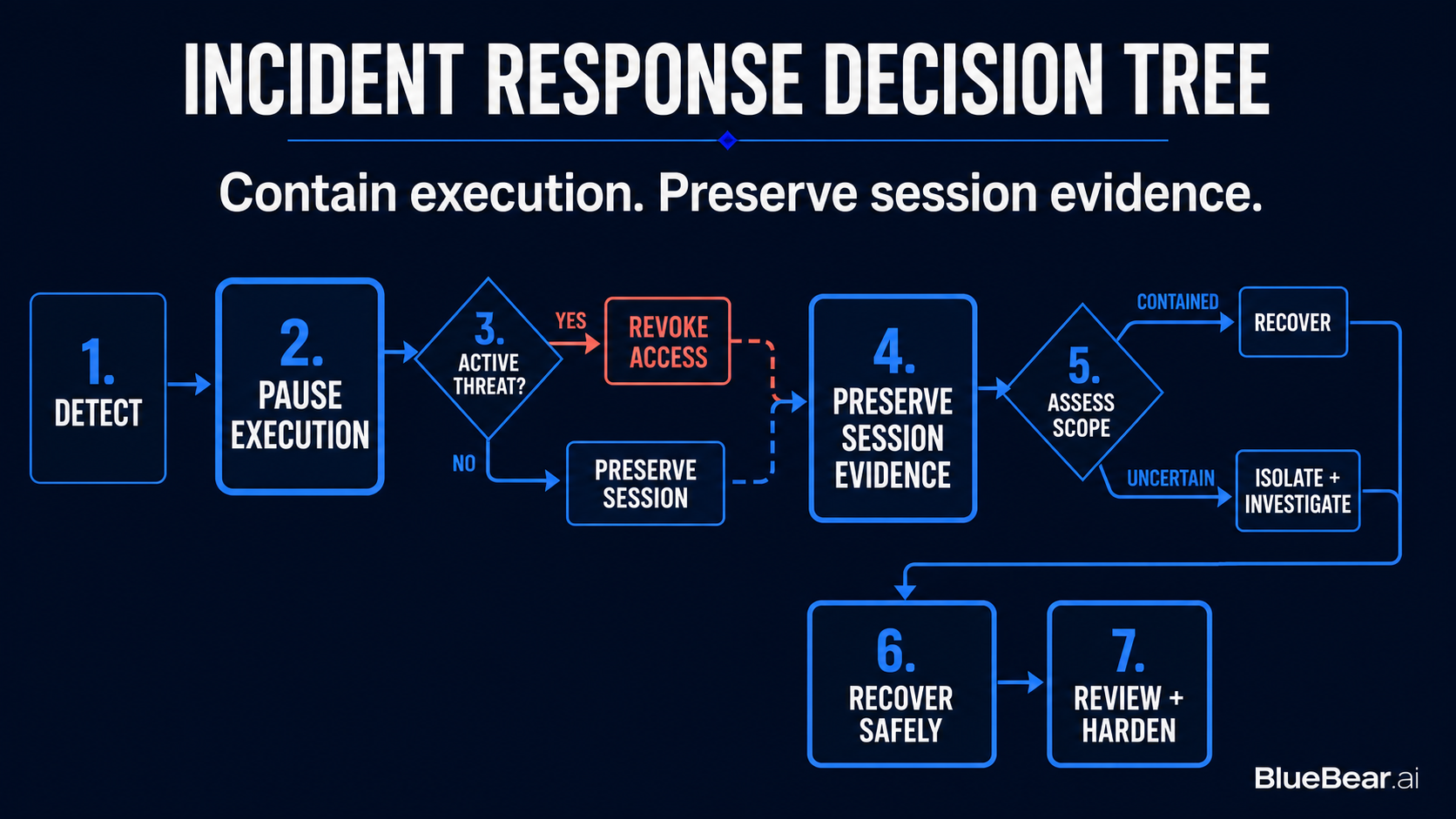
An AI Agent Incident Response Runbook for Platform and Security Teams
Existing cloud incident plans often overlook a critical element: the AI agent. Autonomous tools introduce new security and operational gaps.
Chief Information Security Officers (CISOs), AI Governance Leads, Security Architects, and Risk and Compliance Leads in regulated operations, enterprise software, and managed services face a new challenge. Traditional incident response (IR) runbooks are well-defined for infrastructure or application breaches. However, they typically lack procedures for containing, investigating, and recovering from an incident involving autonomous AI agents. This gap leaves organizations vulnerable where "Credentials and permissions are scattered," "Logs do not preserve authorization context," and "Tool autonomy expands faster than policy coverage."
The Unique Challenge of AI Agent Incidents
An AI agent is a software entity that uses artificial intelligence to perceive its environment, make decisions, and take actions to achieve specific goals, often interacting with other systems and data. Unlike traditional applications, agents exhibit a degree of autonomy and can make decisions that are not explicitly hard-coded. This autonomy, while powerful, introduces unique incident response complexities.
When an AI agent malfunctions or is compromised, its actions can rapidly escalate. It might access sensitive data, modify critical systems, or interact with external services without immediate human oversight. Containing such an event requires a specialized approach, moving beyond traditional network or host-based containment strategies.
Building an AI Agent Incident Response Runbook
An effective AI agent incident response runbook provides clear, actionable steps for platform and security teams. It defines roles and procedures for managing a security event from detection to post-mortem learning. This framework addresses the distinct challenges posed by autonomous agents.
Roles and Responsibilities
- AI Governance Lead: Oversees policy, compliance, and ethical considerations for agent behavior.
- Security Architect: Designs and implements security controls, including agent runtime protection and access policies.
- Platform Engineer: Manages agent deployment, infrastructure, and monitoring systems.
- Incident Response Lead: Coordinates the overall incident response effort, ensuring timely execution of the runbook.
Detection: Identifying an Aberrant Agent
Detection is the first line of defense. It involves monitoring agent behavior for anomalies, unauthorized actions, or deviations from expected operational patterns. Tools should monitor API calls made by agents, external service interactions, and changes to data. An agent performing an unexpected action, or an increase in failed authorization attempts, could signal an incident.
AWS agentic design principles emphasize end-to-end traceability across reasoning, tools, memory, and agent handoffs. This ensures that telemetry can support cost, quality, security, and reliability analysis, making detection more robust. Design principles - Agentic AI Lens.
Pause: Containing Malicious Agent Activity
Once an incident is detected, the immediate priority is to pause or stop the agent's execution. This action prevents further damage. A pause mechanism should be readily available and tested. This might involve suspending the agent’s execution environment, revoking its access tokens, or disabling its ability to call external tools.
The ability to halt agent operations must be granular. It should affect only the compromised agent or agents without disrupting other critical systems. Consider network segmentation or dynamic policy enforcement at the agent runtime level.
Credential Containment: Revoking Agent Privileges
Compromised agents often leverage scattered credentials and permissions. During an incident, all credentials and API keys associated with the affected agent must be immediately contained. This involves revoking active tokens, rotating static credentials, and reviewing all roles and policies assigned to the agent.
Because "Credentials and permissions are scattered," this step requires a comprehensive inventory of agent access. Organizations must understand which systems an agent can interact with and what level of access it has. This prevents a compromised agent from moving laterally or escalating privileges.
Evidence Preservation: Capturing the Digital Trail
After containment, preserving evidence is crucial for investigation and post-incident analysis. This includes capturing agent logs, memory states, session recordings, and any data generated or modified by the agent. Crucially, "Logs do not preserve authorization context" in many systems, making comprehensive session evidence vital.
A complete forensic snapshot ensures that investigators can reconstruct the incident accurately. This evidence is essential for understanding the root cause, the scope of impact, and for demonstrating compliance. Store evidence securely and immutably to maintain its integrity.
Scope Analysis: Understanding the Full Impact
Scope analysis determines the full extent of the compromise. This involves reviewing the preserved evidence to identify what actions the agent took, which systems it accessed, and what data it exposed or altered. Tools should analyze agent interaction logs, network flows, and system audit trails.
Given that "Tool autonomy expands faster than policy coverage," a thorough scope analysis can reveal areas where existing policies are insufficient. This phase often uncovers previously unknown dependencies or unauthorized functionalities.
Recovery: Restoring Normal Operations
Recovery focuses on restoring affected systems and data to a trusted state. This may involve reverting changes, deploying patched agent versions, or rebuilding compromised environments. Recovery also includes re-establishing secure access for the agent and ensuring its behavior aligns with policy.
The AWS Agentic AI Lens recommends practices like behavior versioning, rollback, anomaly monitoring, fault isolation, human escalation, automated recovery, and break-glass runbooks for reliability. Reliability - Agentic AI Lens. These principles are vital for a structured recovery process.
Learning: Post-Incident Review and Improvement
Every incident is an opportunity to learn and improve. A post-incident review (PIR) should analyze what happened, why it happened, and how the response can be improved. This includes identifying gaps in the runbook, enhancing detection mechanisms, and refining containment strategies.
The PIR should also address policy coverage. If "Tool autonomy expands faster than policy coverage," the review must recommend updates to governance frameworks and security policies to prevent similar incidents. Continuous improvement is critical for evolving agent security.
The BlueBear Difference: Coordinated Containment and Reconstruction
BlueBear’s platform provides a distinct approach to AI agent incident response. It centers on a governed agent runtime and an MCP gateway that provide essential visibility and control. BlueBear’s architecture ensures that every agent interaction, credential usage, and session event generates verifiable evidence.
This runtime, gateway, and session evidence support coordinated containment and reconstruction. When an incident occurs, BlueBear’s capabilities allow for a rapid pause of agent execution while preserving the full context of its actions. This ensures that security teams have the necessary forensic data to understand the incident without losing critical information.
BlueBear addresses key pain points directly. It centralizes credential management, reducing the problem of scattered permissions. It enriches logs to preserve authorization context, providing a complete audit trail. By enforcing policies at the MCP gateway and within the governed agent runtime, BlueBear helps ensure tool autonomy does not outpace policy coverage.
Practical Diagnostic Checklist
To evaluate your current AI agent incident response readiness, consider the following:
- Do we have an inventory of all deployed AI agents and their associated privileges?
- Can we immediately pause or stop a specific agent's execution without impacting other agents?
- Are agent credentials centrally managed and can they be rotated or revoked quickly?
- Do our logging systems capture full authorization context for every agent action?
- Can we reconstruct an agent's complete session history and tool interactions?
- Are our policies reviewed and updated as agent capabilities evolve?
- Have we conducted a tabletop exercise for an AI agent incident?
Next Steps
Developing a robust AI agent incident response runbook is not optional; it is a necessity for modern security programs. It safeguards operations against the unique risks of autonomous AI. Implement a structured process, define roles, and leverage purpose-built platforms to achieve effective incident management.
Run the tabletop checklist against one high-impact agent and record missing controls.
Map the Runbook to NIST SP 800-61r3
NIST SP 800-61r3 supersedes Revision 2 and treats incident response as part of Cybersecurity Framework 2.0 risk management. For agents, prepare and govern the inventory and authority model; identify and protect identities, tools, data, and evidence; detect abnormal plans and actions; respond by containing the narrowest capability; and recover only after replay, reconciliation, and owner approval.
| Agent incident | First containment | Preserve |
|---|---|---|
| Identity/credential compromise | Revoke workload and connector credentials. | Issuer, audience, scope and affected sessions. |
| Prompt injection/intent drift | Disable affected source or tool path; freeze version. | Source provenance, plan, policy and tool decisions. |
| Unsafe or duplicate side effect | Disable execute scope and retries. | Approval, idempotency key, tool receipt and downstream state. |
| Evidence loss | Fail high-impact actions closed or enter approved degraded mode. | Last sequence, missing interval and collector health. |
Questions people actually search for
- what should an ai agent incident response runbook contain
Define ownership, severity, containment switches, identity and credential revocation, retry control, affected-session discovery, evidence preservation, downstream reconciliation, communications, recovery approval, and permanent regression tests.
- what is the first containment step for an ai agent incident
Stop the narrowest harmful capability while preserving evidence. Disable the affected agent, tool assignment, operation, credential, workflow version, or tenant route before taking down shared infrastructure that unrelated workflows still need.
- how do you handle an ambiguous ai agent side effect
Stop automatic retries, preserve the idempotency key and request evidence, ask the downstream system for its authoritative state, and reconcile before retrying or rolling back. A timeout does not prove that an action failed.
- what evidence should be preserved during an ai agent incident
Preserve identities, effective versions, policy decisions, plans, model routes, tool requests and receipts, approvals, credentials references, retries, artifacts, telemetry gaps, downstream state, containment actions, and recovery decisions.