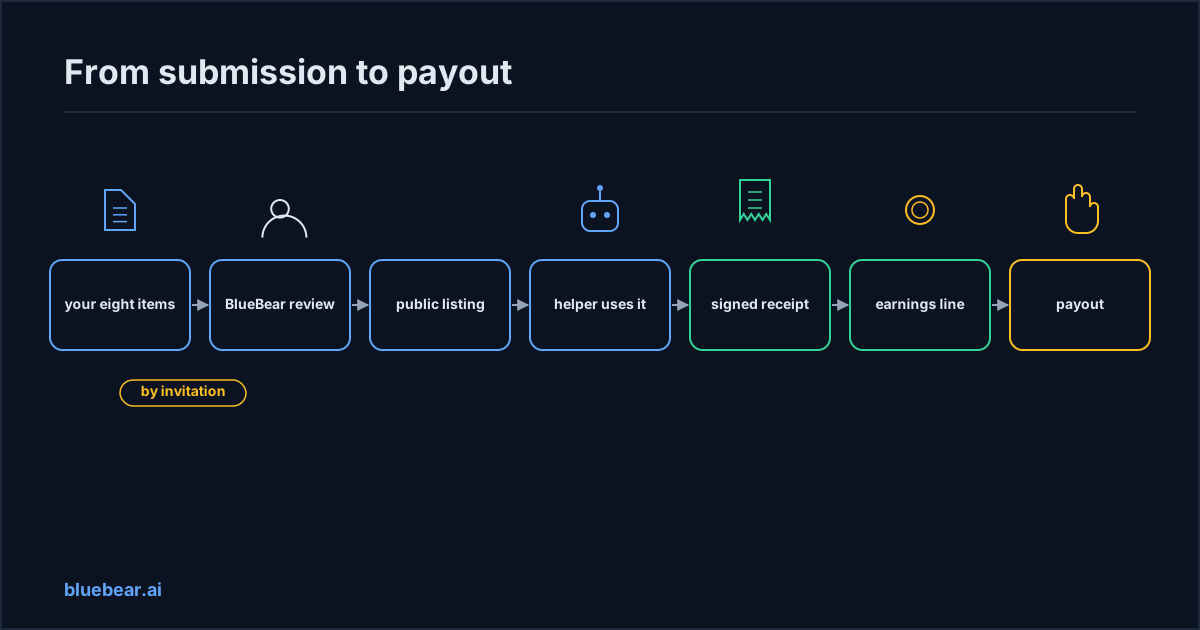
You can get your tool listed for AI helpers without building a storefront. You hand over eight plain facts, a person reviews them, and the listing is built for you: one page, one price, and a receipt for every use. This is the exact path as it stands in September 2026, including what is still done by hand.
The problem
You own a company that sells zoning data to property investors. Their AI helpers want to pull it directly, and you have decided to sell that access. You asked your developer what "sell it" involves.
The answer was a storefront. A sign-up page. A pricing page. Checkout. A way to hand each customer a key and cancel it later. A usage dashboard. A support inbox. A refund process. Three months, at least, and none of it is zoning data.
You searched "how to publish an mcp server" and "where to list your mcp server". You found directories that list tools for free and pay nothing, and cloud stores that want a partner agreement and a big-company buyer. Neither is a place to sell mcp server access from a twelve-person business. The cloud stores describe themselves in purchasing-department language.
"AWS Marketplace now offers AI agents and tools from AWS Partners, allowing customers to find and buy third-party AI agent solutions with streamlined procurement and multiple deployment options."
Amazon Web Services, Introducing AI agents and tools in AWS Marketplace (July 2025)
Partners, procurement, deployment options. That is a store for large sellers and large buyers. What you want is to list a product the way you would list one on a store, and let the store handle the rest.
Why this keeps happening
Most tools that AI helpers call speak MCP, a standard way for AI helpers to use tools. The standard covers how a helper calls a tool. It does not cover who paid, how much, or what they got. So every owner who wants a paid mcp server faces the same choice: build the shop, or find one.
The free directories are not shops. They never see a call, so they cannot charge for one. Even the curated ones ask for a lot. As of September 2026 Anthropic's connector directory wants a business account, a hosted tool, a privacy policy, test logins and seven policy sign-offs, and pays nothing. The cloud stores are shops, but they were built for large sellers and large buyers. The gap in the middle is where most small tool businesses sit. Here is the difference between building the shop and listing in one.
| If you build the storefront | If you list on a marketplace |
|---|---|
| Sign-up, login and customer records | Buyers already have accounts |
| Pricing page and checkout | One price on one page; buyers pay in credits |
| Keys per customer, and cancelling them | No keys; access is bought and can be switched off |
| Counting use and building a dashboard | Every use counted and receipted for you |
| Refund process and support inbox | Refund rule stated once; a reject triggers the refund |
| Months of work before the first dollar | Eight facts and a review |
What the delay costs you is not only the developer's time. Every month without a paid door is a month of free calls you pay to serve, and a month in which helpers learn to use someone else's data.
How to fix it
Whether you list on BlueBear or anywhere else, these are the eight things a marketplace needs from you. Gather them first and the rest goes quickly.
- A working tool, or code someone can run. Either your developer keeps running it and the marketplace stands in front, or you hand over the code and the marketplace runs it. Which one to choose is its own short guide.
- A short, stable name. It becomes the listing's permanent address. A rename later is a new listing.
- A version number. Buyers and other people's workflows pin a version. A change that breaks them is a new major version.
- One price and one model. Per call, per unit, per result, monthly or yearly, stated in credits, where one credit is one US dollar. What a fair price looks like helps you choose.
- One or two sentences on what a buyer gets. What a successful use returns, and what a failed one looks like. This is what a refund is judged against, so make it specific.
- Honest disclosures. Whether your tool needs to reach the buyer's own systems, and which ones. What data leaves the buyer's side. Your rights to any data you bundle.
- Trial, support and refund terms. How many free sample calls, how a buyer reaches you, and the exact condition under which a use is refunded.
- Who you are. A verifiable identity for the public profile and for payout.
Two checks before you submit. Your price should clear your worst-case cost per use after the platform's cut, fees and a refund allowance. And your tool should accept calls only through the marketplace's checkpoint, so a back door cannot skip the count.
What BlueBear's marketplace does about it
You apply at /marketplace/sell with the Apply to publish form. Publishing is by invitation during the pilot, and BlueBear builds the listing on your behalf. There is no dashboard you operate. A person at BlueBear checks your identity, your rights, your disclosures and whether the tool can be delivered safely. That review is a human step without a published turnaround time.
Here is what BlueBear builds from your eight items.
| You provide | What appears |
|---|---|
| Name and version | A stable public page and a computer-readable description at the same address, with a version history |
| Price and model | A price block on the page; a counter set to that unit |
| What a buyer gets | The outcome statement on the page; the line a refund is judged against |
| Disclosures | The access details a buyer reads before connecting; a connection step if your tool needs their systems |
| Hosting choice | Whether the tool runs on your machines behind BlueBear's checkpoint, or on BlueBear's |
| Trial terms | Sample calls a helper can run before the buyer is charged |
| Who you are | A publisher profile the listing links to |
When a buyer's helper uses your tool, the use is counted and a signed receipt is produced: what ran, for whom, at what price, and what came back. If a named reviewer released the result, the receipt says who. Each receipt writes one earnings line for you, linked to the buyer's charge. If the buyer rejects the result under your refund rule, the use is refunded and a new line reverses your earning. Your earnings come from receipts, not from a negotiation.
Buyers never hold a permanent key to your tool. You never hold their passwords. If your tool needs their systems, they grant narrow access from their side and can switch it off. Access to your tool can be switched off the same way.
A fair question: why accept an invite-only pilot with manual payouts? Apify already pays makers 80 percent per event, less platform costs, and lets them list on their own. Apify sells tools to people on its own platform. This path is for a tool that other businesses' helpers call under a budget, with a receipt that names the version. During the pilot, this is the only place that exists.
Being exact matters more than being flattering here. Payout is manual: BlueBear adds up your earnings lines and pays you outside the platform. There is no automatic transfer to your bank, no tax handling, no ranking, and no dashboard you run yourself. Publishing is by invitation, and the first listings come from paid engagements, starting with a technology readiness audit. If any of that is a blocker, better to know now.
What to do next
Gather the eight items this week. Item five, the plain sentence on what a buyer gets, is the one most owners get wrong, so write it first and show it to someone outside the company. If a stranger cannot say whether a given result met it, rewrite it.
Hand your developer one line from the standard's own connection rules before you submit.
"Servers MUST validate the Origin header on all incoming connections to prevent DNS rebinding attacks"
Model Context Protocol, Specification: Transports (June 2025)
It is a basic safety check, and any review of a tool you run yourself will expect it.
Three pieces in the BlueBear library will help you pass the review. What buyers check before connecting anything lists their questions. What a production-ready checkpoint looks like is the standard applied to a tool you run yourself. How buyers link receipts into their own records shows why the receipt matters to them.
When the eight items are ready, apply to publish on BlueBear. Sign-in uses your existing BlueBear login; there is no separate marketplace account. Include a link to your tool's documentation, and expect a conversation about anything unclear before the listing goes live.
Questions people actually search for
- how do i get my tool listed on bluebear
Apply at /marketplace/sell using the Apply to publish form. Publishing is by invitation during the pilot, and BlueBear sets up the listing on your behalf rather than through a dashboard you operate. You supply a short name, a version, a price in credits, one or two sentences on what a buyer gets, what your tool touches and where it runs, your trial, support and refund terms, and who you are. A person at BlueBear checks identity, rights and disclosures, then publishes the page.
- what does bluebear need from me to list my tool
Eight things. A working tool your developer runs, or code BlueBear can run. A short, stable name. A version number. One price in credits, where one credit is one US dollar. One or two sentences saying what a successful use returns, which is what a refund is judged against. Honest disclosures of what your tool touches, what data leaves the buyer's systems, and your rights to any data you bundle. Trial, support and refund terms. A verifiable identity for your profile and payout.
- how and when do i get paid on bluebear
Each paid use produces a signed receipt, and each receipt writes one earnings line for you, linked to the buyer's charge. The lines are never edited; a refund adds a new line that reverses the old one. Payout itself is manual during the pilot. BlueBear adds up what you are owed from the earnings lines and pays you outside the platform. There is no automatic transfer to your bank yet and no tax handling, so plan your own bookkeeping around that.
- can i sell a paid mcp server today
Yes, within the limits of a pilot that publishes by invitation. What exists: a public page and a computer-readable description per listing, purchase in credits, a count and a signed receipt for every use, an earnings line per receipt, refunds when a buyer rejects a result, and a spending limit per request. What does not exist yet: a dashboard you run yourself, ranking, payouts that run on their own, and tax handling. Apply at /marketplace/sell and expect a person to review before anything goes live.