The problem
You run a small marketing consultancy. Over six months you built a Claude skill that pulls a client's top competitors, checks their prices and writes a two-page brief. A day of work now takes twenty minutes.
You shared it with a friend. She shared it with her team. Now people you have never met use it, and one posted it online. Nobody paid you, and you are not sure a text file can be a product at all.
Why this keeps happening
A skill is a folder. Anthropic's documentation says every skill needs a SKILL.md file with a name and a description of when to use it, plus optional scripts and templates. It works in Claude Code, in the Claude apps and through the API. Simon Willison, a well-known independent developer, described the format like this:
"Skills are Markdown with a tiny bit of YAML metadata and some optional scripts in whatever you can make executable in the environment."
Simon Willison, "Claude Skills are awesome, maybe a bigger deal than MCP" (October 2025)
So a skill copies in a second, and no store can stop that. But buyers are also careful. Anthropic's own docs tell people to use skills only from trusted sources, because a bad skill can misuse the tools Claude has access to. That caution works in your favor if people know and trust your name.
| Copies in a second | Does not copy |
|---|---|
| The steps in the file | Keeping them current as tools change |
| The scripts and templates | Your name, and the trust behind it |
| The examples | Help fitting it to one business |
| The wording | The paid work it leads to |
How to fix it
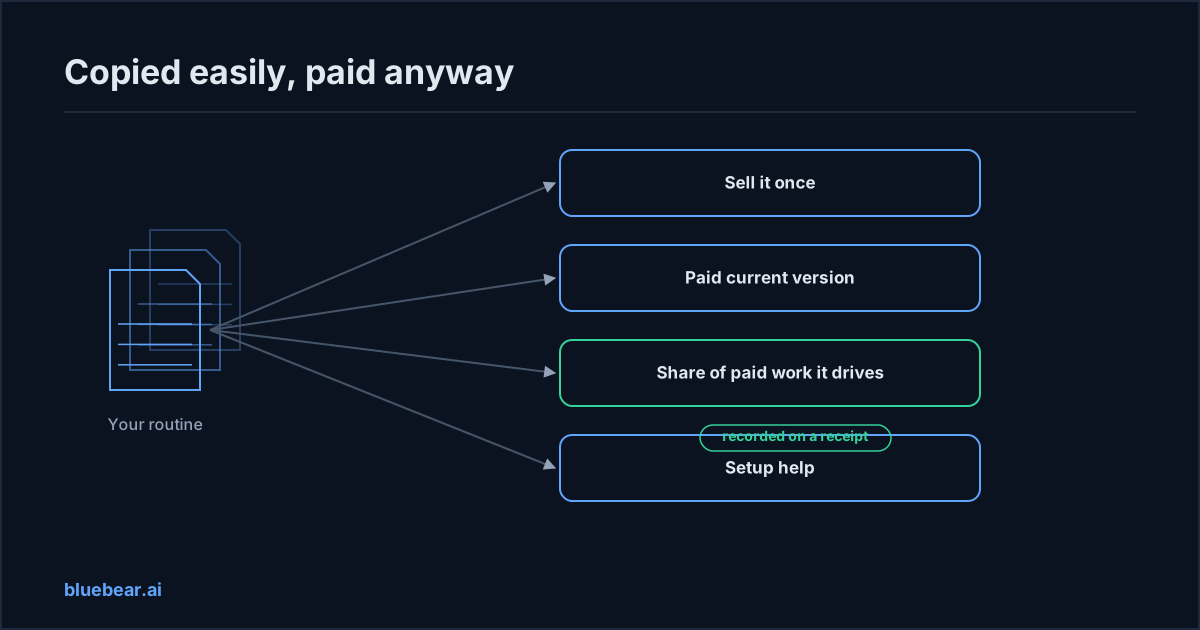
Sell the parts that do not copy, and make the file easy to trust.
- Start from a job you already do well. Ryan Doser, who sells skills, puts it simply: "Stop trying to invent a product."
- Test it on real work until it saves real time. He also warns: "If a skill only restates what Claude does out of the box, most people will not pay for it."
- Bundle a few related skills together, so the package solves a whole job.
- Put your name and a licence line at the top of every file.
- Keep the files readable, with no hidden steps, so a careful buyer can check them.
- Sell from a simple page. Doser says a landing page with a Stripe checkout was enough for him. As of 2026, Gumroad charges 10 percent plus 50 cents on direct sales, and 30 percent when buyers find you through its Discover marketplace.
- Charge for updates and for help setting it up. That is where repeat money comes from.
If your skill needs outside tools or data to work, list them clearly for the buyer. How AI tools connect to other software explains the difference between a skill and a tool connection.
What BlueBear is building for this
BlueBear is not a store for skills today, and you cannot sell a skill through it.
If your skill is really the core of a service you deliver to clients, BlueBear can run that work under your brand, with each client in their own workspace and a record of every run. That turns a file anyone can copy into a service clients pay for each month.
What to do next
Add your name and a licence line to your skill this week. Then decide whether it is a product to sell once or the start of a service. If it is a service, read how to turn repeated work into one package with one price.
Want to deliver your skill as a service for clients? Get in touch.
Questions people actually search for
- can someone copy my claude skill and resell it
Yes. A skill is a folder of plain files, so anyone who has it can copy it. What does not copy is your name, keeping it current as tools change, and helping a business fit it to their work. Put your name and a licence line in the file.
- where can i sell claude skills
Most sellers use their own page with a checkout such as Stripe, or a digital store such as Gumroad. As of 2026, Gumroad charges 10 percent plus 50 cents on direct sales and 30 percent through its Discover marketplace. You do not need Anthropic's approval to sell one.
- what is a claude skill in plain words
A folder with a SKILL.md file that tells Claude how to do one job, plus optional scripts or templates. The file has a name and a short description of when to use it. Claude loads it only when a request matches.
- how much do people make selling claude skills
Results vary widely. In July 2026, Ryan Doser wrote that his first bundle of skills made over $3,000 in about 30 to 45 days. That is one seller's report, not a typical result. Skills that only repeat what Claude already does rarely sell.