You can be paid to review reports an AI wrote, and the job is simpler than it sounds. A report lands in your queue. You read it, fix what is wrong, and either release it under your name or decline it. You are paid a fixed fee per report you release.
The problem
You are a fractional CTO. Twice this month a founder has sent you a report an AI produced about their codebase and asked you to "give it a once-over" before an investor call. You did it for free the first time. The second time you spent two hours on it, found three findings that were flat wrong, and were thanked with a coffee.
You know this is work people should pay for. Your name on a report means something to an investor that a machine's output does not. But you do not know how to charge for it, what you would be agreeing to, or where the work would come from.
The people who insure professionals are blunt about where the responsibility sits. A risk consultant writing for accountants put it this way:
"Remind your employees that the signing CPA is responsible for the accuracy and completeness of all deliverables. Blaming an AI tool for incorrect information or advice is not an option."
Swap "CPA" for your own title. If your name goes on the report, the report is yours.
Search "ai reviewer jobs fractional cto" and you get job boards full of hourly labelling work for labs. That is not this. If you are a lawyer or CPA reading this with your own kind of report in mind, keep reading. The shape of the job is the same, even though your queue is not live yet.
Why this keeps happening
AI can now produce a full report in minutes: an audit of a codebase, a set of books, a contract review. What it cannot produce is a person who will stand behind it. Buyers know that. A buyer searching for "human sign-off ai audit" is looking for a name, not a better model.
The trouble is that nobody has packaged the name as a product. So the review gets asked for as a favour, priced by the hour, or skipped. When it is skipped, wrong findings reach the investor, the lender or the client, and the AI vendor is nowhere to be found.
The demand is measurable. As of July 2026, Avalara surveyed more than 1,500 finance leaders. 36 percent said nobody in their company is specifically responsible for understanding how their AI agents work. Those buyers do not have the reviewer in-house. They have to find one.
There is a second problem. When you do review, nothing records what you changed. If a finding is disputed later, there is no trace of what the AI said and what you corrected. You carry the risk without the record.
The fix is a fixed fee, a clear scope and a written record. That is what a proper agent review queue provides, and it is what you should insist on wherever you do this work.
How to fix it
- Decide what you will put your name on. Pick the report types and sizes you can judge in full. If you cannot read it all, do not sign it.
- Set a fixed fee per report. Not hourly. The buyer is paying for your name and your judgment. A fixed fee also stops the awkward "just a quick look" discount. Price it for the full read, not a glance. The machine made writing cheap and checking expensive, and the checking is the job.
- Write your review standard on one page. What you read, how you record each correction and its reason, and when you decline.
- Stay independent. Never review something you built, own, or are being paid by the buyer to defend. Say so up front.
- Agree what declining means. No release, no signature, and a refund or a redo for the buyer. A reviewer who never declines is not a reviewer.
- Agree a turnaround. Buyers need the report by a date. Commit to a window you can keep.
- Sort out the paperwork. You need an entity or sole-trader status that can invoice. Tax is yours to handle.
- Ask for a sample first. Read one real report before agreeing to anything, so you know whether it is work you want your name on.
How hard you look should match how much the machine did on its own. California's bar wrote that rule down for lawyers in 2026, and it applies to any reviewer:
"The degree of lawyer diligence and supervision must correspond to the level of system access and autonomy."
You can apply all eight steps with your own clients this month. The rest of this page describes how the same steps are built into the reviewer role on BlueBear's marketplace today.
What BlueBear's marketplace does about it
BlueBear sells finished results produced by AI helpers, and the reviewer's signature is part of the result. Here is the loop, exactly as it runs today.
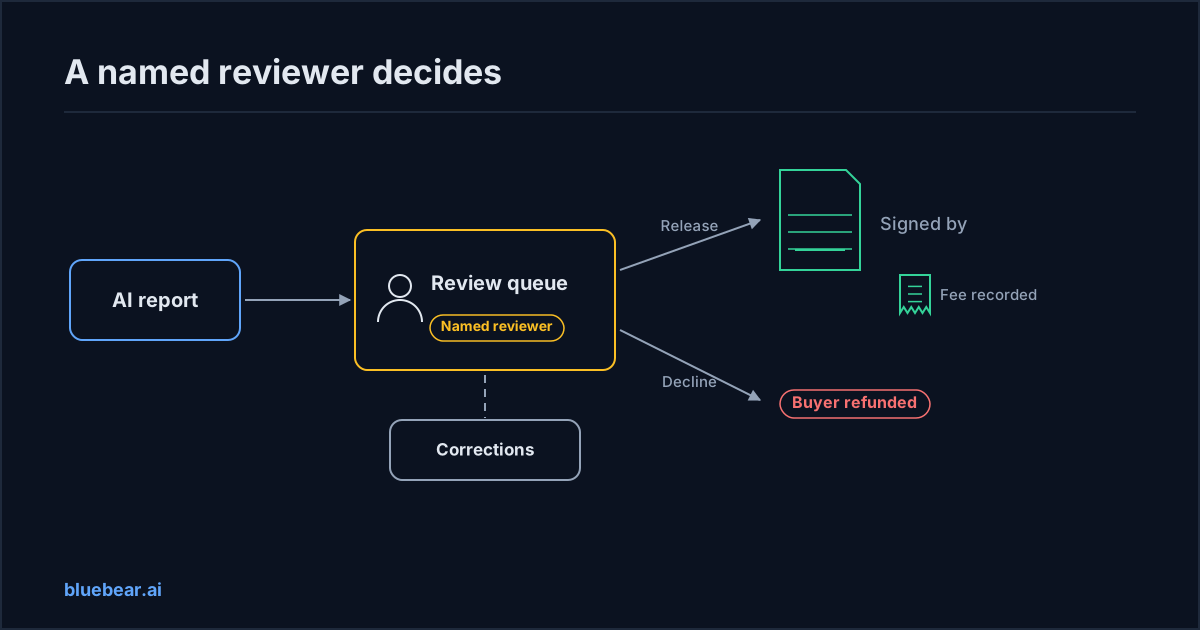
- A report arrives. An AI runs a technology readiness audit on a buyer's codebase using read-only access and a published set of rules. The report is not sent to the buyer. It lands in your queue, in plain language, with each finding naming the rule that produced it.
- You read it. The whole report, finding by finding, with the context the report gives you.
- You correct what is wrong. For each change you record the corrected finding and the reason. Corrections hold findings, never pieces of the buyer's code.
- You release or decline. Release puts your name on the report and delivers it to the buyer. Decline stops it, and the buyer is refunded.
- A receipt is written. The signed receipt for the job records what produced the report, which rules fired, and that you signed it.
- Your fee is recorded. On release, two entries are written: your fixed fee and the seller's share, adding up to the report price. Payout against your entry is made by hand during the pilot.
The report itself covers ten fixed areas: health, architecture, technical debt, security, ownership, key-person risk, productivity, AI readiness, staffing, and a 30/60/90-day plan. Each area is scored, and the overall score is the lowest of the ten, not the average, so one weak area cannot hide. The AI does the measurable part. Your part is judgment: is the finding true in context, is the score fair, does the plan make sense for a team that size. The offer from the seller's side is described in the technology readiness audit as a first offer, and the checklist behind it in the production AI agent readiness checklist.
| What you must have | Why |
|---|---|
| Standing to judge the report: senior engineering leadership, security review, or fractional CTO work, with evidence | Your name carries the report; the buyer is paying for a named independent reviewer |
| Independence from the buyer | You cannot sign a report on something you built or are paid to defend |
| An entity or sole-trader status that can invoice | Fees are paid to an entity; the pilot does not handle tax |
| A BlueBear account with reviewer access | The queue is permission-gated; you hold no keys and no code |
| An agreed turnaround | The buyer is promised delivery within a fixed window |
| Willingness to decline | A reviewer who releases everything is not a control |
Pay is a fixed fee per released report, set when you join and not tied to hours. Prices are in credits, where one credit is one US dollar. For example, a 300-credit audit might carry a fixed 90-credit reviewer fee, with the rest to the seller. The numbers are made up; pilot fees are agreed at onboarding. If you are a lawyer, CPA or clinician, a fixed fee is also what your professional rules require; see the fee-sharing rules for licensing your expertise.
Two protections run in your favour. You sign the report as released, with your corrections in it, and nothing else. And every correction is stored with its reason, so if a finding is disputed later there is a record of what the AI said and what you changed. BlueBear's own test plan treats a report where more than 30 percent of findings needed editing as a defect in the AI, not as reviewer labour to absorb. A professional-liability consultant's recommended file record for AI work is the prompts used, how the outputs were checked, and who did the review. The correction record and the receipt are the same three items, kept for you.
What the role is not, stated plainly. It is not a rewrite job. It is not client management; support is the seller's problem. There are no reviewer scores or public lists. It is not yet a queue for legal, accounting or clinical reports; those are worked examples in the plan. And payout is by hand during the pilot. Buyers who search for "attest ai audit" are asking for exactly this: a named person who stands behind the findings. Why a queue must carry only reports that need judgment is covered in approval fatigue and review queues. How this differs from an approval click is in human-in-the-loop approvals for AI agents and who signs AI work and what that signature means.
What to do next
Reviewing on the marketplace is invite-only during the pilot. Apply through the form at /marketplace/sell and say in your message that you are applying as a reviewer rather than a publisher. Include your credential, the kinds of report you could sign, and a link to evidence of your work. If you prefer, write to us through /contact with the same details. You will be sent a sample report before anything is agreed. If it is work you want your name on, we agree a fee and a turnaround, set up your reviewer access, and the next purchased report reaches your queue.
Questions people actually search for
- how do i get paid to review ai reports
On BlueBear's marketplace you are paid a fixed fee for each report you release, agreed when you join. Prices are in credits, where one credit is one US dollar. For example, a 300-credit audit might carry a fixed 90-credit reviewer fee, with the rest going to the seller of the audit. The figures are made up. The fee is recorded automatically when you release the report and paid out by hand during the pilot. It is not hourly and not a percentage.
- what does an ai report reviewer actually do
You read a report an AI produced, in plain language, inside your BlueBear account. You correct any finding that is wrong and write down why. Then you either release the report to the buyer under your own name or decline it. Release puts your name on the receipt for the job and records your fee. Decline stops the report and refunds the buyer. You never talk to the buyer unless you choose to, and there is no code to write.
- do i need to code to review ai reports
No. You never see code, keys or servers, and you never write anything but corrections. What you do need is the standing to judge the report. The one report type live today is a technology readiness report on a company's software, so the reviewers for it are senior engineers, security reviewers and fractional CTOs. Reports for other fields, such as legal or accounting, are part of the plan and not yet live.
- what happens if i decline an ai report
Declining is a designed outcome, not a failure. The report is not released, your name goes on nothing, no fee is recorded, and the buyer is refunded. Your corrections up to that point are still stored with their reasons. The buyer offer promises this refund in writing, because a reviewer who releases everything is not a control. If you find yourself declining or rewriting often, say so; that is a signal the seller needs.