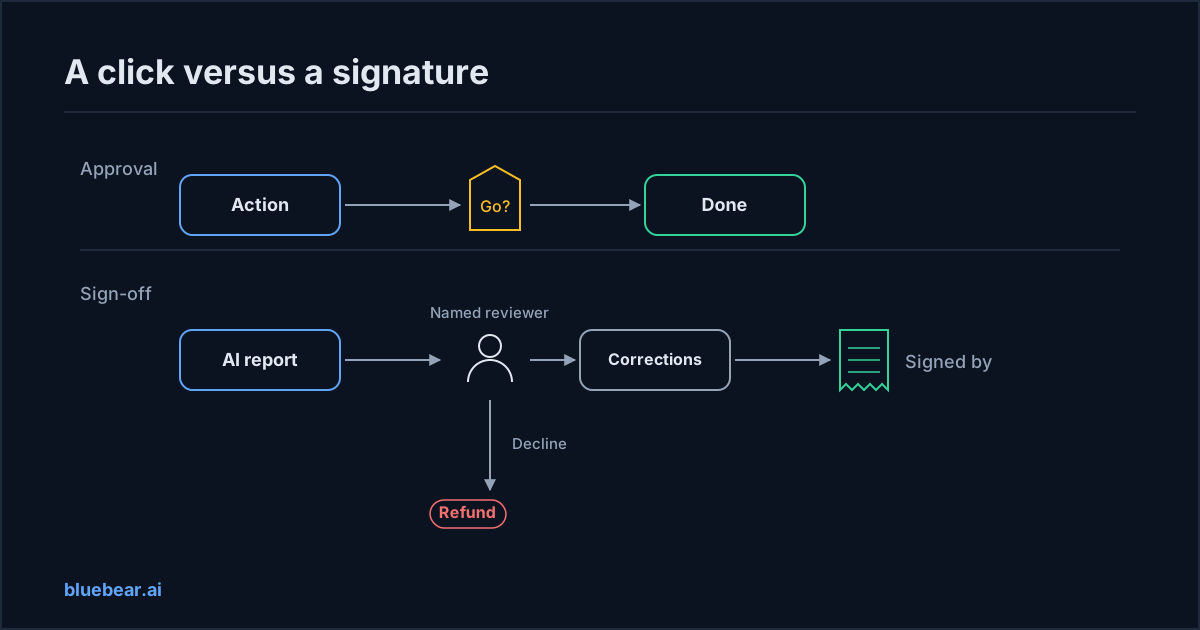
Someone still has to sign AI-produced work, and that person carries the liability for it. If that person is you, the signature should mean something specific: you read it, you fixed it, you stand behind it, and you were paid a fee for doing so. That is different from clicking approve.
The problem
You are a CPA with a dozen small-business clients. One of them has started closing their books with an AI tool. It finishes the month in a day instead of a week. The owner is delighted. Then she asks you to "sign off" on it by the third of the month, for half of what you used to charge for the close.
You open the file. The tool has coded a loan repayment as an expense. It has matched two invoices to the wrong customer. The numbers tie, but the story they tell is wrong. If you sign, it is your signature on a set of books that a lender will rely on. If it goes wrong, nobody will sue the software.
The same request lands on lawyers asked to bless AI-drafted contracts. It lands on pediatricians whose portal drafts replies to parents. It lands on engineers asked to stamp an AI-written report, and on editors handed AI copy to "check". The client wants the speed of the machine and the safety of your name. They want both for less money.
If you have searched for "human in the loop ai compliance who signs off", you already know the software does not answer that question. A person does. The question is what that person is agreeing to, and what it is worth.
The bar has already answered for lawyers, and the answer travels. In its 2024 opinion on generative AI, the ABA's ethics committee wrote:
"In short, regardless of the level of review the lawyer selects, the lawyer is fully responsible for the work on behalf of the client."
ABA Standing Committee on Ethics and Professional Responsibility, Formal Opinion 512 (July 2024)
Read "CPA" or "physician" in place of "lawyer" and nothing changes. The signature is the whole job.
Why this keeps happening
Most AI tools have a step called human approval for AI agents. It is a button. Someone clicks it, and the task continues. The tool records that a click happened and when. It does not record who read what, what they changed, or whether they would put their licence behind it. That kind of click is fine before an action that cannot be undone, like sending money. It is not a professional opinion.
Your clients cannot tell the difference. To them, "reviewed by a human" and "signed by a professional" sound the same. So they price them the same, which means cheaply. You end up carrying the liability of a signature for the price of a click.
| An approval click | A professional sign-off | |
|---|---|---|
| The question it answers | May this go ahead? | Is this right, and who says so? |
| Who does it | Anyone with access, often the requester | A named person with a relevant licence |
| What gets read | A summary of the action | The whole output, item by item |
| What can change | Nothing; yes or no | Each wrong item is corrected, with a reason |
| What is recorded | A user id and a time | The signer's name, plus every correction |
| Who carries the blame | The company running the tool | The signer, for what they signed |
| What it costs | Nothing; part of someone's job | A fixed fee per item |
| How it fails | Clicking becomes a reflex | The signer declines and the client is refunded |
The professions have already decided who is liable when an AI agent makes a mistake. The ABA's Formal Opinion 512, from July 2024, is the clearest. A lawyer must understand any AI tool they use, check its output, protect client secrets before using it, and supervise how it is used. The AMA's principles, adopted in 2023 and restated in its 2024 report, say the physician stays responsible for choosing and using any AI tool. Normal medical liability rules still apply. The AICPA's code holds the CPA who signs a report responsible for it. Regulators agree: the EU AI Act requires that people can oversee and overrule high-risk AI, and the NIST AI framework asks companies to name who is accountable for AI outcomes.
Two more facts show how wide the gap is. As of July 2026, Avalara surveyed more than 1,500 finance leaders. Nearly a quarter, 23 percent, said accountability for a serious AI error would be unclear or would sit with nobody in particular. And the EU AI Act names the approve-click habit as a design fault. The people overseeing a high-risk system must stay aware of the "tendency of automatically relying or over-relying on the output". The reflex click is exactly what regulators are writing against.
So the liability is already yours. What is missing is the pay, the scope and the record. That gap is what the phrase expert in the loop is meant to close: a named expert at the edge of the work, paid per case, instead of a click.
How to fix it
- Sort your work into two piles. Some outputs only need a go-ahead, like sending a routine reminder. Others will be relied on as professional work: a set of books, a filing, a report, a clinical message. Only the second pile gets your signature.
- Read the whole thing. Never sign from a summary. If an item is too long to read in full, it is not ready for a signature, and you should say so.
- Write down every correction and why. "Loan repayment coded as expense; reclassified to liability." A record like that protects you later and tells the tool's owner what to fix.
- Sign a scope, not a blank cheque. Your sign-off covers this version, with your corrections in it, and nothing else. Put that in writing.
- Charge a fixed fee per signed item. Not hourly. The client is paying for your name and your liability, not your minutes. A fixed fee also keeps you out of trouble with rules that bar billing for time a tool saved.
- Keep the right to decline, and agree what happens then. No release, no signature, and a refund or a redo. A signer who never declines is not a control.
- Keep client data out of tools you have not vetted. Before any client file goes into an AI tool, know whether the tool learns from it. If it does, get the client's consent first.
The record in step three is not paperwork for its own sake. The US standards body puts the link plainly:
"Trustworthy AI depends upon accountability. Accountability presupposes transparency."
NIST, AI Risk Management Framework 1.0, NIST AI 100-1 (January 2023)
A signature nobody can trace back to what was read and changed is a click with a name on it. One more reason to price the fee properly: the machine made writing cheap, and it made checking expensive. The work moved to you. A fee set for a glance underprices the job you are actually doing.
None of this needs a platform. It needs a short letter to each client that says what your signature covers, what it costs, and what happens when you say no.
What BlueBear's marketplace does about it
BlueBear's marketplace sells finished results produced by AI helpers, and it treats the signature as part of the product. For the buyer that means one price, one accountable seller, and a receipt that names the person who signed. For you it means the review is structured the way the steps above describe.
Here is what works today. An AI produces a report. It does not go to the buyer. It lands in a named reviewer's queue, written in the plain language of the field, not a developer screen. The reviewer reads it item by item. Each wrong finding is corrected and the reason is stored with it. Then the reviewer releases the report under their own name, or declines. If they decline, the buyer is refunded and nothing is released.
The receipt for the job records what produced the report, which rules it applied, and who signed. Corrections are kept as their own record, with the finding and the reason, never the buyer's underlying files. The reviewer's fee is a fixed amount agreed in advance. For example, a report priced at 100 credits, where one credit is one US dollar, might carry a fixed 30-credit reviewer fee. The number is made up; the shape is the point. The fee is recorded automatically when the report is released and paid out by hand during the pilot.
Three limits, stated plainly. The marketplace is a pilot and publishing is by invitation. The queue today carries one report type, a technology readiness report, read by senior engineering and security reviewers. And for lawyers, CPAs and clinicians the fee is always a fixed fee or a licence, never a percentage of what the buyer paid, because their professional rules require it.
One more design choice matters to you. BlueBear's own test plan treats a report where more than 30 percent of findings needed editing as a defect in the AI, to be fixed at source. It is not reviewer labour to be absorbed. Your time is meant to sit at the edge, on the cases that need judgment, not on rewriting.
How this differs from ordinary approval gates is covered in human-in-the-loop approvals for AI agents. How the signed receipt links to the plan, the approvals and the outcome is in the AI agent evidence chain. Why buyers ask for it is in what is an AI agent audit trail. For how flagged cases reach the right person without every case needing a signature, see healthcare AI agent exception queues.
What to do next
This week, write the one-page letter: what your signature covers, your fixed fee per signed item, and what happens when you decline. Send it to the client who asked for the cheap sign-off. Then, if you hold a professional licence, read the fee-sharing rules for licensing your expertise so the fee you set does not break your profession's rules. If reviewing AI-produced reports for a fee sounds like work you want your name on, here is how the reviewer role works today. You can also see how a signed result looks to a buyer on the BlueBear marketplace.
Questions people actually search for
- who is liable when an ai agent makes a mistake
Courts have not settled a general rule yet, but the professions have. The ABA says a lawyer must check AI output and cannot blame the tool. The AMA says the physician stays responsible for choosing and using any AI tool. The AICPA holds the CPA who signs a report responsible for it. In plain terms, the professional who relied on the AI carries the liability. A proper sign-off makes that clear and limits it to what you actually signed.
- what does it mean to sign off on ai work
It means you read the whole output, fixed what was wrong, and now stand behind it under your own name and licence. It is not the same as clicking approve so a task can continue. A real sign-off names you, records each change you made and why, and covers only the version you released. The formal word for this is professional attestation for AI output. It should be paid as a fixed fee per item, not by the hour.
- should i charge to review ai generated work
Yes, and charge a fixed fee per item you sign rather than an hourly rate. The client is buying your name on the result and the liability that comes with it, not your minutes. Hourly billing rewards you for slow tools and punishes you for fast ones. A fixed fee per signed report, close or letter is easier for the client to budget and, for lawyers, fits the ABA rule that you bill only for work actually done.
- can i refuse to sign an ai report
You must be able to, or your signature means nothing. Agree in advance what happens when you decline: the work is not released, your name does not go on it, and the client is refunded or the work is redone. On BlueBear's marketplace a reviewer who declines stops the report, the buyer is refunded, and no fee is recorded. A reviewer who signs everything is not a control, and clients eventually notice.