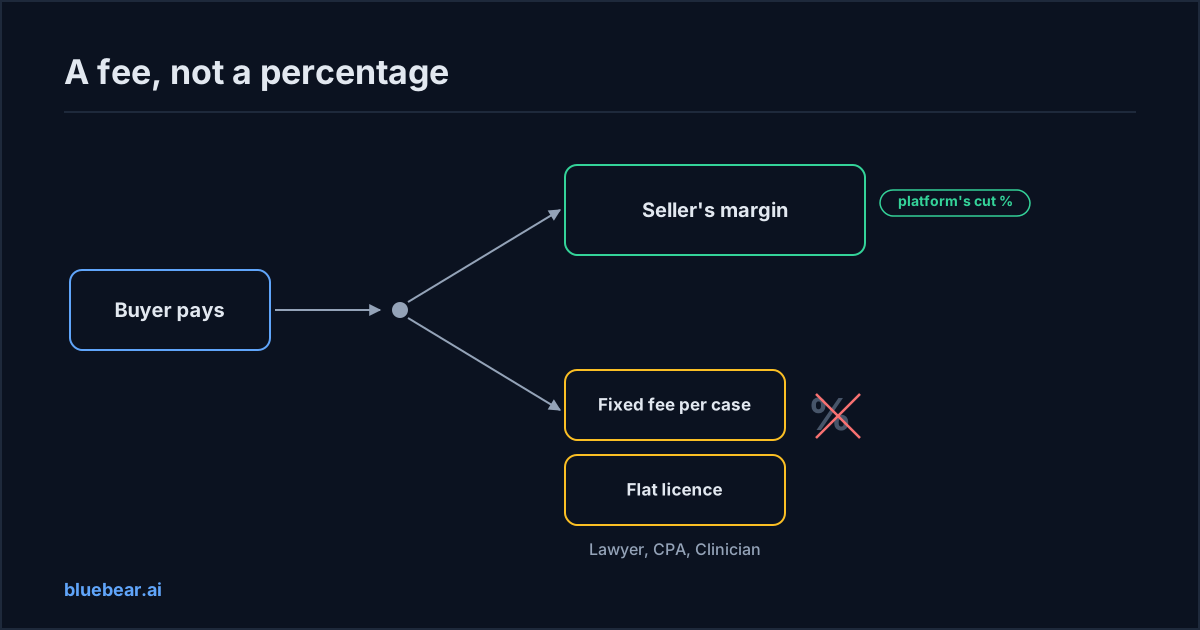
You can license your expertise to AI and be paid for it, even in a regulated profession. The payment must take the right shape: a fixed fee for each case you sign and a flat licence for your rules, never a percentage of what the buyer pays. That one rule keeps lawyers, CPAs and clinicians on the right side of their professional codes.
The problem
You are a lawyer with a forty-point checklist for reviewing commercial leases in your state. You built it over fifteen years. A software company has seen it. They want to build it into their AI tool, and they offer you ten percent of the revenue it earns.
You want the money. You also remember Rule 5.4 from the bar exam. You are not sure whether a percentage from a software company counts as sharing fees with a non-lawyer. You are not sure who you would even ask. So you say you will think about it, and the offer goes cold.
The rule itself is one line long:
"(a) A lawyer or law firm shall not share legal fees with a nonlawyer"
Ten percent of a software company's revenue from legal work looks a lot like a share of legal fees. That is the whole worry, and it is a fair one.
The CPA down the hall has the same problem with a month-end close checklist. The pediatrician across town has it with a set of rules for sorting parent messages. Each of them holds something an AI company would pay for. Each of them is scared of the rules they work under, and rightly so.
This article sets out those rules in plain words and shows the payment shape that fits inside them. It describes the rules; it is not legal advice for your state.
Why this keeps happening
AI companies offer percentages because that is how software deals work. Your profession bars percentages because that is how it protects clients. Nobody in the room speaks both languages, so the deal dies or, worse, gets signed the wrong way.
Here are the rules, one sentence each. A search for "rule 5.4 fee sharing nonlawyer" turns up the first.
ABA Model Rule 5.4. A lawyer generally cannot share legal fees with someone who is not a lawyer, and cannot let whoever pays them steer their professional judgment. There are a few narrow exceptions, such as payments to a dead partner's estate, and none of them covers a software deal.
ABA Formal Opinion 512 (July 2024). A lawyer using generative AI must understand the tool, check its output, protect client information, supervise its use, and bill only for time actually spent.
The AICPA independence and commission rules. A CPA must stay independent from any client they audit or review, and cannot take a commission or a result-based fee from such a client.
The AMA principles. If you wonder who is responsible when AI makes a medical mistake, the AMA has answered. Its principles, first adopted in 2023 and restated in its November 2024 report, say the physician stays responsible for choosing and using any AI tool. Ordinary medical liability rules still apply. Many states also bar doctors from splitting fees with non-doctors, and federal anti-kickback law applies where Medicare or Medicaid patients are involved.
A few places have loosened the lawyer rule. As reported by LawNext in December 2024, Arizona dropped its Rule 5.4 in 2021 and Utah opened a regulatory sandbox in 2020. The District of Columbia has allowed limited non-lawyer ownership since 1991. Unless you practise in one of those places, assume a percentage is off the table.
Ethics lawyers want the rule changed too. In December 2024 the Association of Professional Responsibility Lawyers asked the ABA to allow fee sharing with non-lawyers, under conditions. They say no known data shows it harms a lawyer's judgment. They may be right. Until your state changes its rule, it binds you.
What all four have in common is simple. Your judgment must stay yours. Your pay must not depend on the buyer's result. And your client's material must not leave your office without consent. The cost of getting this wrong is not a fine. It is your licence.
How to fix it
- Say no to any percentage, and say what you want instead. A flat licence fee for your rules, paid per year or per version. A fixed fee for each case you personally sign. Both are set by you and reasonable for the work. Opinion 512 warns that charging the same flat fee with an AI tool as without it may be unreasonable, so set the fee from the review work you actually do.
- Keep your judgment in writing. The agreement should say nobody on the company's side directs how you decide, and you may decline any case without penalty.
- Strip or consent. Before any past matter, working paper or patient record is used to build or test the tool, remove anything that identifies a client, or get their informed consent in writing.
- Separate the roles. You write the rules and sign cases. Someone else sells the product to the buyer, handles support, and takes the margin. That someone is the party a percentage can flow to. You are not.
- CPAs: check the client list. Do not review or sign a close for a company whose books you audit. Its own controller approves that close; management decisions stay with management. Take your fee for reviewing companies you do not audit.
- Clinicians: keep the AI at the drafting stage. The tool drafts, you decide, and patient data stays inside your practice. Any vendor who touches patient data signs a business associate agreement first.
- Put it in your policy. If you need a law firm AI policy template, the sections that matter are short. Approved tools, when consent is needed, how AI work is billed, whether outside licensing is allowed and on what fee basis, and who supervises.
- Ask before you sign. Your bar, your state society or your board will give you an informal answer. For accountants, the CPA liability AI question usually gets one answer: you are responsible for what you sign. So sign on a fixed fee, and only for clients you are independent of.
Accountants are having this argument now. As of September 2026 the IRS wants tax practitioners to pass AI time savings to clients through their bills. The AICPA has pushed back: a fee must also cover the liability you carry. Its tax policy lead put it this way:
"value pricing is something that is just part of business, and you have to be able to include the liability that you're taking as you go through all of this."
A fixed fee per signed case that prices your liability is defensible. Repeating your old hourly total for work a tool now does is not.
| Profession | How you may be paid | What is off limits | Who decides each case |
|---|---|---|---|
| Lawyer | Fixed fee per signed case; flat licence for rules or past cases | Any percentage of legal fees to a non-lawyer; letting the platform steer your judgment | You, on every case you sign |
| CPA | Flat licence for rules; fixed fee per close or report you review | Commissions or result-based fees from audit clients; doing management's job for a company you audit | The client's management approves; you review as a separate engagement |
| Clinician | Fixed fee per reviewed case; licence for message or triage rules | Autonomous clinical decisions; patient data leaving the practice; fee splits without counsel's review | You, with the AI limited to drafting |
What BlueBear's marketplace does about it
BlueBear's marketplace is built so a regulated professional never has to take a percentage. A seller lists a finished result at one price. The seller is the party who owns the buyer relationship and takes the margin, and the platform takes its cut from the seller. What reaches you is a fixed amount that you set.
For example, a contract review offer might be listed at 60 credits, where one credit is one US dollar. It could carry a fixed 40-credit attorney fee per signed review. The seller's margin and the platform's cut come out of the other 20, never out of your 40. The numbers are made up; the shape is the point.
You never write code. A developer partner or BlueBear turns your rules into steps an AI helper follows, and a seller lists the result. Every job produces a signed receipt that records which rules were applied and who signed off. Your earnings are recorded from that receipt as entries that cannot be edited later, so if your bar or board asks, the record is there. AI agent audit trails in financial services shows what that record looks like to a regulated buyer.
Your past cases are treated as licensed material with their own access terms. Privileged content and patient data are removed or transformed before anything is built from them, and you approve the contents before anyone can license them. GenAI telemetry and sensitive data covers how such content is kept out of logs.
What is live today, stated plainly. The marketplace is a pilot and publishing is by invitation. The review queue carries one report type, a technology readiness report, read by senior engineering and security reviewers for a fixed fee per report. Legal, accounting and clinical offers are the plan's worked examples, not listed offers. Earnings are recorded automatically; payout is by hand. How the queue works is in who signs AI work and what that signature means and how the reviewer role works today. The pattern for routing only flagged cases to a professional is in healthcare AI agent exception queues.
What to do next
If you have a percentage offer on your desk, reply with the two-part counter: a flat licence for the rules and a fixed fee per case you sign. Then run the terms past your bar, society or board before anything is signed. To see how a listed offer shows its price, its permissions and who signs off, visit the BlueBear marketplace. Each offer has a plain page at an address of the form /use/<slug>, with the same facts in a form a computer can read.
Questions people actually search for
- who is responsible when ai makes a medical mistake
In practice, the clinician who relied on it. The AMA's 2023 principles say the physician stays responsible for choosing and using any AI tool, and ordinary medical liability rules still apply. A doctor who reviews and sends an AI-drafted message owns it, just as they would own a message drafted by staff. The safe setup is simple: the AI drafts, you decide, patient data stays inside the practice, and a record shows who approved each message.
- can a lawyer take a percentage from an ai company
Generally no. ABA Model Rule 5.4 bars a lawyer from sharing legal fees with a non-lawyer, and bars letting whoever pays you steer your judgment. A few places have loosened this: as reported by LawNext in December 2024, Arizona dropped its rule in 2021, Utah opened a sandbox in 2020, and DC has allowed limited non-lawyer ownership since 1991. Everywhere else, ask for a flat licence fee for your rules and a fixed fee per case you sign, with no percentage either way.
- can a cpa get paid for rules an ai uses
Yes, for a flat licence fee and a fixed fee per case you personally review. Two limits apply. You must stay independent from any company you audit or review, so do not sign off on the close of a company whose books you audit. And you cannot take a commission or a fee that depends on the result from such a client. A flat licence for your mapping rules and a fixed fee per reviewed close sit inside both limits.
- what should a law firm ai policy include
Five short sections cover outside licensing work. Which AI tools are approved, and the rule that a named lawyer reviews every output before it leaves the firm. When a client's consent is needed before their material goes into a tool. How AI-assisted work is billed: actual time or a fixed fee, never time saved. Whether lawyers may license rules or sign cases for outside parties, on a fixed-fee basis only. And who supervises the tools and the people using them.