The problem
You run a regional insurance agency. A vendor shows you an AI helper that answers customer emails and pulls up policy details. The demo is slick. You ask one question. "If this thing tells a customer the wrong thing, who fixes it?" The salesperson smiles and talks about their model partner, their data partner and their hosting partner.
You leave the call with three logos and no name. That is the problem. You want to buy an AI service, but you cannot tell who is responsible if it goes wrong.
The same thing happens with every AI seller you meet. One sells the "brains". One sells the data it reads. One sells the connection to your systems. When the job fails, each one points at the other two. You are left holding the customer complaint.
You know how to buy software. You know how to hire a contractor. This is different, and nobody has given you a plain way to judge it.
You are not imagining the fog. The analysts who track this market see it too.
"Most agentic AI projects right now are early stage experiments or proof of concepts that are mostly driven by hype and are often misapplied."
Why this keeps happening
An AI helper is not one product. It is a chain. Someone makes the model. Someone maintains the tool it calls, such as a permit lookup or an order check. Someone wires it into your email or your billing. Each link is sold by a different company, and each one wrote its own fine print.
Most sellers also blur two things that should stay apart. Paying for the service is one decision. Letting the service into your systems is another. When a seller bundles them, you end up with a vendor holding a login to your systems as a condition of buying. Engineers call this question ai agent authorization. You should call it "who has keys to my building".
The cost is not abstract. Here is what it looks like in a small company.
| What goes wrong | What it costs you |
|---|---|
| Nobody owns the result | Days of back and forth while a customer waits |
| Hidden per-use fees from the data partner | A bill that is double the quote |
| A vendor login you forgot about | An open door long after the contract ends |
| No record of what the helper did | You cannot defend yourself in a dispute |
| No exit terms | You stay with a bad seller because leaving is worse |
Every row is a question you could have asked before you signed. Most buyers do not ask, because the sales process never puts the questions in front of them.
The stakes are real. As of June 2025, Gartner expects more than 40% of these AI agent projects to be canceled by the end of 2027. The reasons it gives are rising costs, unclear value and weak controls. Those are the same rows as the table above.
There is a second reason. AI sellers move fast and their contracts lag behind. Many started as software companies, and their terms still read like software terms. Software does not email your customers on its own. An AI helper does. The paperwork has not caught up with what you are actually buying.
How to fix it
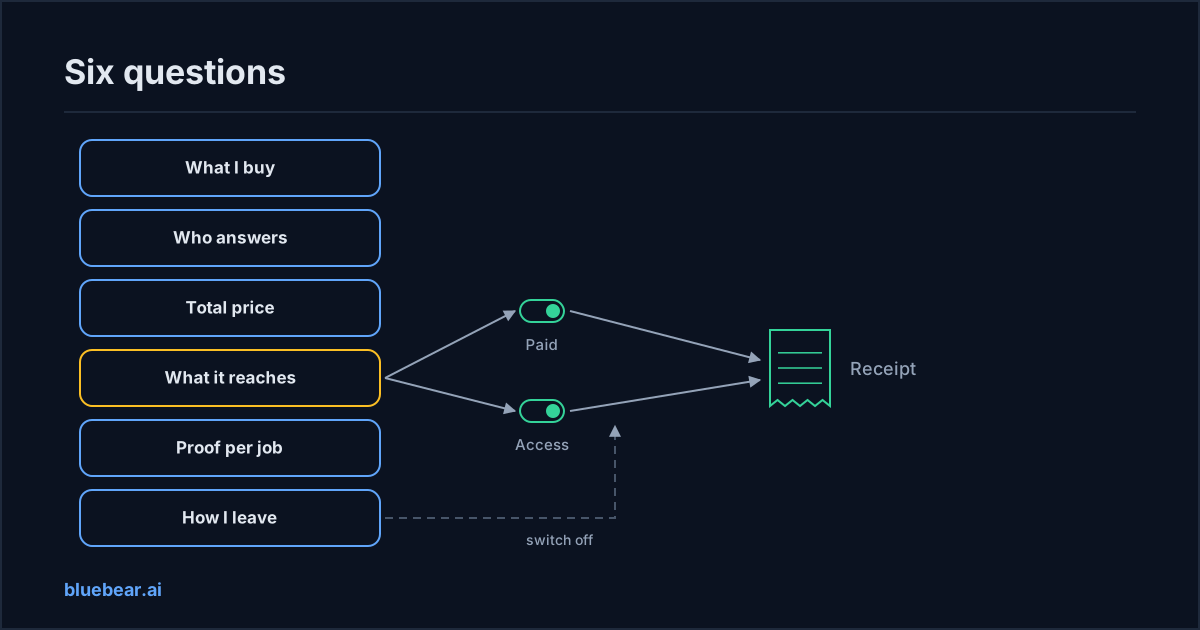
If you searched for how to evaluate an ai agent vendor, this is the short version. Six questions. Ask a zero question first: does this job need an AI helper at all? Gartner's analysts say many jobs sold as "agentic" do not. A plain report or a simple rule might do. They work for any AI seller, on any platform. Ask them in this order and write the answers down.
- What exactly am I buying? Get the result in one sentence, with a sample. "A weekly list of new permits in three counties" is a result. "AI-powered insights" is not.
- Who is the one name on the hook? One company, one contact, one phone number. If the answer is three partners, keep looking.
- What is the total price? The base price plus every per-use fee from the parts underneath. Ask them to put it in writing. Ask for a cap per job too. As of December 2025, OWASP's security guide for AI agents lists spending ceilings with automatic cut-off as a safety control, not just a finance one.
- What does it need to reach in my systems? Not "an integration". The exact list. Read orders, yes. Send emails, no. The least-privilege guide explains why a short list matters.
- What proof comes back after each job? You want a record of what ran, when, for whom, and what it cost. Not a dashboard you have to trust. A record you keep.
- How do I leave? Can you cancel and shut off access yourself, today, without a support ticket? Do you keep your records after you go?
Questions one to three are what you already ask any vendor. Questions four to six are the new ones, and the ones most sellers hope you skip. Put them on your ai vendor security checklist and keep them there. If your IT person wants more depth, the security evaluation checklist goes further.
The same six questions settle the buy vs build ai agent debate. Ask them of your own team as if they were the seller. Can your team name one owner? A total cost per job? A way to turn it off without a code change? If not, you are not ready to build either. Many owners land in the middle. They buy the data and the checks, and build the workflow around them.
What BlueBear's marketplace does about it
BlueBear's marketplace is built so the six questions have answers before you pay. It is a pilot today. Publishing is by invitation, and BlueBear lists each service on the seller's behalf after reading what it does. Here is what that means for you as a buyer.
One price, one accountable seller. Every listing has a public page that states the result, the price and the seller. Prices are in credits, and one credit is one US dollar. The per-use costs of the parts underneath are declared on the page, not discovered on the invoice.
Paying and access are two separate switches. Buying a service gives you proof you paid, nothing more. If the service needs to reach one of your systems, that is a second, separate permission. It names the exact actions. You can switch it off without cancelling the service. The seller never receives your password.
A receipt for every job, kept with your other records. Each time a service runs, the platform writes a signed receipt. It shows what ran, on whose say-so, and what it cost. You keep it after the contract ends. If you already keep an audit trail for your AI helpers, this is one more entry in it. The plain guide to AI audit trails explains that record. The receipts explainer shows what is on each one.
A named person who signs off. Where a result needs judgment, a named reviewer checks it, fixes it or releases it. If they reject it, you are refunded.
What is still manual or limited during the pilot: there is no league table of sellers, no automatic choice between rival sellers, and sellers are paid by hand. The list of services is short, because the first ones come from paid projects rather than open sign-ups. If a claim about the marketplace is not in this section, treat it as not built yet.
What to do next
Take the six questions to the next AI seller who calls you. Write down the answers, including the blanks. A blank is an answer too.
When you have a specific service in front of you, the vendor checklist for marketplace services turns these six questions into a full review. You can also open the public marketplace to see what a listing with all six answers looks like.
Questions people actually search for
- who is responsible when an ai service goes wrong
Whoever you paid, if you bought it right. Insist on one seller who owns the result, no matter how many partners sit behind them. Get that in writing before you sign, along with a total price and an exit you control. If the seller can only name partners, the honest answer is that nobody is responsible, and you should keep looking.
- how to evaluate an ai agent vendor
Ask six questions in order. What exactly am I buying, with a sample? Who is the one name on the hook? What is the total price, including per-use fees underneath? What does it need to reach in my systems, item by item? What proof comes back after each job? How do I leave? Write down every answer, and treat a blank as a warning.
- should i buy or build my own ai helper
Run the same six questions against your own team as if they were the seller. Build when they can name an owner, a total cost per job, a short access list and a way to turn it off. Buy when the service depends on data or rules you would rather someone else maintain. Many owners buy the data and checks and build the workflow around them.
- can i shut off an ai vendor's access myself
You should be able to, without a support ticket. On BlueBear's marketplace, paying for a service and letting it reach your systems are two separate permissions. You can switch off the access and keep the service, or cancel the service and keep the access for other uses. The seller never holds your password, so there is no key to chase down.