The problem
You run a medical equipment supply company with eleven people. Your nephew says you should be using AI. The vendor at the trade show said the same thing. So you tried one of the chat tools for a week. It wrote a nice email. It did not touch the forty referrals waiting in the fax queue.
Or you run a roofing crew across a dozen towns. Every ad you see promises AI agents for small business. You click one. It wants you to pick a model, connect your accounts, write instructions and test it yourself. You have a crew to run. You close the tab.
Or you run a distribution warehouse. Purchase orders, invoices and packing slips do not match. Someone spends every morning sorting it out. You looked at hiring help. You looked at software. Every option is a tool you would have to assemble.
Or you own a dozen rental properties. You want to know when a permit, a sale or a tax change touches the streets you watch. Right now you hear it from a neighbor, or see it in a listing after it closes. The information was public the whole time. Nobody was reading it for you.
You did not want a tool. You wanted the Monday morning pile gone, the same way, every week, with someone to call when it is wrong.
You are in good company. A restaurant owner in Baltimore put it this way in a national survey of small businesses.
"AI is already helping small businesses compete, save time, and better serve customers"
He added that many owners are still figuring out how to use it well. That is the gap this article is about.
Why this keeps happening
The market sells parts. Almost nobody sells the finished result.
Freelancer sites sell a person's hours. Search for "hire AI agents" or "Upwork for AI agents" and that is where you land. Someone will build a helper for you, and then it is yours to run. Template libraries sell pre-built AI agents you install and babysit. Software vendors sell a seat, and the work is still yours. In every case, you become the operator. When it breaks, you own the breakage.
The numbers back this up. As of March 2026, a Goldman Sachs survey of 1,256 small businesses found that 76% use AI in some way. Only 14% say it is fully built into how they run. The barriers owners named were a lack of technical know-how, trouble choosing tools, and worries about data privacy. Every one of those is a problem with buying parts.
The costs are quiet but real. Your evenings go into comparing, connecting and fixing. Your best staff member becomes the person who "knows how the AI thing works". If it makes a mistake with a customer or a claim, nobody outside your walls answers for it. And the pile is still there.
| What you can buy today | What you actually get | Who is on the hook when it is wrong | Fees, as of September 2026 |
|---|---|---|---|
| A freelancer | A person's time to build or run something | You, once the project ends | Fiverr takes 20% from the seller plus a 5.5% buyer fee. Upwork's freelancer fee runs from 0 to 15% |
| A free template | A pre-built helper you install and run yourself | You | Relevance AI lists templates free or up to $1,000, with no cut taken |
| A software seat | A tool your staff operate | You | Per seat or per month |
| A finished result | The weekly or daily outcome, done for you | One named seller | One stated price, plus anything that varies, written down first |
Demand for the first row is real. As of September 2026, Fiverr's investor site reports an 18,347% jump in searches for AI agents on its platform. People want help. They are getting hours, not results.
How to fix it
You can do most of this before you spend a dollar. The goal is to turn "we should use AI" into one job with one clear result.
- Pick one pile. Choose a job that repeats every week, has a right answer, and only needs a person for the odd cases. Pick the one that eats the most hours. As of July 2026, a U.S. Chamber of Commerce Foundation poll found that time on tasks is where most small employers using AI see the gain. Checking referrals for missing forms is a good pick. Talking a customer out of leaving is not.
- Write the result in one sentence. "Every Monday, a list of new roofing permits in our twelve towns, ranked by job size." If you cannot write that sentence, you are not ready to buy anything.
- Write what must never happen. No message leaves without a person reading it. Patient information stays in our billing system. Nothing is submitted on our behalf.
- Ask for one price. One number, plus a plain list of what varies and by how much. If the answer is "it depends on usage", ask for a cap.
- Ask who signs their name. A named company or person should answer for the result. "The platform" is not a name.
- Ask what record you get. For every run, you should see what was read, what came out, what it cost and who approved anything sensitive.
- Try it on sample data first. Old orders, last month's permits, made-up invoices. Nothing live until you have seen a real record from a test run.
- Name your approver. One person on your team owns the flagged cases. That is the only new job the purchase creates.
Run these eight steps with any seller. Most will fall out at step four or five. The ones left are worth your time. Notice that none of the steps ask you to learn the technology. They ask you to be clear about your own business, which you already are.
One caution. Buying the result does not mean you stop paying attention. Most owners in the Goldman Sachs survey said they still want training and help. You need to know the job well enough to judge the weekly output. That is what your approver in step eight is for.
What BlueBear's marketplace does about it
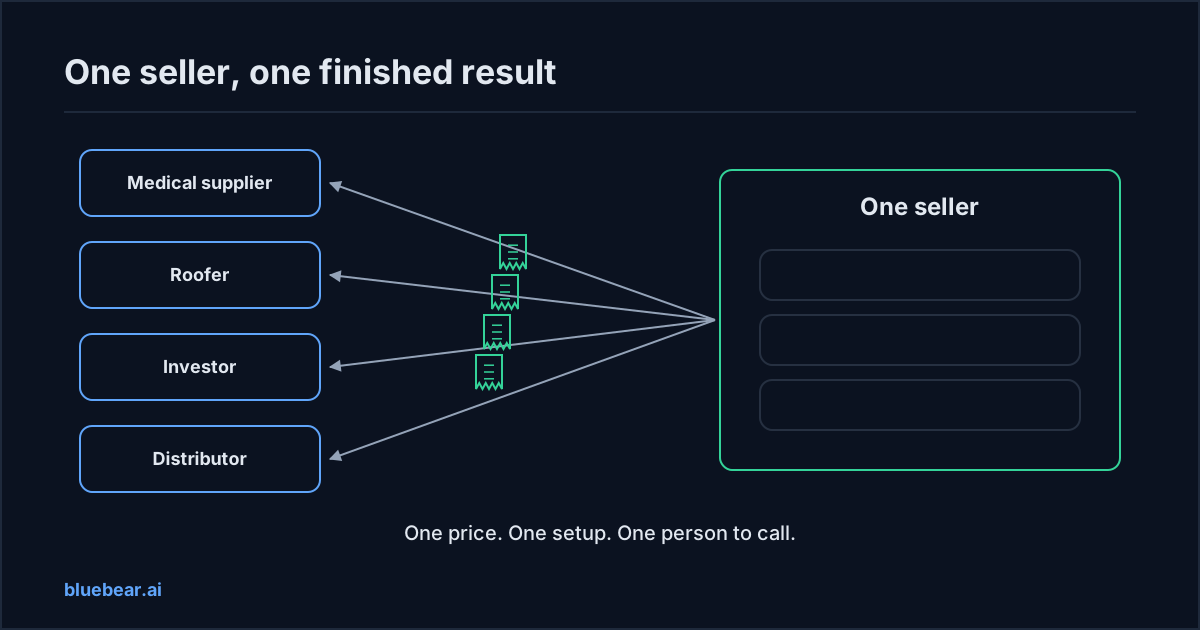
BlueBear's marketplace is built to sell the last row of that table: a finished result, from one accountable seller, at one price. Here is what that means for you, and what is still early.
You see one price. Prices are in credits, and one credit is one US dollar. Anything that varies is written down before you pay. You can set a spending limit. A job that would cross it stops and asks instead of running up a bill.
You get a receipt for every job. It shows what was requested, what was read, what came out, what it cost and who approved any sensitive step. Bigger companies call this an audit trail. For you it is the answer to "what happened to Tuesday's orders". The longer version is in what an AI agent audit trail is. If a result is wrong, you reject it and the charge is refunded against that receipt.
You control access. The seller never gets your passwords. You grant one narrow permission to one service, and you can switch it off yourself at any time. Where a step has consequences outside your business, a named person signs off before it happens. If you want to know how an AI helper reaches your systems without you handing over keys, this explainer for business leaders covers it.
Now the honest part. The marketplace is a pilot. Publishing is invite-only, and BlueBear publishes each offer on the seller's behalf. The first thing you can buy is a technology readiness check. Software reviews a system, and a named person signs the report. The four examples in this article are the kind of service the marketplace is built to carry. They are not listings you can subscribe to this month. There is no ranking system, and payments to sellers are handled by hand. You pay per finished result, not per attempt. Cost per completed workflow explains why that is fairer to you.
What to do next
Pick your pile this week and write the one-sentence result. Then read the guide closest to your business. If you supply medical equipment, start with orders stuck on missing paperwork. If you build or invest in property, start with hearing about big jobs before your competitor does. When you are ready to look at a real offer page, visit the public BlueBear marketplace.
Questions people actually search for
- what are pre-built ai agents for small business
Pre-built AI agents are ready-made helpers you download or copy, then connect to your own accounts and run yourself. They save you the building step, not the operating step. You still pick the settings, watch the output and fix it when it drifts. A finished result is different. A seller runs the job for you every week, puts their name on it, and gives you a record of each run.
- is there an upwork for ai agents
Freelancer sites already sell AI agent work, and demand is high. As of September 2026, Fiverr reports an 18,347% jump in searches for AI agents on its platform. What you buy there is a person's time to build something. Once the project ends, running it is your job. A marketplace of finished results sells the weekly outcome instead, from one seller who keeps answering for it after the first delivery.
- can i buy a finished result instead of software
Yes, that is the idea behind BlueBear's marketplace. You buy the outcome, such as every new referral checked for missing forms, or a ranked list of permits each Monday. One seller stands behind it, at one price in credits, with a receipt for every run. During the pilot, publishing is invite-only and the vertical examples are templates rather than live listings. The first buyable offer is a technology readiness check.
- do i need a tech person to use ai
Not if you buy a finished result. The setup asks you to allow access to only the systems the job needs, with a permission you can switch off yourself. If it needs an account you do not have, it stops and tells you. What you do need is one person on your team who reads the weekly result and approves the flagged cases. That person needs judgment about your business, not technical skills.