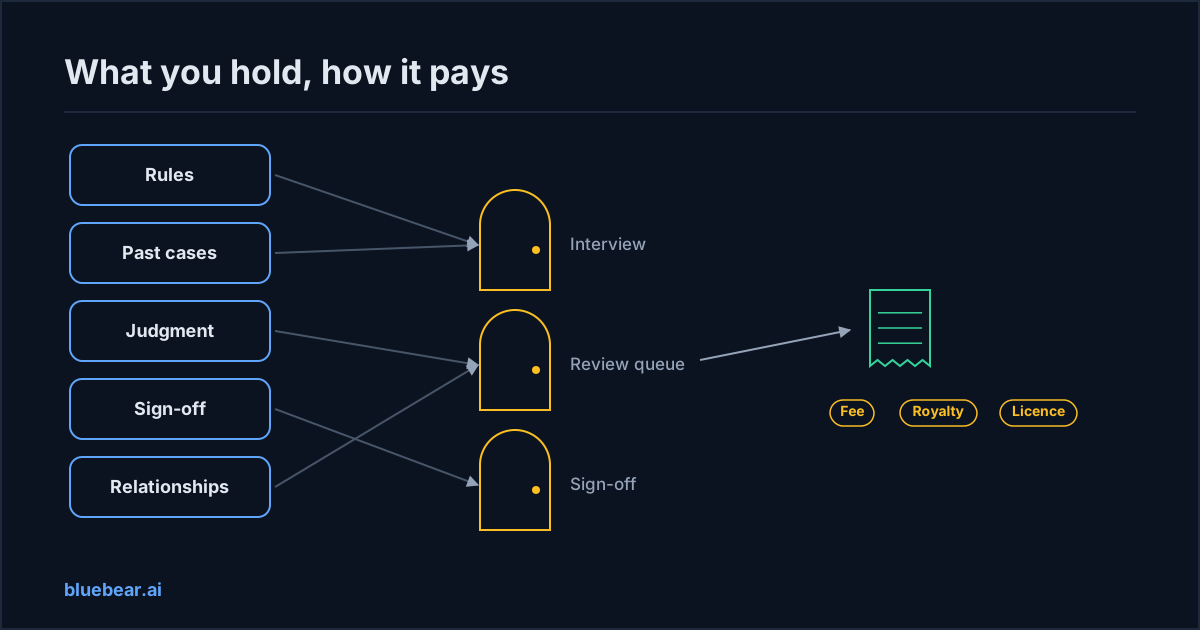
AI is doing parts of your job, and the judgment it borrows came from people like you. You can get paid for that judgment without writing code. You license your rules, you charge a fee for the cases you decide, and you keep your name on the result.
The problem
You are a construction estimator. A general contractor sends you a bid package on Friday. Their AI helper has already done the takeoff and a rough price. They ask you to "just check it" by Monday, for a third of your normal fee.
You spend three hours on it. The waste factors are wrong. The labour rate is two years old. The helper missed a note on the drawings that changes the whole roof. You fix all of it. The contractor pays for a quick review. The AI vendor charges them a subscription. Nobody pays you for the twenty years that made the fix possible.
The same thing is happening to a lawyer asked to glance at an AI-drafted contract. To a pediatrician whose patient portal now drafts replies to parents. To a car salesperson whose follow-up texts come from a bot. To a reporter whose editor wants AI copy "fact-checked" in an hour.
The pattern is the same each time. The AI does the fast part. You do the hard part. You are paid by the hour, if at all, and for fewer hours than before. People search for ways to sell your expertise with AI and mostly find offers to get paid to train AI by the hour. That is not the same thing.
The lawyers' own rulebook says the same thing about the tools. In 2024 the ABA's ethics committee wrote that AI tools have a hard limit:
"they cannot replace the judgment and experience necessary for lawyers to competently advise clients about their legal matters"
ABA Standing Committee on Ethics and Professional Responsibility, Formal Opinion 512 (July 2024)
Swap in your own profession and the sentence still holds. The judgment is the part the tool cannot replace, and it is the part you are giving away.
Why this keeps happening
AI tools learned from work like yours, but they do not know your rules. What the model has is general. What you have is specific. You know which waste factor applies to a hip roof in your county. You know which clause a local judge will not enforce. You know which parent needs a phone call, not a message.
That knowledge is invisible because it has never been written down. It lives in how you decide. When an AI output lands on your desk, you apply it for free, fix the output, and hand it back. The fix improves the client's result. Nothing records that you made it.
Hourly pricing makes it worse. AI shortens the hours you can bill, but it does not shorten the judgment you supply. So your income falls while your value rises. Here is what you hold and what it costs you when it is borrowed for free.
| What you hold | Why the AI cannot own it | What it costs you today |
|---|---|---|
| Rules you apply every day | They are local, dated and in your head | You apply them free on every review |
| Past cases you already judged | Only you know which outcomes were right | Others test their tools against guesses, not your record |
| Judgment on whether an output is good | It comes from the cases above | Billed as a cheap "quick look" |
| Your licence, byline or signature | Only a person can carry liability | Clients get it bundled into a discount |
| Your relationships and access | Sources and referrers trust you, not a tool | Given away with each introduction |
The hourly training offers do not fix this. You label examples for a lab, the batch leaves, and nothing pays you the second time your knowledge is used. You keep no asset. The better path is to license your expertise and keep it in your name.
How to fix it
You can start on this month, with or without any platform. None of these steps needs a developer.
- Write your rules down as rules. Pick one narrow job you do often. Write ten rules with the date they took effect. "If the roof pitch is over 8/12, add 15 percent waste" is a rule. "Use good judgment" is not.
- Keep every correction. Each time you fix an AI output, note what was wrong, why, and which of your rules it broke. In three months you will have a record nobody else has.
- Stop selling review by the hour. Charge a fixed fee per case you sign. The client is paying for your name on the result, not for your time.
- Separate three things you can sell. If you have asked yourself "can I license my checklist to AI", this is the answer. Your rules can be licensed for a flat fee. Your live decisions earn a fee per case. Your past cases, with the right answers marked, can be licensed as a test set to people building tools.
- Check how your profession lets you be paid. Lawyers, CPAs and clinicians can take a fee and a licence, but generally not a percentage of what a client pays a non-professional. The details are in the fee-sharing rules for licensing your expertise.
- Never hand over client files. Strip names and private details, or get consent, before any past case leaves your office.
- Find someone else to do the packaging. You supply the rules and the sign-off. A partner turns them into something an AI helper can follow. If anyone shows you a developer screen, the packaging is wrong.
Step three is the one to do first. It works from day one and needs nothing to be built. A live decision today becomes a marked past case tomorrow and a confirmed rule next month. Your income moves from hours toward licences while your hours fall.
Your own professional body is already arguing for this shape of fee. As of September 2026 the IRS wants tax preparers to pass AI time savings on to clients through their bills. The AICPA has pushed back, saying a fee must also cover the liability you take on. Its vice president put it this way:
"professional services are increasingly priced based on value delivered, not just time spent, and that the benefits AI creates for clients should be considered as part of that equation."
One caution. Some analysts expect many AI agent projects to be cancelled before they earn anything. If that happens, a licence on rules inside them earns nothing either. A fixed fee per case you sign is paid today, whether or not the agents around you succeed.
What BlueBear's marketplace does about it
BlueBear runs a marketplace where businesses buy finished results from AI helpers. Each result is priced once and sold by one accountable seller. It comes with a receipt that says what ran and, where a person signed off, who that was. The professional's part is built around that receipt.
Here is what works today. A named reviewer reads a report an AI produced, in the plain language of their field. They correct what is wrong and record why. Then they release it to the buyer under their own name, or they decline. If they decline, the buyer is refunded. The receipt names the reviewer. A fixed fee for that reviewer is recorded the moment the report is released.
Three things are worth saying plainly. The marketplace is a pilot, and publishing is by invitation. Today the review queue carries one report type, a technology readiness report, read by senior engineering and security reviewers. And fees are calculated automatically but paid out by hand during the pilot.
The other two doors, the rules interview and licensing your past cases, are how the plan intends professionals to join. During the pilot they are done by hand with each early contributor, not through a product screen. For lawyers, CPAs and clinicians the platform pays a fee and a licence, never a percentage, because their professional rules require it.
It helps to know the norm you would be stepping out of. As of September 2026, most directories that list AI tools, including Smithery and Glama, pay contributors nothing. Apify's pay-per-event model pays developers 80 percent, and it pays developers, not the expert whose rules made the decision. Paying the person on the receipt is the difference.
Why approvals alone do not solve this is covered in human-in-the-loop approvals for AI agents and approval fatigue and review queues. What a buyer sees on the receipt is explained in what is an AI agent audit trail.
What to do next
This week, write down ten rules for one job you do often, and start keeping your corrections. Then read who should sign AI-produced work, and what that signature is worth to see what the expert-in-the-loop role involves. If you hold a professional licence, read the fee-sharing rules before you agree to any payment structure. When you want to see what a finished, signed-off result looks like from the buyer's side, visit the BlueBear marketplace.
Questions people actually search for
- can i license my checklist to ai
Yes. A checklist is a set of rules, and rules can be licensed with you named as the person who keeps them current. You do not write any code. A partner or the platform turns your checklist into steps an AI helper follows on every case. You are paid a flat licence fee for the rules, plus a fee for any case you decide yourself. During BlueBear's pilot this packaging is done by hand with each early contributor.
- how do i sell my expertise to ai companies
There are two very different ways. The first is hourly work for a lab: you label examples or grade answers, and your knowledge leaves with the batch. The second is to sell your expertise with AI rather than to it. You keep your rules, your past cases and your sign-off in your own name. An AI helper uses them one case at a time, and you are paid a fee or a licence each time it does.
- what does expert in the loop mean for me
Yes. A human in the loop is anyone who clicks approve before an AI takes an action. An expert in the loop is a named professional who wrote the rules, reviews the flagged cases and signs specific results under their own name. The expert is on the receipt for the job and is paid per case. The AI handles the routine cases under the expert's rules, so the expert reads only what needs judgment.
- will licensing my rules to ai replace me
It changes what you are paid for. Today you are paid for hours, and AI is cutting those hours whether you take part or not. If you license your rules, you are paid each time they are used, and you are paid a fee for the cases the rules cannot settle. Your hours fall while your income comes from more places. The part nobody can copy, your licence and your signature, stays yours.