Disclosure: BlueBear builds an AI agent platform, so we have a commercial interest in this topic. Nothing below reports a customer measurement or a benchmark. Where we describe implementation detail, it is our own, quoted from our own source, and named as such.
The short answer: it is the layer that lets an AI agent act, under rules you set
An AI agent is software that takes a goal, decides on the steps, uses tools to carry them out, and returns a result. "Update the customer's address in the CRM and the billing system, then confirm by email" is agent work. It is different from a chatbot, which produces words for a person to act on.
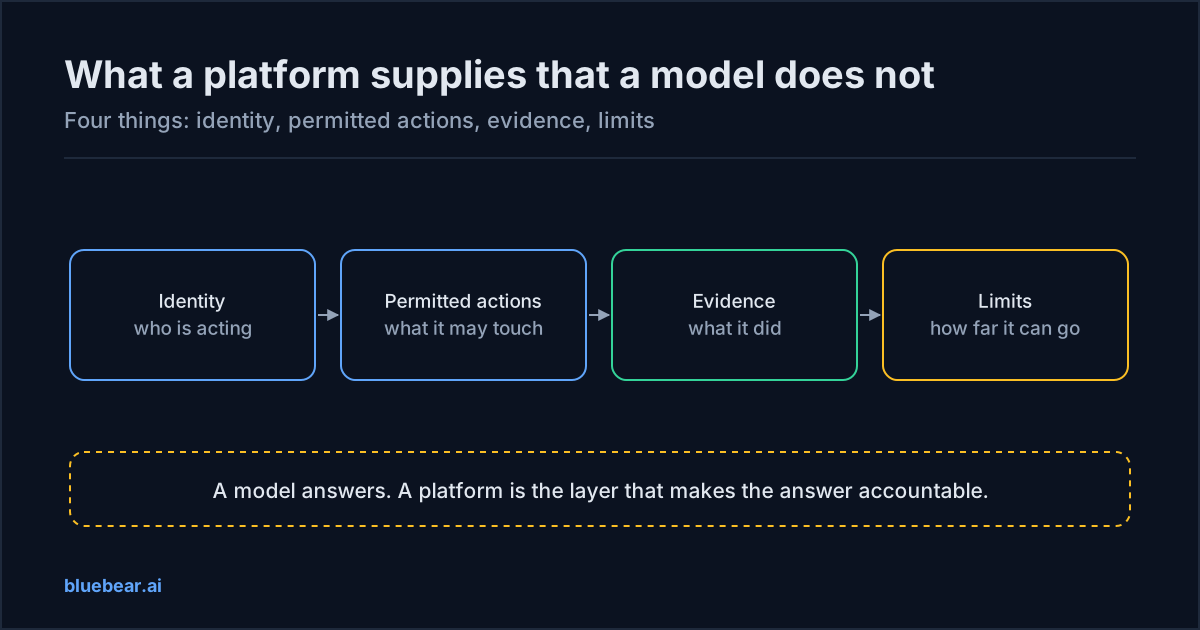
An AI agent platform is the layer around that agent. It does not make the agent smarter. It makes the agent accountable, by supplying four things the AI model has no way to supply for itself:
| What the platform supplies | The question it answers | What happens without it |
|---|---|---|
| Identity — the agent is a named actor, not an anonymous API key | Who did this? | Every action traces back to one shared credential shared by everything. |
| Permitted actions — a defined, narrow list of systems and operations | What was it allowed to do? | The agent inherits whatever the key can reach, which is usually far more than the job needs. |
| Evidence — a durable record of the request, the decision and the result | What actually happened? | You have application logs, which record that code ran, not that a decision was authorised. |
| Limits — spending ceilings, approval gates, reversibility | How bad can this get? | The blast radius — how far the damage from one bad afternoon can reach — is discovered rather than chosen. |
That is the whole category, in one table. Everything else — orchestration, memory, retrieval, model choice — is real engineering, but it is not what makes this a distinct class of software. Those four are.
Three things people mean by "agent platform", and how to tell them apart
The word is used for at least three different products, which is why evaluations go sideways. In plain terms:
| What it is | What it optimises for | Who buys it | What it does not do |
|---|---|---|---|
| An agent framework — a code library for building agents | Developer speed and flexibility | An engineering team, usually one team | Nothing about who is allowed to do what, or evidence across teams. It is a library, not a boundary. |
| A model gateway — a layer in front of the AI models | Model choice, key custody, spend | A platform or infrastructure team | Nothing about the business action the agent performs, or the systems it touches. |
| An agent platform — the operating layer around agent work | Authority, evidence, containment, cost per outcome | An operations, risk or platform owner, for many teams | It is not where you write the clever prompt. It is where the clever prompt is allowed to have consequences. |
These are complements, not rivals. Most organisations that end up with a platform started with a framework, and the framework is still there — it just no longer decides what the agent may touch. AI agent platform vs. agent framework works that trade-off through in more depth, and control plane vs. orchestrator vs. gateway disambiguates the vocabulary if the terms are colliding in your evaluation.
Two terms you will meet, glossed once
Control plane. Borrowed from networking, where one layer works out the routes and another forwards the packets. In software generally, and in an agent platform specifically, the control plane is the layer that decides, and the runtime is the layer that does. The control plane holds the policy — who this agent is, what it may reach, what needs approval — and the runtime carries out the work. Keeping them separate is what lets you change a rule without redeploying an agent. See what an AI control plane is for the one-paragraph version.
MCP. Short for Model Context Protocol, an open standard for how an AI agent connects to a tool or data source. Before it, every agent-to-system connection was bespoke. With it, a connection is a described capability with declared operations, which is what makes it possible to say "this agent may call these three operations and no others". MCP for business leaders covers what it changes commercially.
When a business actually needs one — and when it does not
The honest disqualifiers first, because they are where the credibility is.
You probably do not need a platform yet if: your AI only produces drafts a human reads and acts on; one team owns everything and can hold the whole picture in their heads; the agent touches one system, read-only; and nothing it does would be difficult to explain to a regulator, a customer or an auditor. A framework and good logging will carry you further than a vendor will admit.
You have crossed the line when any of these is true:
- The agent writes — it changes a record, sends a message, or moves money.
- More than one team runs agents, and no single person can say what all of them can reach.
- Someone outside engineering has asked "what did it do?" and the answer took more than an hour.
- An agent's credentials would, if misused, reach materially more than that agent's job requires.
- You cannot attribute AI spend to the workflow, customer or team that caused it.
Notice that none of these thresholds are about scale. They are about authority and attribution. A five-person company whose agent issues refunds has crossed the line; a thousand-person company whose AI only summarises documents has not.
If you operate in a regulated industry
The threshold arrives earlier, and it arrives as a document request rather than an incident. What a reviewer asks for is not "is your AI accurate" but "show me, for this specific action on this date, who authorised it, under what rule, what the system did, and what evidence you retained". That is an evidence chain — a linked record running from the identity of the requester through the policy that was evaluated, the plan, the approval, the execution and the result. Application logs will not produce it, because they were designed to help engineers debug, not to prove authority. Why your existing logs are not an audit trail is the specific version of that argument, and audit trails for AI agent activity in financial services covers the regulated framing.
If you are a platform or engineering lead
The practical question is not "build or buy" in the abstract, it is which of the four supplies you can defer. Identity and evidence are cheap to add early and expensive to retrofit, because retrofitting means reconstructing history you did not record. Permitted-action scoping and spend limits can be added later with less pain. If you are going to build, build the recording first — it is the part that cannot be back-filled. The control plane architecture piece sets out what the layer contains.
If you resell this to customers
Your requirement is stricter than an internal buyer's: you need a boundary per customer that you can describe in a contract, and usage you can attribute per customer for billing. That is a multi-tenancy requirement, and it is the one thing frameworks reliably do not give you. Multi-tenant AI isolation for buyers covers the guarantees worth asking for, and the unit economics of a white-label AI platform covers the margin arithmetic.
What this looks like in an implementation
Categories are easy to describe and hard to verify, so it is worth seeing what the four supplies look like as real machinery rather than as bullet points. From our own gateway:
- Identity is a tenant and workspace boundary carried on the request, not a header an agent can set for itself. Keys are issued per tenant and scoped, rather than one platform key shared across customers.
- Permitted actions are declared connections with named operations, evaluated at the execution boundary — the point where the tool call actually happens — rather than being described in prompt text, which an agent can be talked out of.
- Evidence is a typed record with a schema version, not a log line. A record that has a contract can be validated; a log line can only be read.
- Limits are budget scopes with typed alerts, where exhaustion is a hard stop rather than a louder warning.
You do not have to buy ours. But when you evaluate anything in this category, ask to see those four as artefacts — a schema, a scope definition, a stored record — rather than as capabilities on a slide. Security posture evidence for buyers lists what to ask for.
An honest note on what we can and cannot show you
BlueBear is early. We can show you the contracts, the field names, the schemas and the decisions behind them, because those are real and specific. We are not going to show you aggregate customer benchmarks or savings percentages, because we do not have a customer base large enough for such a number to mean anything, and a fabricated one is worse than none. When you read a vendor claim in this category, the useful test is whether the specifics are checkable — a named field, a documented behaviour, a stated limit — or whether they are a percentage with no method attached.
Do this next
Take the single most consequential thing an AI currently does in your business and answer four questions about it in writing: who is the actor, what is it permitted to touch, where is the record, and what is the ceiling. If any answer is "the shared key" or "the application logs", you have found the gap, and what an AI agent audit trail is is the next thing to read. If you want the buying-stage version instead, proving AI agent value beyond demos covers how to evidence that any of it worked.
Questions people actually search for
- what is an agent platform
An agent platform is the software layer that lets an AI agent act inside real business systems under rules a company sets. It supplies four things the AI model itself does not: an identity for the agent so actions can be attributed, a defined set of things the agent is permitted to touch, a durable record of what it did, and limits on what it may spend or change. Without that layer you have a model that can talk. With it you have software that can be held to account.
- what is the difference between an ai agent and an ai agent platform
An agent is one worker; a platform is the workplace. The agent is the thing that reads a request, decides on steps, calls tools and produces a result. The platform is what gives it credentials, restricts which systems it can reach, records each action, enforces approvals for the risky ones, and meters the cost. One agent needs no platform. Ten agents touching customer data across three teams do.
- do I need an ai agent platform or just an ai tool
If your AI produces drafts that a person reads and then acts on, a tool is enough. The moment the AI itself changes something - updates a record, sends a message, moves money, files a claim - you need the surrounding layer, because you now have to answer who authorised it, what it was allowed to do, and what it actually did. That question arrives with the first write action, not with the hundredth user.
- is an ai agent platform the same as an llm gateway
No, though the two are often bundled. A gateway sits in front of the models and handles which model runs, key management, rate limits and spend. An agent platform sits around the whole unit of work: identity, tools, permissions, approvals, evidence and outcome. A gateway answers "which model, at what price". A platform answers "who did what, to which system, under whose authority, and did it work".
- what does an agent control layer actually do
It intervenes at four moments: before a step runs, it decides whether the agent is allowed to run it; while it runs, it supplies scoped credentials rather than handing the agent standing access; after it runs, it writes a record that names the actor, the action, the policy applied and the result; and across all of it, it holds a spending and blast-radius limit. Everything else a platform offers is convenience. Those four are the reason the category exists.